Testimonials
Services
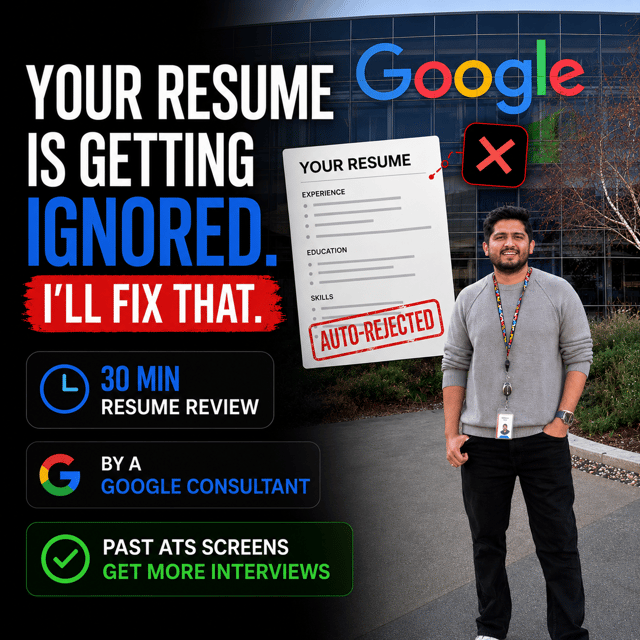
Resume Review by a Google Consultant
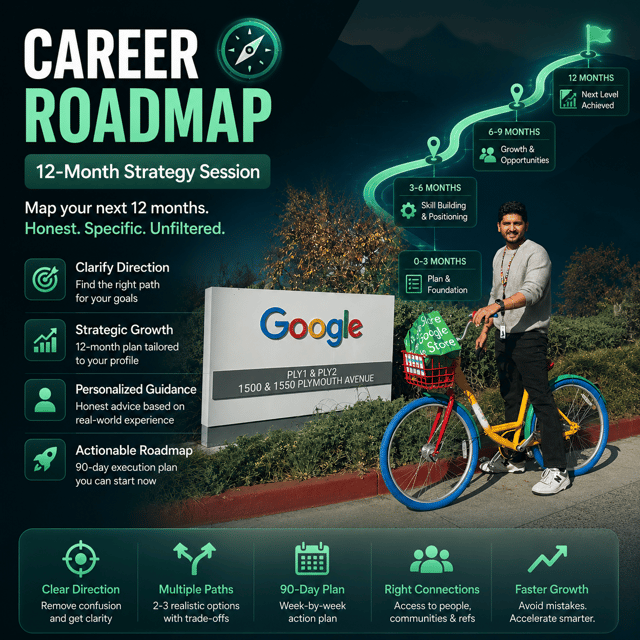
Career Roadmap — 12-Month Strategy Session
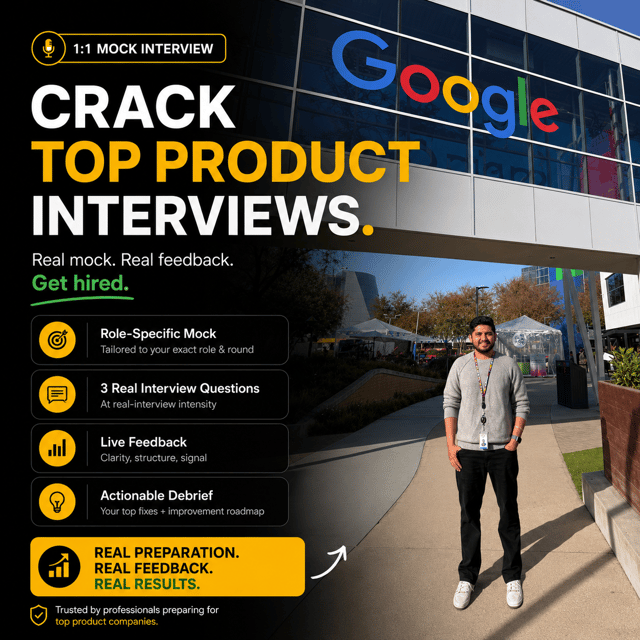
Mock Interview — Product & FAANG Roles
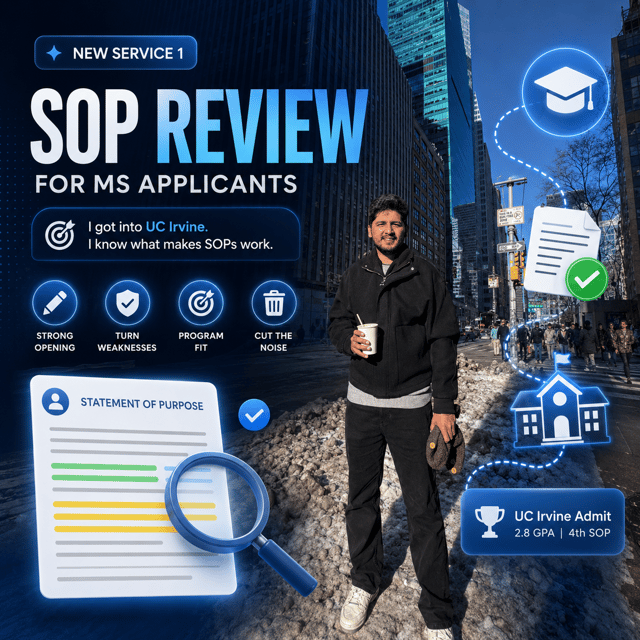
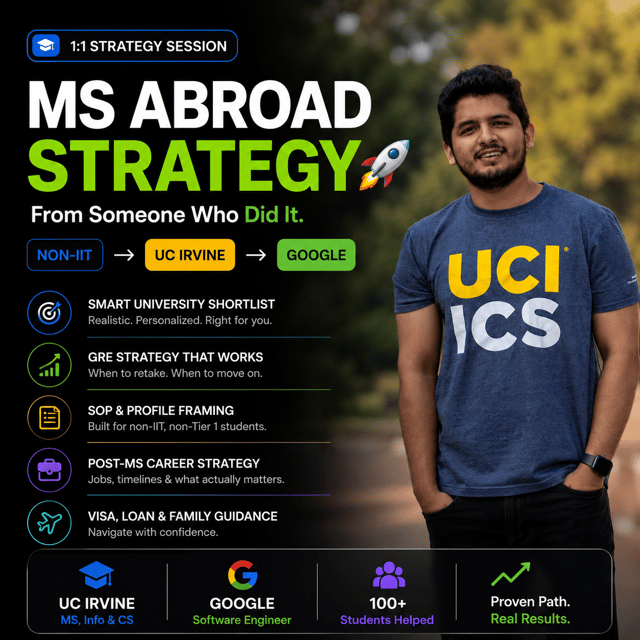
MS Abroad Strategy — From Someone Who Did It
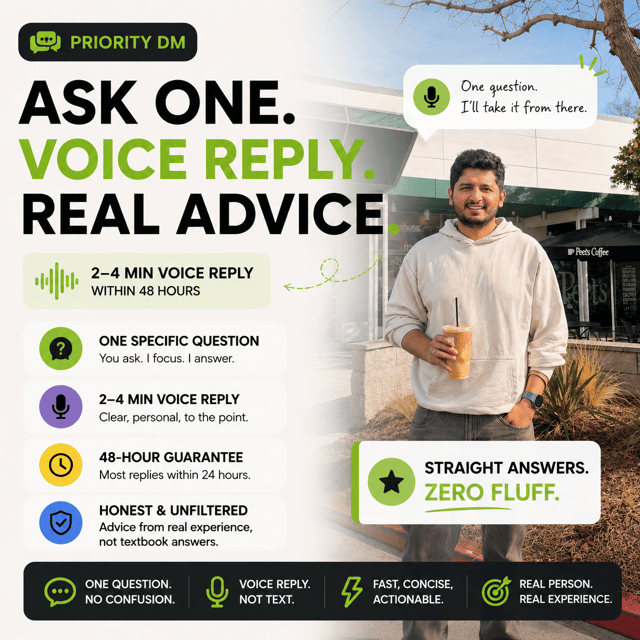
Priority DM — One Question, Voice Reply
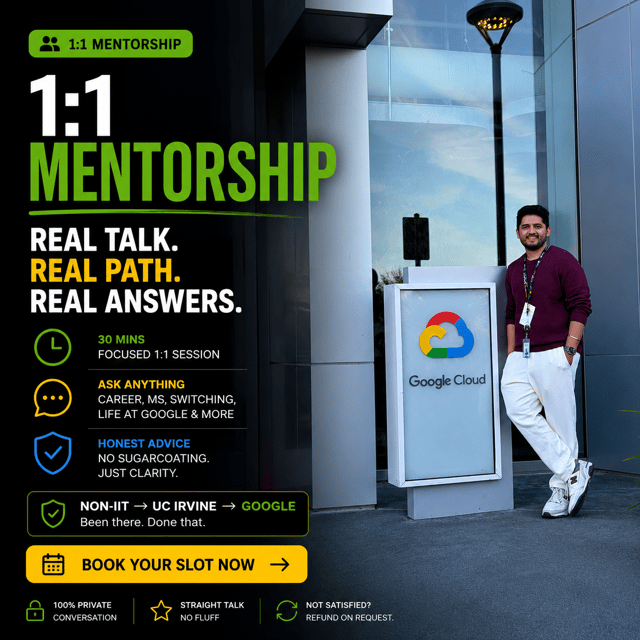
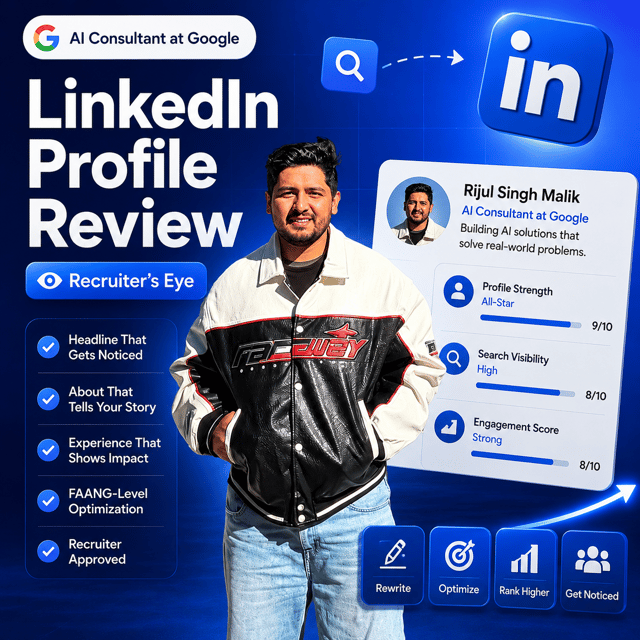
LinkedIn Profile Review — Recruiter's Eye
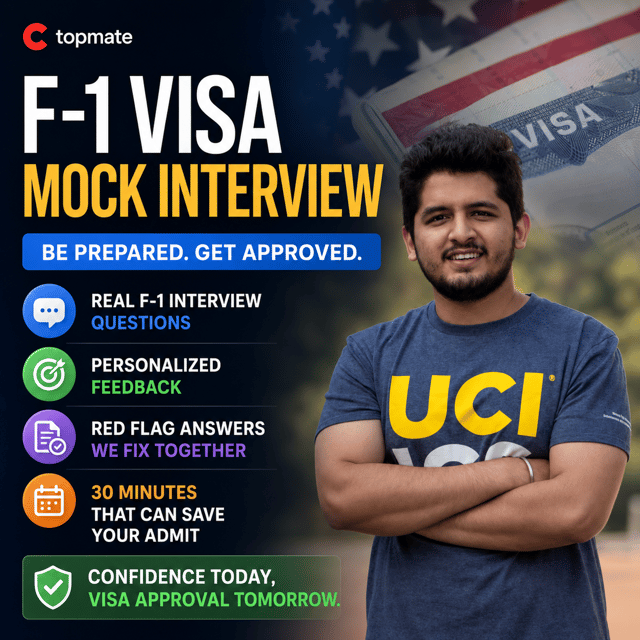
F-1 Visa Mock Interview
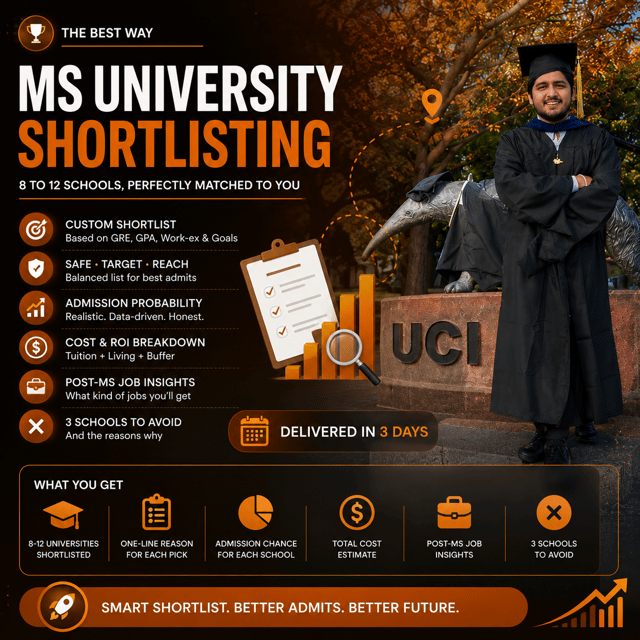
MS University Shortlisting — 8 to 12 Schools
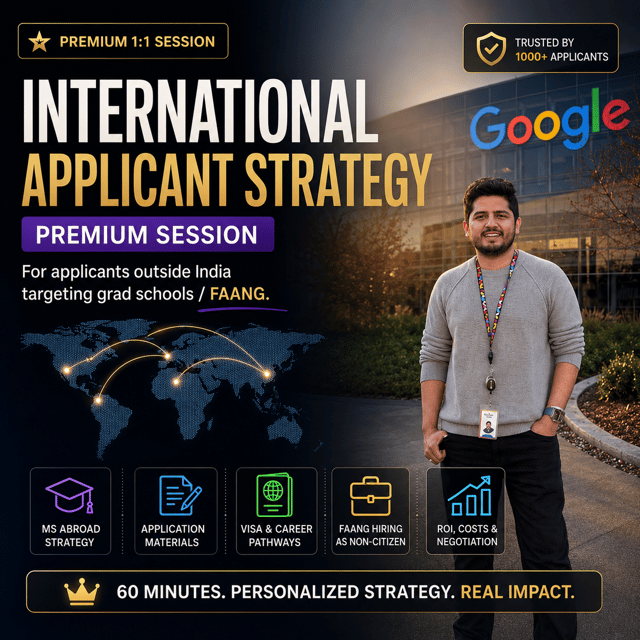
International Applicant Strategy — Premium Session
About me
Frequently asked questions
How to pursue Masters abroad?
Start 12–15 months before your intended intake. The standard sequence: choose a country and program, take the required tests (GRE plus an English test like IELTS or TOEFL for most programs), shortlist 8–12 universities across ambitious, moderate, and safe categories, prepare your SOP, LORs, and resume, apply between November and February for the fall intake, and then handle visa, funding, and accommodation once admits arrive.
Is MS abroad for Indian students still worth it?
It can be. MS abroad for Indian students is worth it when the program is strong in your target field, the total debt is manageable against realistic post-degree salaries, and you have a clear plan for post-study work visas. It is usually not worth it if you are using it to escape a stuck job without knowing which role you want — for some profiles, a job switch or targeted upskilling delivers better ROI at a fraction of the cost.
Can I pursue MS abroad after B.Tech, or do I need work experience?
Yes, you can go directly. MS abroad after B.Tech is a well-trodden path — most MS programs admit fresh graduates, unlike MBAs. A decent GPA, GRE score, projects or internships, and a specific SOP are enough. One to two years of work experience can strengthen certain applications and improve funding chances, but it is not a requirement for the majority of MS programs.
How to study Masters abroad for free?
A completely free ride is rare, but if you want to study Masters abroad for free, the realistic routes are: fully-funded scholarships (such as DAAD for Germany or Chevening for the UK), research and teaching assistantships in the US that waive tuition and pay a stipend, public universities in Germany and similar countries with near-zero tuition, and employer sponsorship. The practical strategy is applying to a mix of funded programs and assistantship-friendly departments rather than banking on one scholarship.
How much are typical MS abroad fees?
MS abroad fees vary mainly by country. Roughly: US tuition runs about $25,000–60,000 per year, with total program cost often crossing $100,000 including living; UK one-year Masters tuition is around £20,000–35,000; Canadian programs roughly CAD 20,000–40,000 per year; and public universities in Germany charge little to no tuition beyond a small semester contribution. Always budget for the entire program — tuition, living, exams, and applications — not just first-year tuition.
Which MS abroad exams do I need to take?
The main MS abroad exams fall into two buckets: English proficiency (TOEFL or IELTS, with some universities accepting PTE or Duolingo) and the GRE, which is either required or optional depending on the program — a good score still helps with scholarships where it is optional. Some management-focused Masters programs ask for GMAT instead, and a few European programs need neither. Check each university's current requirements because these change almost every year.
Can I pursue MS abroad through GATE?
For most universities, no. GATE is designed for M.Tech admissions at IITs, NITs, and other Indian institutes. A small number of foreign institutions have considered GATE scores, but MS abroad through GATE is not a standard or widely accepted route — the standard path abroad is GRE plus an English proficiency test. Treat GATE as an India option and build your abroad plan on the conventional exams.
How to write an SOP for Masters?
Use a five-part structure: an opening tied to your genuine motivation, your academic background, two or three specific projects or internships with measurable outcomes, why this exact program (name courses, labs, or professors), and a concrete post-degree goal. Keep it around 800–1,000 words and tailor it for every university. The most common rejection trigger is a generic SOP that could be sent to any school — admissions committees spot template essays immediately.
How do I write an SOP for MS in Data Science?
The strongest SOP for MS in Data Science shows evidence instead of making claims. Anchor it in concrete data work — projects, internships, or research where you applied statistics or machine learning to produce a measurable result. Connect your background (even if it is not CS) to data science logically, mention specific courses or faculty in the program you are applying to, and show a clear direction such as ML engineering, applied data science, or research. Committees want proof you understand what the field actually involves, not a keyword dump.
How to crack a FAANG interview?
Crack a FAANG interview by building three pillars. First, DSA depth — master core patterns like two pointers, sliding window, graphs, and dynamic programming, and learn to explain trade-offs and complexity, not just produce working code. Second, structured communication — think aloud, clarify requirements before coding, and test your own solution. Third, behavioral readiness — STAR stories with measurable impact. Give yourself 4–6 months if you are working full-time, and do mock interviews, because most candidates fail on communication rather than coding alone.
How to get a FAANG interview?
Getting shortlisted is a separate skill from passing the interview. Tailor your resume to the exact role's keywords so it clears ATS and recruiter screening, write impact-driven quantified bullets instead of job descriptions, prioritize referrals since they dramatically raise callback rates over cold applications, keep your LinkedIn optimized for the role you want, and apply at the correct experience level. Also consider strong product companies as a stepping stone and transferring internally later — a very common and valid path.
What are FAANG interviews like?
Typically 4–6 rounds spread over a few weeks: one or two online assessments or phone screens with coding, two to three rounds of live problem-solving on data structures and algorithms, a system design round for experienced roles, and a behavioral or culture-fit round. Interviewers evaluate how you think and communicate, not just whether you reach the answer, and they will often change constraints mid-problem to see how you adapt.
What are the most common FAANG interview questions?
Most FAANG interview questions map to a small set of patterns: arrays and strings (two pointers, sliding window), hashmaps, trees and graphs (BFS/DFS), recursion and backtracking, dynamic programming, and heap-based problems. Experienced candidates also face system design on scaling, caching, load balancing, and data modeling. Behavioral favorites include conflict, failure, and leadership scenarios. Company-tagged lists help you see each company's favorites, but fundamentals beat memorization because questions rotate constantly.
How should I plan my FAANG interview preparation?
Realistic FAANG interview preparation needs 4–6 months. Months 1–2: core data structures and patterns through roughly 100–150 curated problems, prioritizing depth over volume. Month 3: mixed timed practice plus your first mock interviews. Month 4: system design basics if you are experienced, alongside a bank of 8–10 STAR behavioral stories. In the final weeks, do company-specific practice and send out applications so shortlisting and preparation run in parallel instead of sequentially.
Is FAANG interview coaching worth it?
It depends on where you are in your preparation. Disciplined candidates with strong fundamentals can absolutely do it through self-study. FAANG interview coaching is worth it in specific situations: you are stuck despite consistent effort, you need honest feedback on communication and structure, your resume is not generating shortlists, or you have an interview scheduled soon and limited time. The genuine value is calibration on where you actually stand — not leaked questions. Free alternatives include peer mocks, recorded mock interview videos, and curated problem lists.