Testimonials
Services
Resume / CV Word Doc Template

Category Manager Interview Question Bank
Resume Building Guide for Category Roles
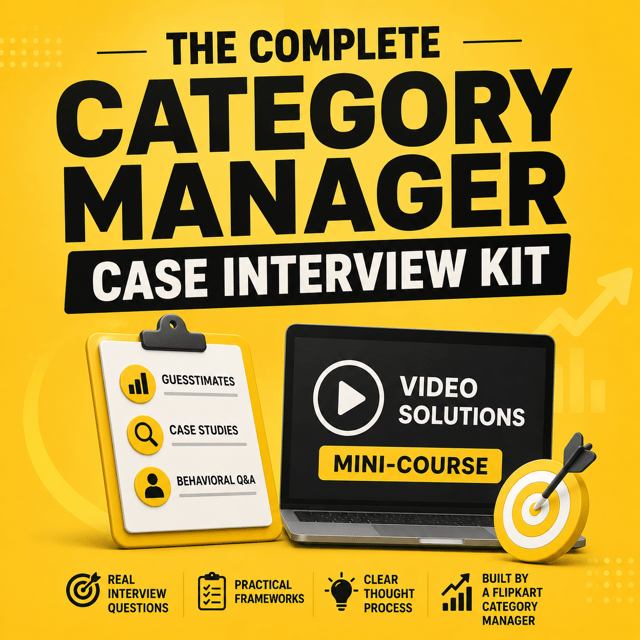
How to Crack Category Manager Case Interviews?
Category P&L Masterclass Session Recording
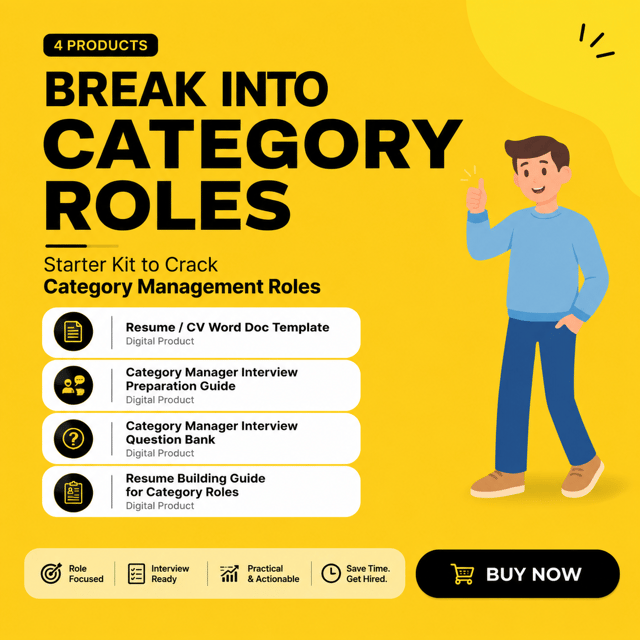
Guide to Break into Category Roles


SQL Question Bank for Category Interviews
Category Manager Interview Preparation Guide

Forecasting the Year Ahead
Resume review

1:1 Mentorship for Category Management


Business Growth Consulting (Ecom, Qcom, D2C, GTM)
Category Management Workbook: Advanced Excel Data
About me
- Sanchit is really knowledgeable. He didn't clarify my doubts regarding category management, but he also suggested alternative roles & industries I could target. Definitely recommend.Recommended by Anjali Pradeep on

- Sanchit Goyal is an insightful mentor praised for his expertise, approachable nature, and ability to simplify complex topics, greatly enhancing career clarity for many.
 AI-generated based on testimonials
Frequently asked questions
How to prepare for a category manager interview?
Treat it like three layers. First, build the fundamentals: understand what a category manager owns — assortment, pricing, promotions, sourcing/vendor negotiation, and P&L. Second, practise the formats almost every Indian e-commerce or quick commerce company uses: guesstimates, case rounds (grow a category, improve margin, launch and pricing problems, reduce returns), and SQL or data-based questions. Third, prepare 4–5 metric-backed stories from your own experience and research the company's categories and competitors. Most serious candidates start 3–4 weeks in advance and do at least 2–3 mock rounds with honest feedback before the real interview.
What are the most common category manager interview questions?
Across rounds, the most common category manager interview questions fall into a few buckets: strategy cases ("How would you grow X category on our platform?" or "How would you improve margin by 5%?"), guesstimates ("How many orders does a dark store handle in a day?"), execution questions (pricing a new product, planning a sale event, deciding which SKUs to delist), negotiation role-plays with a brand or seller, and behavioural questions on using data and handling conflict. Interviewers care less about the "right" answer and more about structure, numbers, and trade-offs — so practise answering out loud rather than only reading questions and answers.
How early should I start my category manager interview prep?
At least 3–4 weeks if you're already in a related function (sales, marketing, FMCG, consulting, analytics), and 6–8 weeks if you're switching from an unrelated background. A sensible split for category manager interview prep: weeks 1–2 on fundamentals like assortment, pricing, promotions and P&L; weeks 2–3 on guesstimates and case practice; and the final stretch on company research, SQL/Excel practice, and mock rounds. Cramming only frameworks in the last few days is the most common mistake candidates make.
What do the category manager interview questions at Urban Company usually focus on?
Like most consumer internet companies in India, expect a mix of guesstimates, case discussions around category growth, margin and supply, plus execution and behavioural rounds. The category manager interview questions at Urban Company typically test structured problem-solving, comfort with numbers, and genuine interest in their categories such as home services, beauty and wellness. Study their app and business model beforehand, and prepare examples where you used data to drive a decision. Practising with a company-specific question set and a mock round with someone from the industry is the most reliable way to know where you stand.
What does a typical category management career path look like?
In India it usually starts as a category analyst, associate or trainee, then category manager owning a sub-category, then senior category manager owning full P&L, and eventually head of category or director. The category management career path in e-commerce and quick commerce has become faster in recent years because platforms keep launching new categories and expanding into new cities. Lateral entry is common too — professionals move in from FMCG sales, brand management, consulting, retail buying and supply chain. The skills that push you up fastest are P&L ownership, brand negotiation, and data fluency in Excel and SQL.
What is category management and why does it matter in e-commerce?
What is category management, in simple terms? It is the retail discipline of managing a group of related products as one strategic business unit instead of managing individual brands or SKUs in isolation. The category manager owns assortment (what to list and delist), pricing, promotions, supplier or brand negotiations, and ultimately the revenue and margin of that category. On Indian marketplaces and quick commerce apps, it also covers seller and brand onboarding, listing quality, ratings, and campaign planning — which is why the role sits at the centre of commercial decisions in every large e-commerce company.
What is the average category management specialist salary in India?
There is no single number — a category management specialist salary in India varies widely with the company, city, and your experience. Broadly, e-commerce and quick commerce platforms pay better than traditional retail at the same level, specialists usually support senior category managers on analytics, assortment and reporting, and the biggest jump comes when you move from specialist to a full category manager role with P&L ownership. SQL, advanced Excel, and demonstrated business impact are the three things that most directly increase what you can command in negotiations.
What should a good quick commerce guide cover?
A useful quick commerce guide for India should first explain the model itself — dark stores, hyperlocal catchments, 10–30 minute delivery — and then the commercial layer: unit economics (average order value, delivery cost, commissions), how platforms like Blinkit, Zepto, Instamart and JioMart differ, how brands decide pack sizes and price points for small high-frequency baskets, and how availability, search rank, and sponsored ads drive sales. If you're a professional rather than a brand, it should also cover what category teams at these platforms actually do day to day, since that is the skill set interviews and the role itself test.
What should a quick commerce marketing strategy in India focus on?
Focus on hyperlocal execution, not national branding. A quick commerce marketing strategy for Indian brands should win the digital shelf inside each dark-store catchment: search rank on the platform, sponsored listings, strong images and ratings, and above all availability — stockouts undo every other marketing effort. Pack sizes and price points need to suit small, repeat baskets, and campaigns should be planned around demand peaks like weekends, paydays and festive events. Measure performance at the city and dark-store level, because national averages hide the exact stores that need attention.
How should brands build a quick commerce festive strategy?
Start planning 6–8 weeks before the season. A quick commerce festive strategy typically means creating festive and gifting packs suited to small baskets, locking inventory and dark-store stocking plans early because demand spikes unpredictably, ramping up sponsored ads and in-app visibility during sale events, and negotiating campaign placements with the platform's category teams well in advance. Also set a clear price architecture so quick commerce doesn't undercut your marketplace pricing. Brands that treat the festive months as a separate planning cycle with their own stock, budgets and targets consistently outperform those that simply extend their regular plan.
What does the Amazon India quick commerce strategy mean for D2C brands?
It signals a new high-frequency channel opening up alongside the traditional marketplace. As the Amazon India quick commerce strategy expands into more cities with faster delivery, brands get access to daily-need and impulse purchases that a regular Amazon purchase journey rarely captures. Practically, D2C brands should get their listings and content ready early, identify their high-velocity SKUs, plan smaller pack sizes, and sort out supply at the city level before demand ramps up. Early movers typically enjoy better visibility and placement while the channel is still less crowded.
How does the JioMart quick commerce strategy work for brands?
JioMart's advantage is Reliance's physical store network, which it uses for hyperlocal delivery instead of relying only on standalone dark stores. For brands, the JioMart quick commerce strategy translates into a different playbook: ensuring availability in store-linked catchments (especially in markets beyond metros where other quick commerce networks are thinner), maintaining strong fill rates, and participating in platform campaigns. Treat it as a complementary channel alongside Blinkit, Zepto and Instamart rather than a copy-paste of the same plan — assortment mechanics and promotions differ, and store-level execution matters more here.