Testimonials
Services

JD-to-Interview: Targeted Research Report

Company Research + Mock Interview
Java Interview DSA &Algorithm Complete Prep
Mock Interview + Interview Prep

Scaling Transaction Systems — Problems & Solutions

Company Research + Career Guidance

Complete Loop: Report + 3 Mocks

Career Restart Package


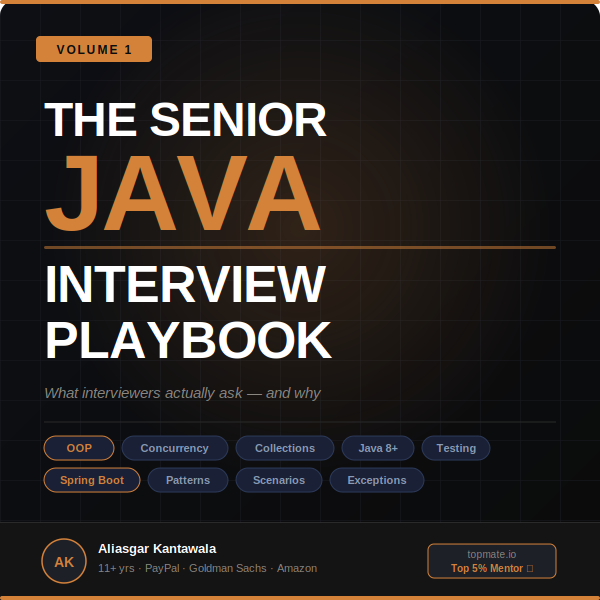
Senior java interview playbook v1
Complete interview prep
About me
- Aliasgar Kantawala provides impactful mock interviews with honest feedback and structured guidance, greatly aiding candidates in preparation.
 AI-generated based on testimonials
 - My BlogSpothttps://aliasgarmkantawala.hashnode.dev/

Frequently asked questions
What is Spring Boot and how does it work?
Spring Boot is a framework built on top of the Java Spring ecosystem that removes most of the manual configuration needed to build production-ready applications. It works through auto-configuration — it inspects your classpath and sets up sensible defaults for the web server, database connectivity, and messaging. Starter dependencies pull in pre-configured libraries, and the embedded server (Tomcat by default) lets you run the app as a standalone jar. Features like Actuator, profiles, and externalised configuration make it the default choice for building REST APIs and microservices. If you can explain auto-configuration, starters, and the embedded server clearly, you have covered the core of this question.
What are the most common Java interview questions for freshers?
Java interview questions for freshers revolve around core fundamentals rather than frameworks. Expect questions on OOP concepts (inheritance, polymorphism, abstraction, encapsulation), String handling and immutability, Collections (ArrayList vs LinkedList, HashMap internals), exception handling (checked vs unchecked), and basic multithreading. Many companies also ask about JVM memory areas, garbage collection basics, and Java 8 features like streams and lambdas. The biggest mistake freshers make is memorising answers — interviewers dig one level deeper ("why is String immutable?") to check genuine understanding. Build 2–3 small projects of your own so you can anchor these answers to code you have actually written.
What are the top Java interview questions for 5 years of experience?
Java interview questions for 5 years of experience shift from syntax to depth and design. Interviewers probe concurrency (synchronized, volatile, ThreadPoolExecutor, CompletableFuture), HashMap and ConcurrentHashMap internals, JVM tuning and garbage collection, Java 8+ streams, and exception handling in real systems. For backend roles, expect Spring Boot internals, microservices patterns, Kafka, SQL queries, and an entry-level system design round. What separates candidates at this level is discussing trade-offs — why you chose a design, what broke in production, and how you fixed it. Prepare 2–3 detailed war stories from your own projects; they anchor almost every senior-level discussion.
How to prepare for a Spring Boot interview?
Start by solidifying core Java, because Spring Boot questions assume that foundation. Then revise the framework fundamentals: dependency injection and IoC, bean lifecycle and scopes, auto-configuration, starters, and key annotations like @RestController, @Service, @Transactional, and @ConfigurationProperties. Build and deploy a small REST API with a real database layer so you can answer "explain your project" confidently. For 5+ year profiles, go deeper into transaction propagation, Actuator and monitoring, exception handling via @ControllerAdvice, and how Boot simplifies microservices. Finally, practise answering the most common Spring Boot questions out loud — knowing a concept and explaining it under pressure are two different skills.
What are the common Spring Boot interview questions and answers?
The Spring Boot interview questions and answers asked most often cover: what auto-configuration is and how @SpringBootApplication works; the difference between Spring and Spring Boot; bean scopes (singleton vs prototype) and the bean lifecycle; how dependency injection works and @Component vs @Service vs @Repository; @Transactional behaviour, propagation, and pitfalls; exception handling with @ControllerAdvice; Actuator, profiles, and externalised configuration; and embedded servers with packaging and deployment. At experienced levels, expect scenario follow-ups — a transaction not rolling back, or a bean being created twice. Answer with the concept first, then back it with a real example from your project.
How to explain a Spring Boot project in an interview?
Structure it in four parts: the problem the project solves, the high-level architecture, your specific contribution, and the hard decisions you made. A common mistake is walking through CRUD screens — interviewers want the engineering story: why you chose Spring Boot, how services communicate, where you used Kafka or scheduled jobs, how you handled validation and exceptions, and what you would improve with more time. Be ready for the follow-up chain: "Why REST and not messaging here?", "What happens if the database goes down mid-request?", "How did you test this?" Practise a 2-minute version and a 10-minute deep-dive version of the same story. If you cannot answer three "why" questions about your own project, that is the gap to fix first.
How to prepare for a system design interview?
Preparing for a system design interview needs a structured plan, not random reading. First, learn the building blocks: load balancers, caching, SQL vs NoSQL, replication and sharding, message queues like Kafka, and consistency trade-offs. Then study 10–15 classic problems — URL shortener, rate limiter, chat app, news feed, ticket booking — and for each, practise the full flow: clarify requirements, estimate scale, sketch the API and data model, then handle scale and failure cases. Use one good book or course for theory, but spend most of your time actually drawing and talking through designs. Give yourself 4–6 weeks of consistent practice; cramming the night before rarely works at senior levels.
How to practice for a system design interview?
Practising for a system design interview is different from reading about it. Pick one classic problem, set a 40–45 minute timer, and design it out loud while drawing — exactly like the real round. Record yourself or, better, do it with a peer or a mentor who can poke holes in your assumptions. Repeat the same problem a few days later and track what improved; most people keep missing the same things — capacity estimation, failure handling, justifying trade-offs. Aim for 15–20 problems covered this way across domains like payments, feeds, booking, and messaging, so no prompt feels new on interview day. Honest, specific feedback during practice is what actually moves the needle.
What are the most asked system design interview questions?
The system design interview questions that come up repeatedly in India's product and fintech companies include: design a URL shortener, design a rate limiter, design a chat application like WhatsApp, design a news feed, design a ticket-booking system like BookMyShow, design a UPI-style payment system, design a food-delivery platform, design a notification service, and design a distributed job scheduler. Note how many are modelled on apps you use daily — interviewers expect you to reason about large-scale traffic, peak loads during sales or big-match days, and failure scenarios. For each problem, the evaluation is on requirement clarity, data modelling, scalability choices, and failure handling — not on one "correct" answer.
Which system design interview book should I read?
The two most useful starting points are "System Design Interview – An Insider's Guide" (Volumes 1 and 2) by Alex Xu, which walks through classic problems step by step, and "Designing Data-Intensive Applications" by Martin Kleppmann, which builds the deeper distributed-systems theory behind them. Choose the first if you want interview-focused patterns quickly, and the second if you want to understand why systems behave the way they do. Keep one thing in mind, though: a system design interview book alone will not get you through, because the round is a live performance. Use the book to learn frameworks and vocabulary, then move to timed practice and mock interviews.
What is Grokking the System Design Interview?
Grokking the System Design Interview is a well-known online course that teaches system design through a set of classic problems — URL shortener, cloud storage, chat apps, news feeds — using a repeatable step-by-step framework. It is popular because it breaks an intimidating, open-ended round into a learnable pattern: gather requirements, estimate scale, outline the design, then refine for bottlenecks. It is a solid starting point if you have no structure at all, but treat it as a foundation, not a finish line — interviewers today expect you to go beyond the standard solutions with trade-offs and real-world constraints. Pair it with hands-on practice and at least a few mock sessions before the actual round.
Are mock interviews worth it for Java and system design interviews?
Yes — especially for senior roles, where rounds are decided by communication and judgement as much as knowledge. A good mock interview simulates real pressure, exposes gaps you cannot see on your own (rambling, missing edge cases, weak trade-off justifications), and gives you a clear list of what to fix. One serious mock is worth more than a week of passive reading, because you rehearse the actual skill: thinking out loud while designing or debugging. Take them seriously — time-box each session and ask the interviewer to be blunt. If the feedback keeps flagging the same weakness across two or three sessions, that is exactly where your remaining preparation should go.
How to write a resume for an experienced Java developer?
Lead with impact, not responsibilities. Instead of "worked on payment microservices", write "built payment retry service handling X transactions per day, cutting failures by Y%". Recruiters hiring for senior Java roles scan for years of relevant experience, stack depth (Java, Spring Boot, Kafka, PostgreSQL, AWS), the scale you have handled, and clear ownership. Keep it to two pages, put your best 2–3 projects with metrics at the top, and tailor keywords to each job description, since most companies screen resumes with software before a human sees them. A brutally honest review from someone who has sat on interview panels can expose the gaps you have stopped noticing — get that before you mass-apply, not after weeks of silence.
How to restart a career in Java after a gap?
Own the gap briefly and confidently, then redirect the conversation to your readiness. Start by refreshing core Java and Spring Boot fundamentals, then rebuild proof of current skills: a small but complete project — a REST API with a database, deployed on AWS, pushed to GitHub — goes a long way. Add one modern skill such as Kafka or Docker so you can speak the current stack's language in interviews. Apply to companies known to be gap-friendly, and prioritise referrals over cold applications. A structured restart plan with weekly targets, a rebuilt resume focused on transferable experience, and a few mock interviews shortens the journey considerably compared to figuring it out alone. Interviewers rarely reject the gap itself; they reject unpreparedness.