Testimonials
Services
Portfolio Creation + Cover letter guide



CV & LinkedIn revamp

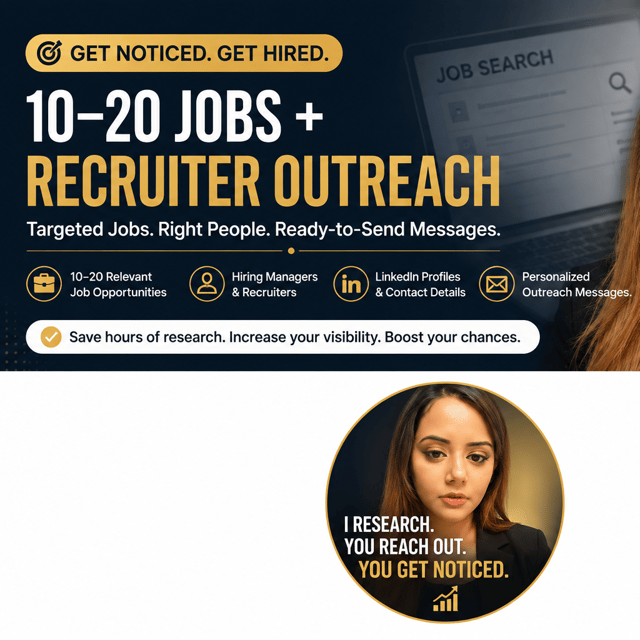
Get Noticed: Job Hunt & Recruiter Outreach
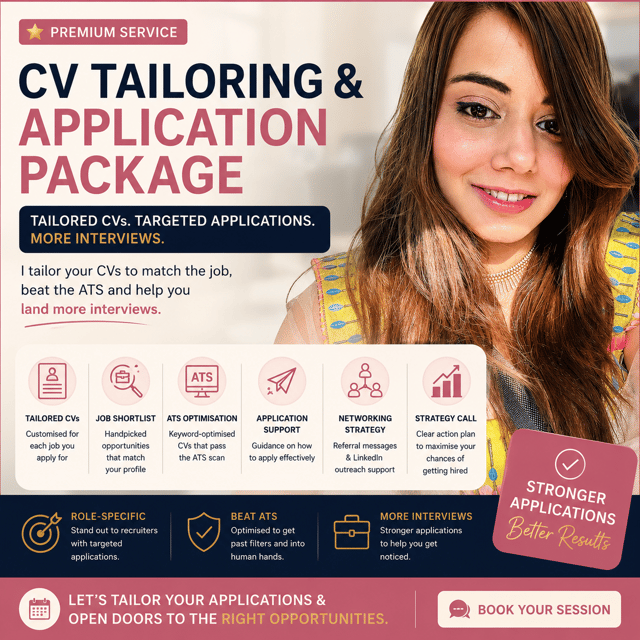
Tailored CV & Job Application Shortlisted

The UK Job Search Accelerator
About me
Frequently asked questions
How do I job search in the UK?
A strong UK job search rests on three basics: a UK-format CV, tailored applications, and consistent daily effort. If you're working out how to job search in the UK, set up alerts on the major job boards, apply within the first few days of a role going live, and use LinkedIn to connect with recruiters and people already doing the job you want — referrals consistently beat cold applications. Track everything in a simple spreadsheet so you can follow up rather than apply and forget.
What are the best UK job search websites?
The most-used UK job search websites are Indeed, LinkedIn, Reed, Totaljobs and Glassdoor, which between them cover most mainstream roles. Add specialist boards for your sector — CWJobs for tech, NHS Jobs for healthcare, CharityJob for non-profits — and go direct to the careers pages of 20–30 target companies, since many roles are filled before they reach the big boards. Narrow daily alerts matter more than which platform you pick.
What are visa sponsorship jobs in the UK?
Visa sponsorship jobs in the UK are roles where the employer holds a Home Office sponsor licence and can legally hire workers who don't already have the right to work in the UK, usually through the Skilled Worker visa. The job must meet the required skill and salary thresholds, and the employer must be licensed before a visa can be issued. You can check whether any company is licensed to sponsor by searching the UK government's public register of licensed sponsors — a verification step most applicants skip and shouldn't.
How can I get visa sponsorship jobs in the UK?
If you're researching how to get visa sponsorship jobs, flip your strategy: instead of applying everywhere and hoping, target employers that already hold a sponsor licence, since they can hire you without going through a new approval process. Focus on sectors that sponsor heavily — healthcare, tech, finance, engineering and consulting — check that the advertised salary meets visa requirements, and be upfront in your CV or cover letter about your right-to-work status. Students can also use post-study work time to gain UK experience before switching to a sponsored role, which makes them far more employable.
Is it easier to find visa sponsorship jobs in London?
Usually, yes. Visa sponsorship jobs in London are more plentiful because the capital has the densest concentration of licensed sponsors — particularly in finance, tech, consulting and law — with thousands of roles at the salary levels visas require. The trade-off is heavier competition per role and higher living costs, so it's worth also targeting cities like Manchester, Birmingham, Edinburgh and Leeds, where licensed sponsors hire with fewer applicants per opening.
Is it good to work in the UK?
For many professionals, yes — the UK offers competitive salaries in sectors like finance, tech, healthcare and engineering, strong worker protections such as paid holiday, pension contributions and workplace rights, and clear visa pathways once an employer sponsors you. The honest downsides are high living costs (especially housing in London), a competitive job market for newcomers, and income tax that's higher than in some countries. Whether it is good to work in the UK usually comes down to your industry: if your field is in demand, the career progression and long-term options tend to make it worthwhile.
How can international students get a job in the UK after graduation?
Most graduates start on the Graduate Route visa, which currently lets eligible UK degree holders stay and work — including full-time job hunting — for two years after graduation, or three for PhD graduates. Use that window deliberately: build a UK-format CV, target employers on the licensed sponsor register because you'll eventually need to switch to a Skilled Worker visa, take internships or placement-style roles, and network on LinkedIn rather than only applying online. Students who start building UK experience and contacts in their first year — not their final term — consistently land roles faster.
How to study in the UK as an international student?
The process runs in clear stages: choose your course and check the entry requirements, apply (undergraduate applications go through UCAS, while most postgraduate courses take direct applications), then accept your offer and receive a CAS document from the university, which you use to apply for the Student visa. Give yourself 12–18 months, because personal statements, English tests like IELTS, references and scholarship deadlines all take longer than expected. Also check early how your home country's qualifications map to the course's entry criteria.
How to study in the UK for free?
Studying in the UK entirely for free is rare for international students, but you can get close. The realistic routes to study in the UK for free — or heavily subsidised — are fully funded scholarships such as Chevening and Commonwealth Scholarships for master's study, university-specific merit awards and fee waivers, and funded PhD studentships that cover tuition plus a living stipend. Pairing a partial scholarship with permitted part-time work (up to 20 hours a week on a Student visa) is how most students keep net costs manageable.
Is it worth using study abroad UK consultants to apply to universities?
You don't need one — UK universities accept direct applications and nothing in the process requires an agent. That said, study abroad UK consultants (or mentors who have actually studied and worked in the UK) earn their fee on the judgement calls: shortlisting realistic universities, sharpening a personal statement, building a scholarship strategy, and avoiding deadline mistakes that cost applicants a full year. If you pay for help, choose someone with verifiable UK experience over anyone promising guaranteed admission.
How long should a CV be in the UK?
One to two pages — one if you're early in your career, two once you have solid experience, and almost never more. UK CVs also follow conventions that surprise many applicants: no photo, no date of birth, no marital status, and a short personal profile at the top instead of an objective statement. What matters most is tailoring — mirror the language of the job description, lead with quantified achievements rather than duties, and keep the format simple enough for the ATS software most UK employers use to actually read it.
How do I prepare for a job interview in the UK?
Expect a multi-stage process — recruiter screen, hiring manager interview, then a technical or competency round — and prepare differently for each. The core skill in UK competency interviews is answering with the STAR structure (Situation, Task, Action, Result), so prepare four or five flexible stories from your experience that you can adapt to different questions. Research the company and your interviewers, prepare two or three genuine questions to ask, and rehearse out loud or in a mock interview — knowing your material and delivering it under pressure are very different skills.