Testimonials
Services
Growth Coaching for creators, personal brands
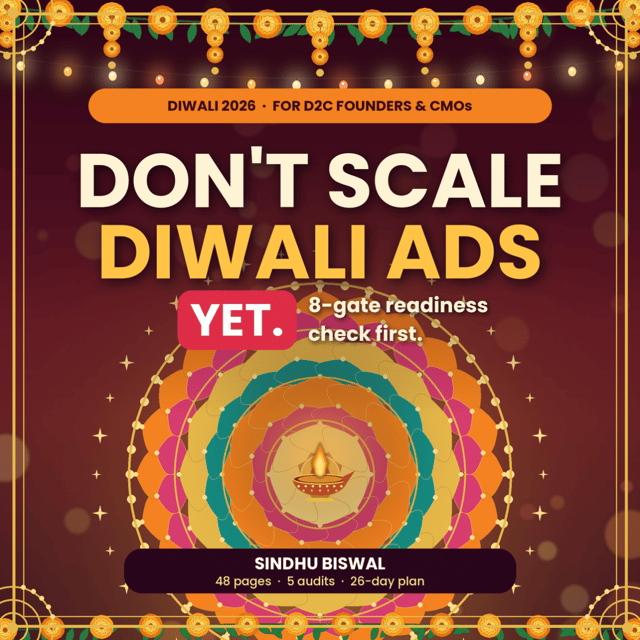
The D2C Festive Handbook: Before You Scale
Marketing Consulting-for Brands,Founders,Agencies
1:1 Career Mentorship
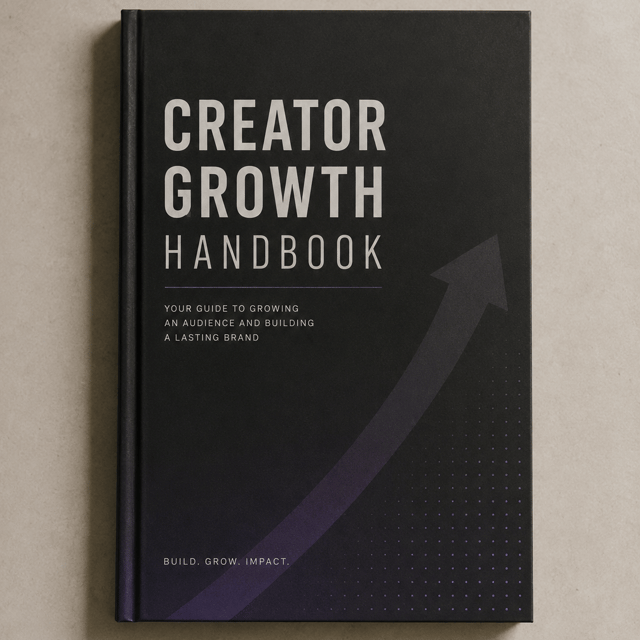
Creator Growth Marketing 2026 Playbook
About me
Frequently asked questions
What is the meaning of growth marketing, and how is it different from traditional marketing?
The meaning of growth marketing is a data-driven, experiment-led approach that focuses on the entire funnel — acquisition, activation, retention, revenue and referrals — instead of only awareness campaigns. Traditional marketing runs campaigns and measures reach, while growth marketing runs continuous A/B tests across ads, landing pages, onboarding and referral loops, and scales only what measurably moves a metric. This is why startups, apps and consumer brands prefer growth marketers who can tie every rupee spent to outcomes like CAC, retention and LTV.
What is growth marketing vs performance marketing?
When comparing growth marketing vs performance marketing, performance marketing is the narrower discipline — running and optimising paid campaigns on Meta, Google and similar channels for measurable actions like installs, leads or sales. Growth marketing includes performance marketing but also covers organic channels, content, product-led loops, onboarding, retention and experimentation. In most startups, a performance marketer is hired to scale a channel that already works, while a growth marketer is hired to find and compound multiple growth levers.
What does a growth marketing manager actually do?
A growth marketing manager owns the growth numbers of a product or brand. Day to day, this means planning experiments across paid ads, SEO, social, email and referral programs, setting up tracking, analysing funnels and cohorts, and working with product, design and content teams on what to test next. Unlike a pure brand role, success is judged on metrics such as CAC, activation rate, retention and LTV, not reach or impressions.
What is the average growth marketing manager salary in India?
The growth marketing manager salary in India varies widely with company stage and experience. Freshers usually enter as growth associates at roughly ₹4–7 LPA, mid-level managers with 3–6 years of experience typically earn ₹10–25 LPA, and senior growth leads at funded startups can cross ₹30 LPA plus bonuses or ESOPs. Consumer internet sectors like fintech, edtech, D2C and media generally pay at the higher end because the role directly impacts revenue.
What skills are needed for growth marketing jobs in India?
For most growth marketing jobs, hiring managers look for a mix of analytics (GA4, Excel, basic SQL, tools like Mixpanel or Amplitude), hands-on paid ads experience on Meta and Google, content and SEO basics, copywriting, and the ability to design and read A/B tests. A portfolio of real experiments — even growing your own Instagram or LinkedIn page or a small business account — usually matters more than a degree. Comfort with numbers and clear communication are the two things that separate strong candidates from average ones.
How to apply for marketing jobs without experience?
The practical way to apply for marketing jobs without experience is to create proof first: run a small ad campaign with a tiny budget, grow a page organically, or do free or freelance work for a local business and document the results as mini case studies. Then target internships, associate and executive roles — startups and agencies are far more open to non-traditional profiles than large corporations. A short, specific outreach email with one concrete idea for that company's marketing usually converts better than a generic resume blast.
Is a growth marketing course worth it, or can you learn it for free?
A growth marketing course is worth it if it teaches frameworks through real case studies and gives feedback on your work; free content covers the same concepts but rarely provides structure, sequence or accountability. If you are self-learning, follow a path instead of random videos — fundamentals, one acquisition channel, analytics, then retention — and apply everything to a live project. Many professionals speed this up with 1:1 mentorship from someone who has actually scaled apps or brands, since real-world trade-offs rarely appear in course material.
When should a startup hire a growth marketing agency instead of an in-house team?
A startup should consider a growth marketing agency when product-market fit is proven, there is a monthly marketing budget, and speed matters more than building internal capability — for example, around a launch, a funding announcement or a festive-season push. An in-house hire usually makes sense once one or two channels are already working and need daily ownership. A common middle path is hiring a fractional growth consultant to set the strategy and measurement, then using an agency only for execution-heavy channels.
Which growth marketing tools should an early-stage startup use first?
Start with a minimum stack: GA4 with proper event tracking, Meta Pixel with Conversions API for paid campaigns, the free tier of Mixpanel or Amplitude for funnel and retention analysis, a no-code landing page builder, and one email or WhatsApp tool for lifecycle messaging. Add A/B testing, attribution and CRM tools only once you have consistent traffic worth analysing. Most early teams lose more time constantly switching growth marketing tools than running experiments, so pick simple tools and master them.
What is mobile app marketing and how is it different from regular digital marketing?
Mobile app marketing covers everything that drives installs, activations and long-term retention of an app — app store optimization (ASO), paid user acquisition through Google App Campaigns and Meta app ads, creator collaborations, referral loops, and engagement through push and in-app messaging. The key difference from website marketing is the funnel: a website visitor can convert in one session, while an app user must download, onboard and return, so retention matters as much as installs. That is why app marketing is measured on CPI and D1/D7/D30 retention rather than just clicks.
What should an app marketing strategy include before and after launch?
A complete app marketing strategy has three phases. Pre-launch: competitor and keyword research for ASO, sharp positioning, a waitlist or teaser campaign, and a beta community. Launch: paid user acquisition, creator and influencer collaborations, PR and review generation. Post-launch: onboarding optimisation, push and in-app engagement, referral programs and weekly cohort analysis to fix drop-offs. If you are working out how to do app promotion on a small budget, prioritise ASO, micro-influencer barter collabs and community-driven launches before spending heavily on paid installs.
How to do digital marketing for a small business with a low budget?
To do digital marketing on a small budget, start with assets that compound: a fully filled Google Business Profile for local search, organic Instagram or YouTube content answering real customer questions, and WhatsApp for follow-ups and repeat sales. Once you see organic traction, run small test budgets (₹5,000–10,000 a month) on Meta or Google ads and track leads and sales, not likes. For small businesses in India, WhatsApp catalogues, customer reviews and regional-language content often deliver the fastest returns.
How to grow Instagram followers without buying them?
The sustainable way to grow Instagram followers is to commit to one clear niche, post reels consistently with a strong hook in the first three seconds, write keyword-rich captions since Instagram now works like a search engine, and collaborate with accounts of a similar size to exchange audiences. Engage genuinely in your niche's comments, use stories and highlights to convert visitors into followers, and study which formats get saves and shares rather than vanity likes. Organic Instagram growth is slower than paid shortcuts, but the followers it brings actually watch, trust and buy from you.
Is it safe to use an Instagram growth service?
Most providers promising fast, guaranteed results run an Instagram growth service built on bots, fake engagement or mass follow/unfollow automation — all of which violate Instagram's policies and can trigger action blocks, shadowbans or permanent bans. Even when accounts are not penalised, the fake followers they add destroy your engagement rate, which tells the algorithm to show your content to fewer real people. If you want outside help, choose strategists or specialists who grow accounts through content strategy, collaborations and legitimate Meta ads instead of automation.
Do Instagram growth hashtags still work?
Hashtags play a much smaller role in reach than they did a few years ago, as distribution now depends mainly on reels watch time, shares, saves, captions and on-screen keywords. They still help with categorisation, so instead of pasting 30 generic tags, use 3–5 highly relevant, niche-specific Instagram growth hashtags that match what your target audience actually follows and searches. Treat hashtags as a small labelling layer and put your effort into hooks, watch time and shareable content, which is what actually drives discovery today.