Testimonials
Services

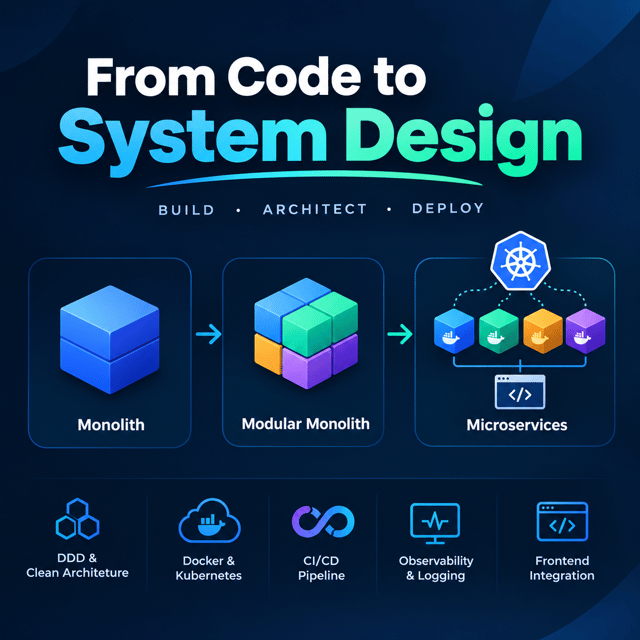
Backend Architecture & DevOps Mentorship (.NET)
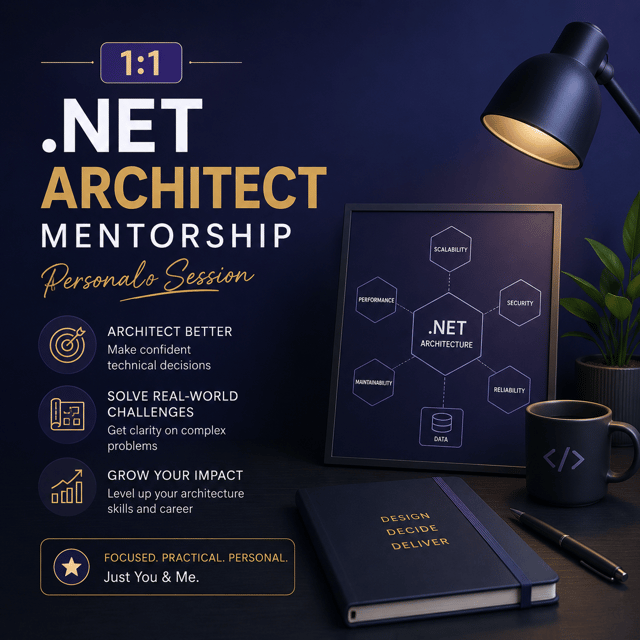
1:1 .NET Architect Mentorship | Personal Session
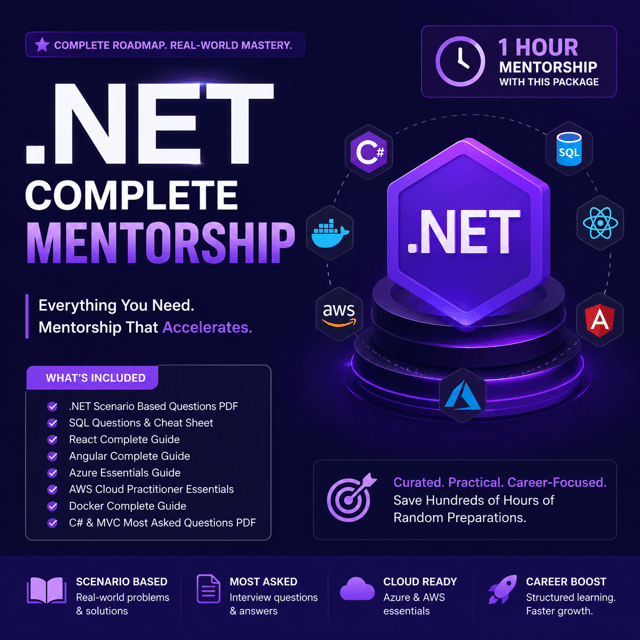
.NET Complete Mentorship + Interview Bundle
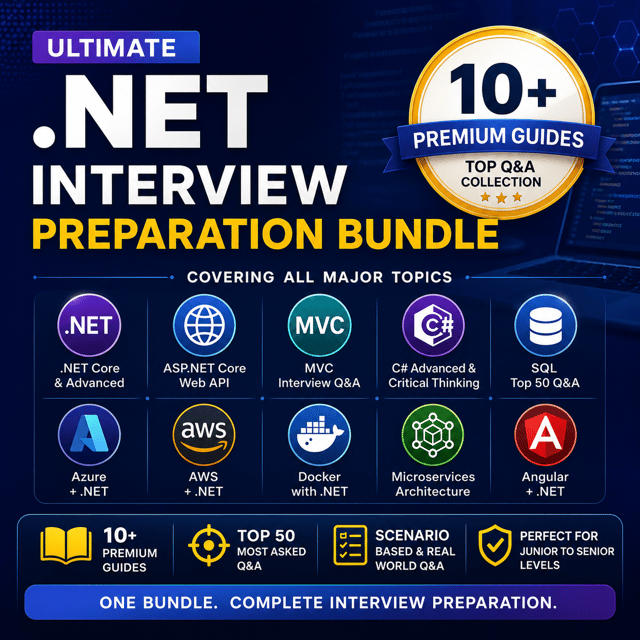
Ultimate .NET Interview Preparation Bundle
Top 50 C# Critical Thinking Interview Q&A Guide
Top 50 .NET + React Interview Questions Guide
Senior .NET Microservices Interview Q&A (Top 50)

Top 50 .NET Scenario Based Interview Q&A(PDF)
1:1 .NET Developer Mock Interview & Preparation
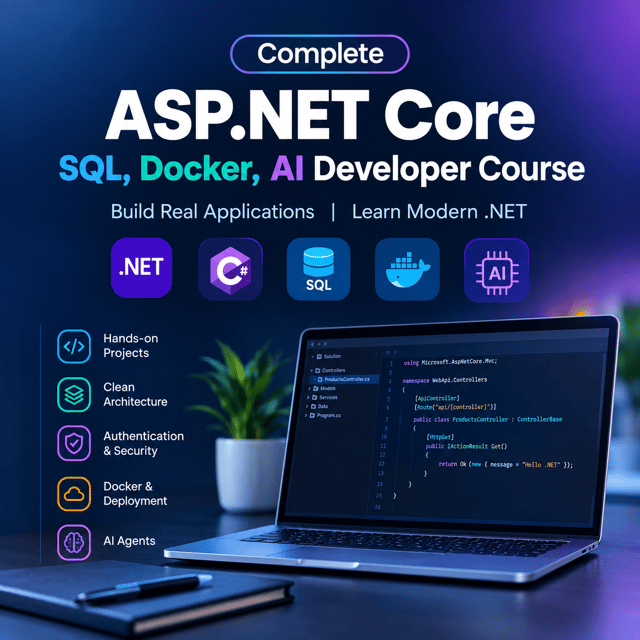
Complete ASP.NET Core, SQL, Docker, AI Bootcamp

Career Switch & Company Exit Mentorship
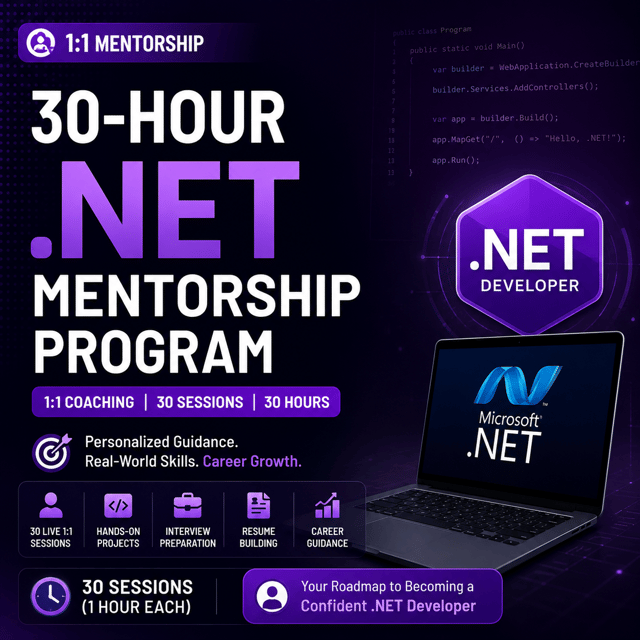
30-Hour .NET Mentorship Program (1:1 Coaching)
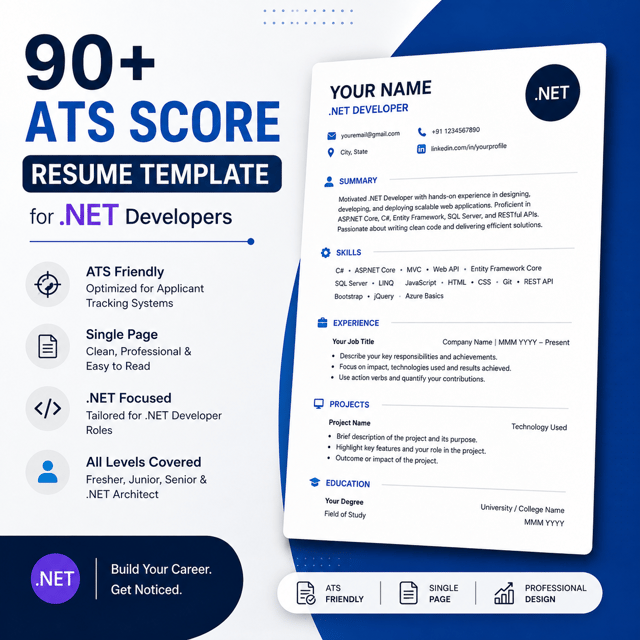
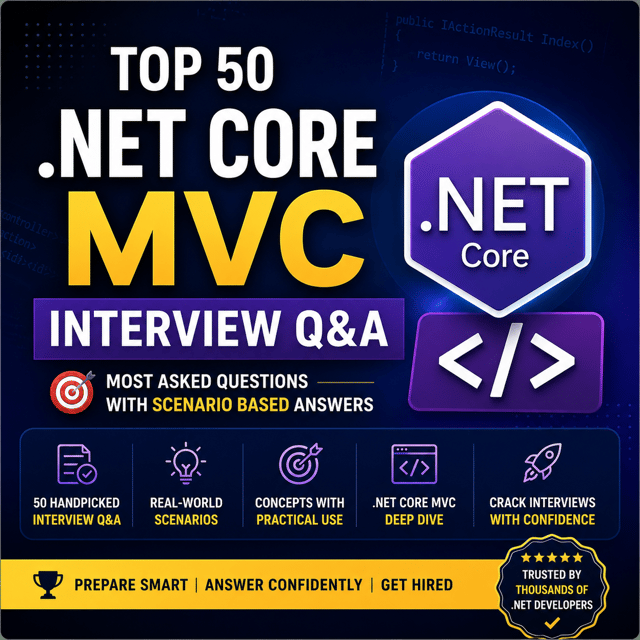
Top 50 Docker + .NET Scenario-Based Interview Q&A
Top 50 .NET + AWS Interview Questions (Most Asked)
Top 50 .NET Interview Questions (Advanced Ques)
Master SQL Interviews: Top 50 Questions + Answers

Azure + .NET Interview Guide: Top 50 Q&A Pack
.NET Interview Preparation (1:1 Mentorship)
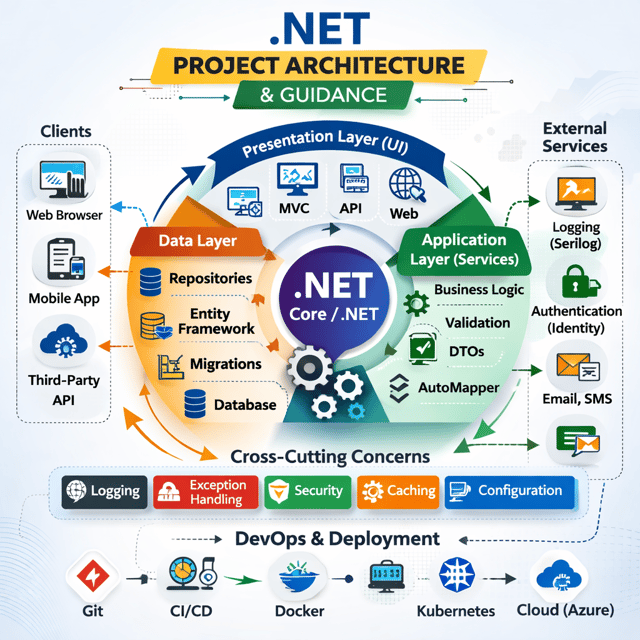
.NET Project Architecture & Guidance
About me
- Rohan's Code Hub - YouTubehttps://youtube.com/@RohansCodeHub
- My LinkedInhttps://linkedin.com/in/rohankumawat

- Frontend to Backend with Rohan - YouTubehttps://youtube.com/@FrontendToBackendWithRohan


Frequently asked questions
What are the most common .NET interview questions for freshers?
Fresher rounds focus on C# fundamentals — value vs reference types, the four OOPs pillars, interfaces vs abstract classes, exception handling, collections and LINQ basics — then ASP.NET Core essentials like the MVC pattern, middleware, routing, and a simple Web API, plus basic SQL queries. You will also be asked to walk through your academic or pet project end to end, so prepare to explain your architecture and every technology choice. Practising topic-wise question sets and keeping your resume ATS-friendly (recruiters in India rely heavily on screening software) will help you land those interview calls in the first place.
What are the most asked .NET interview questions for 5 years experience?
At five years, interviewers test depth, not definitions: dependency injection lifecycles (Transient, Scoped, Singleton), the middleware pipeline, async/await and threading, LINQ and EF Core optimization, SQL indexing and query tuning, caching strategies, Web API versioning, and security with JWT. Scenario-based questions dominate at this level — "how would you fix a slow endpoint", "how do you handle a failure between two services" — so prepare real stories from your projects covering the problem, your solution, and the trade-offs you made.
What kind of .NET interview questions for 10 years experience should I expect?
Senior rounds are architecture and leadership rounds: microservices vs modular monolith decisions, scalability and performance engineering, resilience patterns like circuit breakers and message queues, database design at scale, cloud architecture on Azure or AWS, CI/CD, security, and mentoring experience. Expect a system-design whiteboard where you must justify trade-offs, plus behavioral questions about leading teams. Pure definition-based questions almost disappear at this level — interviewers evaluate how you think and lead, not what you memorized.
How do I practice .NET interview questions and answers without just memorizing them?
Learn the concept first and build the answer second: for every question, write the explanation in your own words and say it aloud as if teaching someone — if you stumble, you have found a gap. Back this up with tiny hands-on demos (a custom middleware, a generic repository, a JWT-secured endpoint), because interviewers immediately follow up with "why" and "what if" twists. Finally, do at least two or three mock interviews; a mentor or peer firing follow-up questions — the kind of drilling Rohan Kumawat does in his 1:1 .NET interview preparation sessions — exposes weak spots that silent reading never will.
What topics do C# interview questions for experienced developers usually cover?
Expect depth on language internals: delegates and events, generics and constraints, LINQ and deferred execution, async/await and Task vs Thread, value vs reference types and boxing, garbage collection and IDisposable, threading and thread safety, reflection, design patterns like Singleton, Factory, Strategy and Repository, and SOLID principles. Many interviewers hand you a code snippet and ask you to spot the bug or refactor it, so practice reading and improving code — not just reciting definitions.
Is a C# interview questions PDF enough to crack an interview?
A PDF is excellent for structured revision, especially in the final one or two weeks before interviews, but it cannot be your only tool because real interviews are conversational — every answer triggers a follow-up "why" or a twisted scenario. Use a well-curated C# interview questions PDF (for example, the top-50 guides Rohan Kumawat publishes) to build breadth, then explain each answer aloud with a small code example and solve related coding problems. If you can handle the follow-ups comfortably, the PDF has done its job.
Which ASP.NET Core interview questions come up most often?
The recurring set covers middleware and the request pipeline, dependency injection lifecycles, appsettings.json and configuration, conventional vs attribute routing, filters vs middleware, model binding and validation, EF Core (migrations, lazy vs eager loading), and Web API essentials like status codes, versioning, JWT authentication, and minimal APIs — plus "what's new" in the version you claim to know. For senior roles, add performance tuning, rate limiting, load balancing, health checks, and microservices communication. Scenario questions like "your API slows down in production — how do you debug it?" are increasingly common.
What is ASP.NET Core Web API?
It is the ASP.NET Core framework for building HTTP/REST services that return data — usually JSON — instead of HTML pages. It is the backend you expose for Angular or React frontends, mobile apps, and third-party integrations. The essentials to know: controllers with attribute routing, model binding and validation, correct status codes, API versioning, JWT authentication and authorization, Swagger/OpenAPI documentation, and at scale, caching and rate limiting. Interviewers often convert this into a "design this API for X" scenario question.
What is ASP.NET Core MVC?
It is the model–view–controller framework for building server-rendered web applications: the Controller receives the request, the Model carries the data, and Razor Views generate the HTML. Interview questions typically cover the request lifecycle, routing conventions, model binding, tag helpers, partial views, filters, and validation. It differs from Web API — MVC returns views and HTML while Web API returns data — and modern teams frequently pair ASP.NET Core MVC or Web API with a JavaScript frontend, or use Razor Pages for simpler page-oriented apps.
How do I answer dependency injection in C# interview questions?
Structure the answer in three beats. First, the problem: a class that creates its own dependencies becomes tightly coupled and hard to unit test. Second, the mechanism: dependencies are supplied from outside (via constructor injection in most cases) and resolved by ASP.NET Core's built-in container using three lifecycles — Transient (new instance every time), Scoped (one per HTTP request), and Singleton (one for the app's lifetime). Third, a real example, like injecting an IRepository into a controller. Then be ready for the classic traps: injecting a Scoped service into a Singleton, the service-locator anti-pattern, and circular dependencies.
How should I prepare for OOPs in C# interview questions?
Start with the four pillars — encapsulation, abstraction, inheritance, and polymorphism — each explained with one crisp, real-world code example instead of a textbook line. Then prepare the depth questions that interviewers layer on top: interface vs abstract class, method overriding vs method hiding, sealed and static classes, and how OOP principles map to SOLID. In India, fresher and mid-level .NET interviews almost always open with OOPs, so fluency here sets the tone for the entire round.
What do I need to know for generics in C# interview questions?
Be clear on why generics exist — type-safe, reusable code without casting or boxing — and know the everyday generics like List<T>, Dictionary<TKey, TValue>, and IEnumerable<T>, plus generic constraints: where T : class, struct, new(), a base class, or an interface. For senior rounds, add covariance and contravariance (in/out keywords), generic repositories, and generics combined with dependency injection. A frequent hands-on task is writing a generic method or class with a constraint, so practice one end to end.
How to check the ASP.NET Core version on my machine and how to upgrade ASP.NET Core?
To check, run dotnet --info or dotnet --list-runtimes in a terminal — this lists every .NET and ASP.NET Core runtime and SDK installed — and open your project's .csproj to see the TargetFramework a specific app targets. To upgrade: install the latest .NET SDK, update the TargetFramework (for example net6.0 to net8.0), refresh your NuGet packages, review the breaking-changes guide for that version jump, and run your full test suite. If your app is hosted behind IIS on Windows Server, install the matching ASP.NET Core hosting bundle after upgrading and restart IIS. When crossing several versions (like .NET Core 3.1 to .NET 8), migrate step by step and verify third-party library compatibility first.
What is the ASP.NET Core meta package and do I still need it?
It is a bundled set of all ASP.NET Core libraries — Microsoft.AspNetCore.App in current versions, previously Microsoft.AspNetCore.All in .NET Core 2.x — that ships with the shared runtime. Instead of installing dozens of individual NuGet packages with potentially mismatched versions, all framework components (MVC, Web API, SignalR, and so on) stay version-aligned with the runtime you deploy. In modern .NET projects using the Microsoft.NET.Sdk.Web SDK, these APIs are available automatically, while class libraries that need ASP.NET Core APIs add a FrameworkReference instead of a PackageReference. The practical benefit: fewer version conflicts and simpler upgrades.
Which ASP.NET Core tutorial should I follow to learn step by step?
Pick one structured path and finish it — jumping between five tutorials is the most common reason learners stall. A sensible sequence: C# fundamentals, then ASP.NET Core MVC basics, then Web API with EF Core and SQL Server, then authentication (JWT/Identity), then deployment to Azure. Use the official ASP.NET Core documentation as your reference while you build, and add project-style video walkthroughs on YouTube — for example, Rohan Kumawat's channel, where .NET concepts like Web API, microservices, and dependency injection are demonstrated on live projects. Whatever you choose, build and deploy one complete application alongside it; that single project will carry most of your interviews.