Testimonials
Services
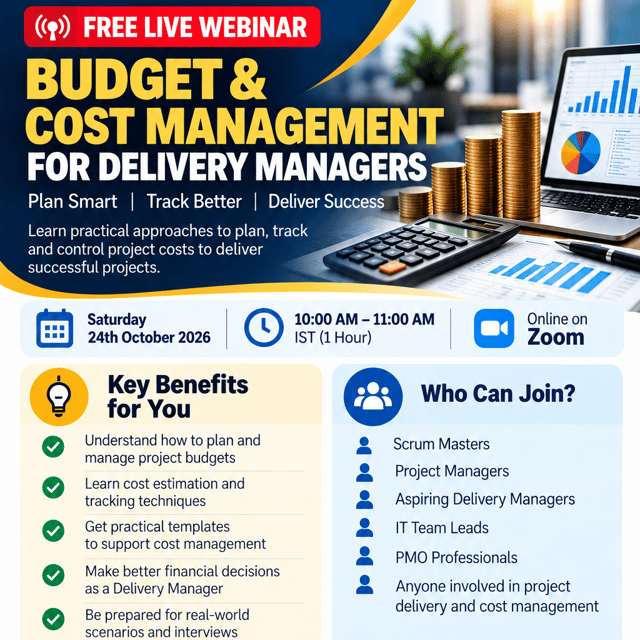
Live Webinar | Budget & Cost Management for Delivery Managers
20 AI Prompts for Scrum Masters & Agile PM
Delivery Manager Role - Strategy Call
RTE Role / Program Manager - Strategy Call
Resume review and ATS friendly update for IT Roles
Priority DM
Scrum Master & Agile PM Toolkit
PMO Toolkit : 27 Ready-to-use Templates
JD based Mock Interview & Guidance for Job
8 AI Prompts for Risk Management in Agile Projects
Scrum Master Role - Strategy Call
PMO Leader Role - Strategy call
Project Manager / Agile PM Role - Strategy Call
Promotion Readiness Checklist - Agile Leader Role
Agile and Scrum Videos for Beginners
Agile Coach - Career Strategy call
Sr IT Leadership Roles - Career Strategy
About me
Frequently asked questions
What is the agile project management methodology, and why do IT companies prefer it?
The agile project management methodology is an iterative approach where work is delivered in short cycles (sprints), requirements evolve through customer feedback, and teams self-organise instead of following a rigid upfront plan. Frameworks like Scrum, Kanban and SAFe operate under it. IT companies prefer it because it ships working software faster, absorbs changing requirements, and reduces the risk of building the wrong product — which is why agile skills are among the most demanded in India's IT job market.
Agile project management vs waterfall: which approach should your team choose?
Waterfall moves sequentially — requirements are frozen first, then design, development, testing and delivery follow in fixed phases. Agile project management vs waterfall really comes down to flexibility versus predictability: waterfall suits projects with stable, compliance-heavy requirements, while agile suits fast-changing software work where feedback shapes the product. Most Indian IT companies today run agile or hybrid models, so understanding both — and knowing when each fits — is a strong interview differentiator.
How to learn agile project management as a beginner?
Start with the Agile Manifesto and the Scrum Guide (both free), then take a structured agile project management with Scrum course to build fundamentals properly. Practise with real artefacts — sprint boards, user stories, retrospectives, capacity and release planning templates — and apply the concepts to small pieces of work in your current role. Once the basics are solid, move to a recognised certification; learning theory without hands-on practice is the most common beginner mistake.
How to get agile project management certification in India?
Pick a certification that matches your experience level. Beginners typically start with CSM (Certified Scrum Master) or an agile foundation certification, while experienced professionals targeting leadership tracks go for SAFe credentials such as RTE or SPC. The process is simple: enrol with a certified training provider, attend the training (usually two days for CSM), and clear the online exam. Costs in India generally range from about ₹20,000 to ₹60,000 depending on the certification and provider.
What should a Scrum Master do on a daily basis?
A Scrum Master facilitates the Scrum events, removes impediments blocking the Developers, coaches the team and Product Owner on agile practices, shields the team from outside interruptions, and drives continuous improvement sprint after sprint. It is a servant-leader role, not a project manager role — a Scrum Master succeeds when the team becomes self-managing and consistently delivers, not by assigning tasks or tracking timesheets.
What is the main reason for the Scrum Master to be at the Daily Scrum?
The Daily Scrum belongs to the Developers — the Scrum Master attends only to ensure the event takes place and stays within its 15-minute timebox. It is not a status report to the Scrum Master or management; if the team already runs it well, the Scrum Master need not attend at all. This appears in almost every Scrum Master interview and certification exam, so understand the intent behind it rather than memorising a one-line answer.
How to crack a Scrum Master interview?
Prepare in three layers: core Scrum theory (roles, events, artefacts, Definition of Done), scenario-based questions (a team missing sprint goals, a dominating retrospective member, scope added mid-sprint), and your own examples told in the STAR format. Interviewers now test practical judgement over bookish definitions, so rehearse how you would handle conflict, a disengaged Product Owner or stakeholder pressure. One focused mock interview with an experienced agile coach usually exposes gaps that self-study misses.
How to crack a Scrum Master interview without experience?
Accept that you won't have "in my last project as a Scrum Master" stories, and build answers from adjacent experience instead — coordinating releases, mentoring juniors, running team rituals, or driving process improvements. Get a recognised certification like CSM to clear the resume filter, prepare scenario questions even more thoroughly than theory, and highlight transferable strengths like facilitation, communication and conflict resolution. Plenty of professionals from testing, development and support backgrounds make this switch successfully.
What are the most common Scrum Master interview questions and answers?
Frequently asked ones include: How do you handle a team member who isn't cooperating? What would you do if the Product Owner keeps changing requirements mid-sprint? What is the difference between a Scrum Master and a Project Manager? How do you measure a Scrum Master's success? For every answer, follow a simple structure — state the Scrum principle, explain your practical action, and close with an example. Preparing around 15-20 Scrum Master interview questions and answers this way covers most interview panels.
What does a Release Train Engineer do?
A Release Train Engineer (RTE) is the chief facilitator of an Agile Release Train in SAFe — essentially a "Scrum Master at the program level." The RTE facilitates PI (Program Increment) planning, manages risks and dependencies across multiple Scrum teams, tracks ART progress and predictability metrics, escalates impediments, and coaches Scrum Masters and teams on lean-agile practices. Where a Scrum Master serves one team of 5-9 people, the RTE serves a train of 50-125.
How to become a Release Train Engineer in India?
The realistic path is progressive: become a strong Scrum Master first, then take on wider responsibility as a Lead Scrum Master, Agile Coach or Delivery Manager, and then step into the RTE role. Most Indian companies hiring for RTE expect 8-10+ years of IT experience, SAFe certifications (RTE or SPC), and proven skills in PI planning, dependency management and stakeholder handling. Volunteering to coordinate SAFe events or PI planning in your current organisation is the fastest way to build the exact experience interviewers look for.
Do you need a Release Train Engineer certification to get an RTE role?
For most RTE openings in India, a SAFe credential is listed as required or highly preferred, and a recognized release train engineer certification also helps your resume clear ATS screening. That said, certification alone doesn't get you the role — companies want demonstrable program-level facilitation experience. The ideal order is to build solid Scrum Master or delivery experience first, then add the certification, and then target RTE openings.
What is the Release Train Engineer salary in India?
Release Train Engineer salaries in India typically fall between ₹18 and ₹35 LPA, with experienced RTEs in large product companies and mature SAFe transformations earning ₹40 LPA or more. Pay varies with city — Bangalore, Pune and Hyderabad have the highest concentration of RTE roles — along with certifications and depth of program-level experience. It is one of the best-paid tracks on the agile career ladder, which is why many Scrum Masters target it.
Release Train Engineer vs Scrum Master: which role should you aim for?
A Scrum Master facilitates a single team, while a Release Train Engineer coordinates an entire Agile Release Train — planning PI events, resolving cross-team dependencies and reporting to leadership. Release Train Engineer vs Scrum Master is less a comparison of skills and more one of scope: RTE is a senior, higher-paying role that usually follows several successful years as a Scrum Master or Agile Coach. If you're new to agile, master the Scrum Master role first; if you already have deep facilitation and program experience, upskilling toward RTE is the natural next step.
What are the most common Release Train Engineer interview questions?
Expect deep questions on PI Planning — how you prepare, facilitate and handle teams that miss PI objectives — along with dependency and risk management across teams, ART predictability metrics, escalation handling, and SAFe concepts like release on demand and DevOps. Scenario questions such as "A team consistently fails its PI objectives — what do you do?" are standard. Rehearsing these with someone who has actually operated at the program level helps you answer with real depth instead of textbook theory.