Testimonials
Services
Java Interview Guide
Evolution of Java (8 through 24)
Java Career Advancement guide
Spring Interview Guide
Java Multithreading Advanced guide
Dependency Injection - Spring Framework
System design - Last Minute Interview Guide
Java Spring Full Guide
Spring Transaction Internals
Java Stream API - Full Guide
About me
Frequently asked questions
What are the most common system design interview questions?
The most frequently asked system design interview questions revolve around designing familiar large-scale products — a URL shortener, rate limiter, chat application, Instagram-style news feed, notification system, food delivery app, and ticket booking system. Interviewers rarely expect a perfect answer; they evaluate how you clarify requirements, estimate scale, draw a high-level design, choose databases and caches, and handle bottlenecks. Practicing 10–15 classic designs end to end prepares you for most interview rounds.
How to prepare for a system design interview?
Start 4–6 weeks before your interview. First build conceptual clarity on load balancing, caching, database sharding, replication, message queues, and consistency models. Then study a handful of solved designs, and finally practice designing systems yourself with a timer while drawing the architecture and speaking your trade-offs out loud. Mock interviews are the fastest way to expose gaps in your structure and communication.
How to approach a system design interview?
Use a repeatable framework: clarify functional and non-functional requirements, estimate scale (users, storage, bandwidth), sketch the high-level design, define the data model, deep-dive into one or two critical components, and finish with bottlenecks and trade-offs. Keep talking throughout instead of silently drawing — interviewers judge your reasoning and how you justify each decision more than the final diagram.
Which book should I read for system design interview preparation?
If you want a single system design interview book to start with, the System Design Interview by Alex Xu (Volumes 1 and 2) is the most widely recommended starting point because it walks through classic problems step by step. Don't just read passively — attempt each problem yourself first, draw your own architecture, and then compare your approach with the book's solution so you build a personal framework instead of memorizing diagrams.
Is Grokking the System Design Interview worth it?
Grokking the System Design Interview is genuinely useful if you have never seen a solved design, because it breaks classic problems into a clean, repeatable template. The common gap is that reading solved designs feels easy while reproducing that structure on your own is hard, so treat it as a starting point and follow it with self-practice, whiteboarding, and mock interviews rather than relying on it alone.
What is Spring Boot and how does it work?
Spring Boot is an opinionated layer over the Spring framework that removes most of the manual configuration Java applications traditionally need. It works through three core ideas: starters, which bundle all dependencies for a capability like web or data JPA into a single dependency; auto-configuration, which inspects your classpath and applies sensible defaults automatically; and an embedded server such as Tomcat, which lets you run the whole application as a simple executable JAR.
What is Spring Boot and what are its advantages?
The biggest advantages of Spring Boot are speed and less boilerplate: auto-configuration eliminates manual wiring, starter dependencies prevent version conflicts, and the embedded server makes deployment a single runnable JAR. It also ships production-ready features through Actuator such as health checks and metrics, integrates smoothly with databases, security, and cloud platforms, and has become the default choice for REST APIs and microservices in Java — which is why Spring Boot skills dominate backend job descriptions today.
How should a beginner start learning Spring Boot?
First make sure your core Java is solid — OOP, collections, exceptions, and lambdas — because Spring Boot builds directly on those concepts. Then understand the Spring fundamentals of inversion of control and dependency injection, follow one structured Spring Boot tutorial for beginners end to end instead of hopping between random videos, and immediately apply it by building small REST APIs like a todo or inventory app. Once CRUD works, add a real database, validation, exception handling, and security layer by layer.
What is microservices architecture and how does it work?
Microservices architecture is a style of building an application as a collection of small, independently deployable services, each owning one business capability such as payments, orders, or notifications. Every service has its own database, communicates with others through lightweight APIs or message brokers, and can be scaled or updated on its own. Compared to a monolith, you gain independent scaling and fault isolation, at the cost of handling distributed-system complexity like network failures and data consistency.
How do I build microservices architecture in Java with Spring Boot?
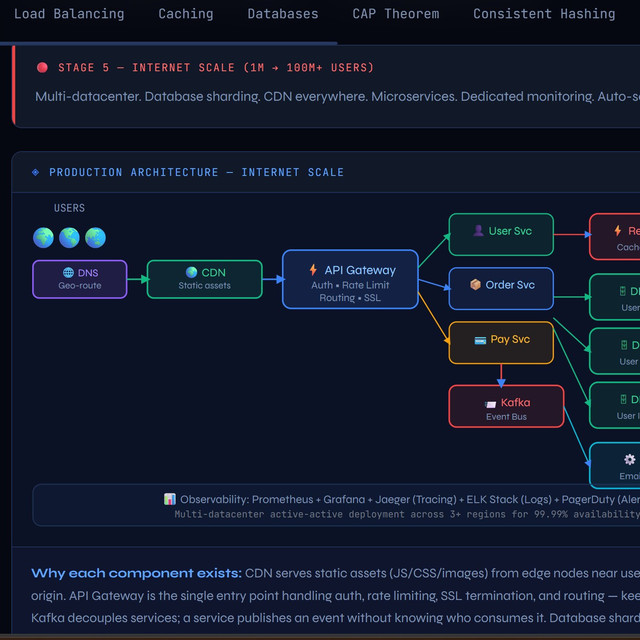
Start by identifying service boundaries from business domains, then create a separate Spring Boot application per service with its own database. In a typical microservices architecture in Java with Spring Boot, services talk to each other over REST or through Kafka, an API gateway acts as the single entry point, and Spring Cloud handles service discovery and centralized configuration. Finally, containerize each service with Docker and deploy on Kubernetes, adding resilience features like circuit breakers and distributed tracing as the system grows.
How to design microservices architecture for a real-world application?
Begin with domain-driven design: map business capabilities into bounded contexts and make each context a service that fully owns its data. Choose synchronous (REST/gRPC) or asynchronous (Kafka/RabbitMQ) communication per interaction, plan for failure with timeouts, retries, and circuit breakers, and use patterns like Saga for distributed transactions. Well-known microservices architecture patterns — API Gateway, Database per Service, Saga, CQRS, Strangler Fig — solve specific problems, so adopt one only when that problem actually shows up in your system.
Microservices architecture vs monolithic architecture — which one should you choose?
A monolith is a single deployable codebase that is simpler to develop, test, debug, and cheaper to operate, which makes it the right starting point for small teams and early-stage products. The microservices architecture vs monolithic architecture decision is a trade-off: microservices buy you independent scaling, fault isolation, and team autonomy, but demand strong DevOps maturity and distributed data handling. Most teams do best with a well-structured modular monolith first, extracting services only when scale, team size, or deployment pain genuinely demands it.
What are the most common microservices architecture interview questions?
Frequently asked microservices architecture interview questions cover the difference between monoliths and microservices, how services communicate (REST vs messaging), why each service should own its database, distributed transactions with the Saga pattern, the role of API gateways and service discovery, circuit breakers, eventual consistency, and idempotency. Interviewers often follow up by asking you to design a ride-hailing or food-delivery system, so practice connecting all these concepts inside one end-to-end design.
How to explain microservices architecture in an interview?
Keep a 60–90 second structure ready: define microservices as small, independently deployable services aligned to business capabilities, contrast them with a monolith, explain how services communicate and why each owns its data, and finish with one trade-off you have handled, such as eventual consistency or fault tolerance. When explaining microservices architecture in an interview, anchor the answer in a project you actually worked on — real decisions, failures, and numbers stand out far more than textbook definitions.