Testimonials
Services
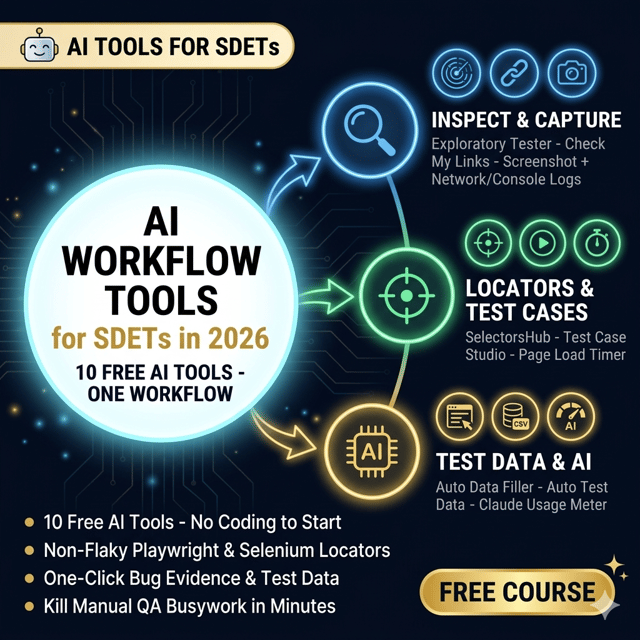
Top 10 AI Workflow tools for SDETs in 2026
Automation Interview Prep - Journey to SDET
Detailed discussion regarding your career
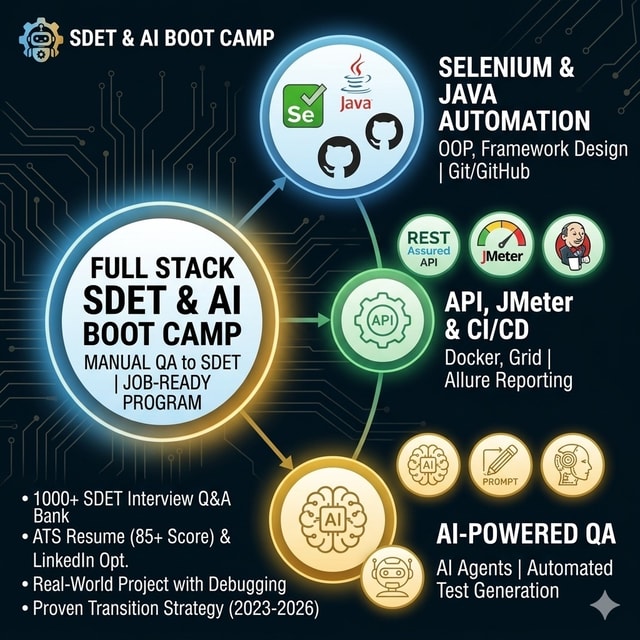
Job Ready Full Stack QA & Automation Course
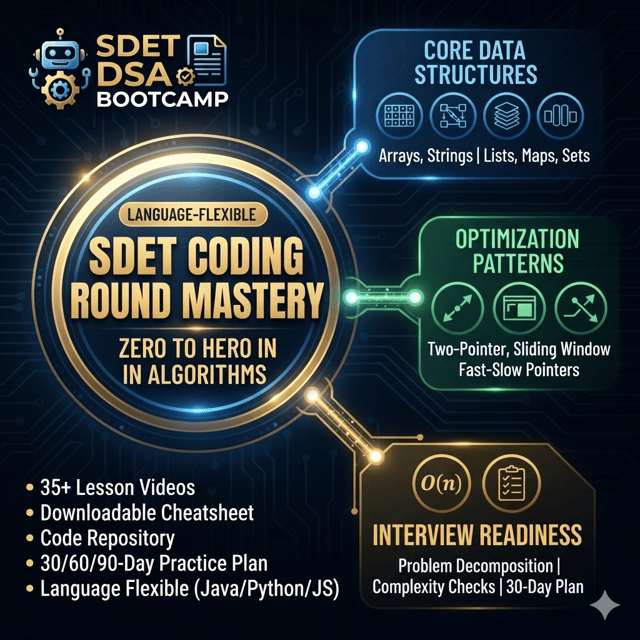
Crack your next SDET Coding Interview
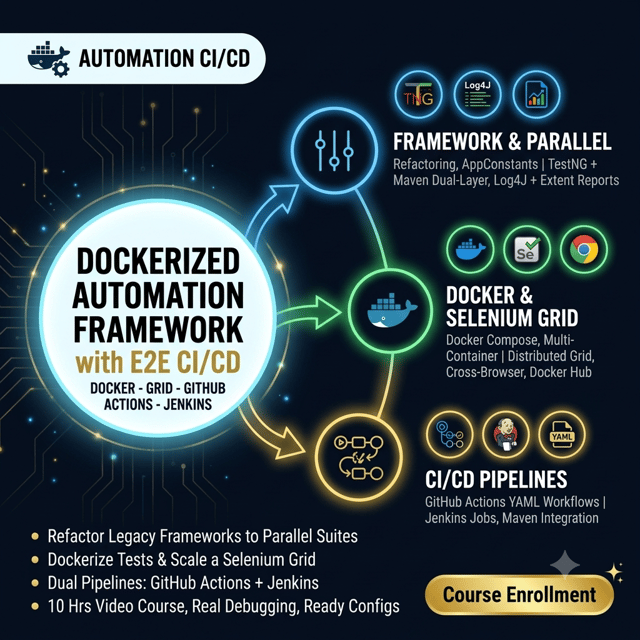
Become Proficient Automation Tester with CI/CD
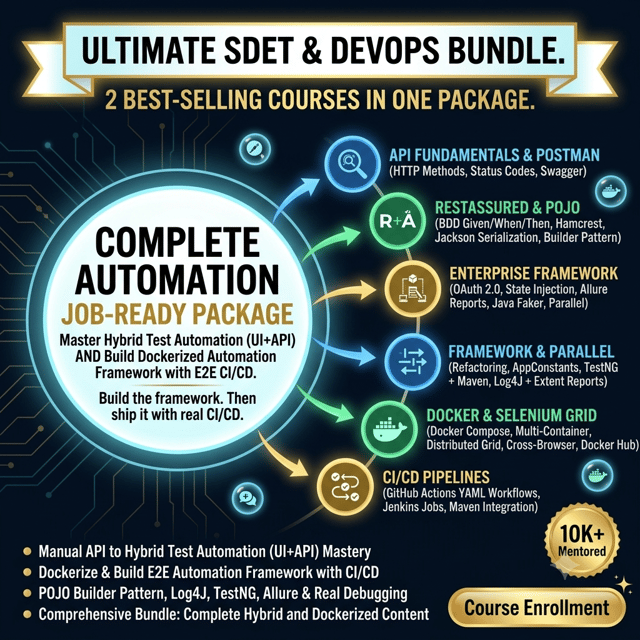
Job-Ready SDET: Framework API testing & Automation
Mock interview & Custom Roadmap
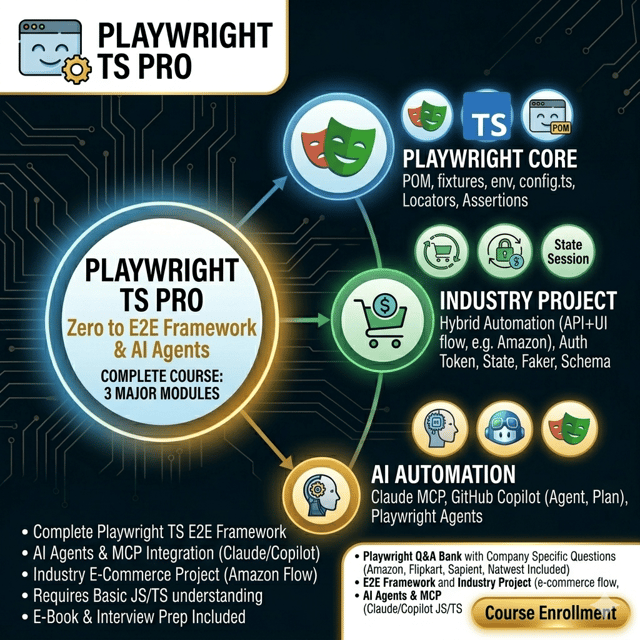
Playwright TypeScript: E2E to AI Agents + MCP
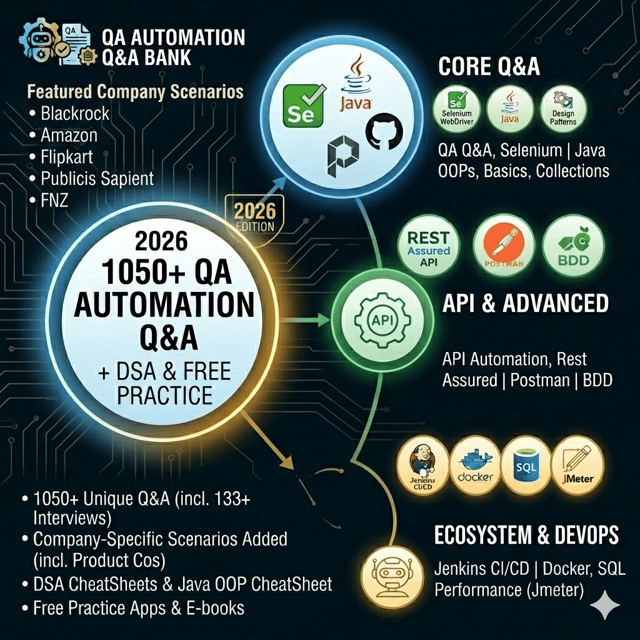
2026 1050+ QA Automation Q&A + DSA + Free Practice
Job Shortlisting Guide 2026 with My ATS Resume
Have a question?
About me
- Join my Free Telegram channel for regular updateshttps://t.me/japneetsachdeva

Frequently asked questions
What is test automation in software testing, and what does a test automation engineer do?
Test automation in software testing means using scripts, tools, and frameworks to execute test cases automatically instead of manually checking every feature. It is widely used for regression suites, API checks, and CI/CD pipelines so releases stay fast and reliable. A test automation engineer designs these frameworks, writes maintainable scripts in languages like Java or TypeScript, integrates tests into CI/CD, and works closely with developers to catch bugs early. In India, it is one of the fastest-growing career paths for manual testers looking to move into product companies.
What is a test automation framework, and why do interviewers expect you to build one?
A test automation framework is a set of guidelines, reusable components, and tools that makes automation scripts structured and maintainable. It usually includes a defined folder structure, page objects or locators, reporting and screenshot utilities, configuration management, and CI/CD integration. Instead of writing random scripts, an SDET builds tests inside a framework — for example, a Playwright or Selenium framework using the Page Object Model — so that when the application changes, only one place needs updating. Interviewers frequently ask you to design one from scratch, so building at least one framework end to end is essential.
What is the average test automation engineer salary in India?
A test automation engineer salary in India typically starts around ₹4–6 LPA for freshers with manual testing exposure, moves to roughly ₹8–15 LPA with 3–5 years of strong automation skills, and can cross ₹20–30 LPA at senior SDET or lead levels in product-based companies. Skills that push you into the higher band include API automation, framework design from scratch, CI/CD, cloud testing, and AI-assisted testing workflows. Service-company and product-company packages differ significantly for the same experience, so skills matter more than years alone.
Which test automation tools should I learn in 2026?
The core stack to learn is Playwright or Selenium for web, Postman or Rest Assured for API testing, and a CI/CD tool like Jenkins or GitHub Actions. Playwright with TypeScript is currently the fastest-growing combination because of its speed, auto-waiting, and built-in test runner. On top of these, AI workflow tools for test case generation, self-healing locators, and defect analysis are becoming a real differentiator for SDETs, so learning to plug AI into your daily testing workflow gives you an edge in interviews and appraisals.
Which test automation practice websites are best for hands-on QA practice?
Popular test automation practice websites include demo e-commerce and banking applications where you can safely practise login, cart, checkout, and payment flows, plus dedicated sites for alerts, iframes, dynamic tables, and drag-and-drop. For API practice, use public dummy REST APIs. The right way to use them is not to write one random script but to build a small framework around a practice site — with page objects, reporting, and a GitHub Actions or Jenkins pipeline — because that mirrors what real projects and interviews expect.
Is Test Automation University enough to get a test automation job?
Test Automation University is a good starting point because its free courses cover fundamentals like Java, Selenium, API testing, and Git in a structured way. On its own, though, certificates rarely get you shortlisted. Hiring managers look for evidence that you can apply what you learnt — a framework project on GitHub, API automation with reporting, a CI/CD pipeline, and the ability to explain your design decisions in an interview. Use free courses to build basics, then invest time in projects and interview preparation to become genuinely job-ready.
How do I start learning Playwright with TypeScript as a complete beginner?
Start with the basics of TypeScript itself — types, interfaces, async/await, and ES modules — because Playwright tests are written in it. Then follow a structured Playwright TypeScript tutorial that covers installation, your first test, locators, assertions, and handling dropdowns, frames, and pop-ups. Once you are comfortable writing individual tests, move to building a complete Playwright TypeScript framework with the Page Object Model, fixtures, custom reporting, and CI/CD integration. Adding API testing within Playwright at this stage makes you interview-ready much faster.
How to install Playwright with TypeScript?
Run npm init playwright@latest in your terminal, choose TypeScript when the setup wizard asks, and select the browsers you want. This command installs Playwright, creates playwright.config.ts, and generates a tests folder with example specs — so it also shows you how to create a Playwright TypeScript project without manual configuration. After installation, run npx playwright test to execute the sample tests and npx playwright codegen to record your first test against any website. If browsers fail to download, running npx playwright install usually fixes it.
What is a promise in Playwright TypeScript, and why do tests fail without await?
A promise in Playwright TypeScript is the returned value of almost every Playwright action, because operations like click(), fill(), and page.goto() take time to complete. Since JavaScript runs asynchronously, the code does not wait by itself — you must use await so the next step starts only after the previous action finishes. Forgetting await is one of the most common reasons beginners see flaky tests, "element not found" errors, or assertions behaving unexpectedly. Getting comfortable with async/await is essential before writing any serious Playwright test.
What is the difference between Playwright and TypeScript?
Playwright and TypeScript are not alternatives — one is a tool and the other is a language. Playwright is a test automation framework from Microsoft used to automate browsers for end-to-end testing, while TypeScript is a programming language that adds static typing on top of JavaScript. When people say "Playwright with TypeScript," they mean writing Playwright test scripts using TypeScript, which gives better autocompletion, fewer runtime errors, and cleaner code than plain JavaScript. Comparing Playwright with Selenium or Cypress makes sense; comparing it with TypeScript is like comparing a car with the fuel.
Which Playwright TypeScript interview questions and answers should I prepare for SDET roles?
Focus on the questions that come up in almost every Playwright TypeScript interview: how auto-waiting works, differences between locator strategies, handling dropdowns, iframes, and multiple tabs, fixture-based setup, grouping and tagging tests, API testing with the request context, and Playwright versus Selenium. Interviewers also expect you to explain your framework structure, how you handle flaky tests and retries, and how reports are generated. Prepare answers with small code examples rather than theory — candidates who can write and explain code live consistently clear these rounds.
What are the most frequently asked SDET interview questions and answers?
The most common SDET interview questions cover coding problems using strings, arrays, and collections, framework design, API testing, SQL queries, Git, and CI/CD concepts, along with a few behavioural questions. The depth changes with seniority — SDET interview questions for 5 years experience focus more on designing frameworks from scratch, test strategy, mentoring juniors, and handling flaky suites at scale, while 2–3 year profiles get more direct tool and coding questions. Prepare every answer in a structured format: approach, code, edge cases, and complexity.
How do I handle scenario-based SDET interview questions for product based companies?
Scenario-based SDET interview questions for product based companies test how you think, not just what you remember. Typical scenarios include automating a new feature from scratch, handling a flaky test that fails only in CI, deciding what to automate versus leave manual, testing a payment flow, and speeding up a slow regression suite. Answer with a structure — clarify requirements, define scope, choose tools, explain framework design, and call out trade-offs and risks. Product companies value candidates who discuss test strategy, coverage, and business impact instead of jumping straight into code.
What kind of SDET interview questions in Java are asked in coding rounds?
Most SDET interview questions in Java revolve around string manipulation (reverse, palindrome, character count), arrays and ArrayList operations, HashMap-based problems, sorting logic, and classic programs like Fibonacci and factorial. For automation-specific roles, expect questions on the singleton pattern, method overloading versus overriding, the final keyword, exception handling, and file handling — plus small tasks such as swapping two variables without a third variable. Practising these on a plain editor without autocomplete, the way you will write them in the interview, is the best preparation.
Are Playwright TypeScript jobs in demand in India?
Yes — Playwright TypeScript jobs are growing quickly in India as startups and product companies replace legacy Selenium suites with faster, more stable Playwright frameworks. Most of these roles are published as SDET, Automation Test Engineer, or QA Automation Engineer, and they typically expect TypeScript or JavaScript, API automation, CI/CD, and framework design skills rather than Playwright alone. Since the talent pool is still smaller than Selenium's, candidates with a solid Playwright framework project and real API testing experience often get shortlisted faster and negotiate better packages.