Testimonials
Services
SQL Project 1: Fraud Detection Using Triggers
Gen AI Project 4: Agent Guardian:

Gen AI Project 1- MultiAgent Change Detection
Job Support Service

SQL HEIST - Learn SQL Through Real Stories
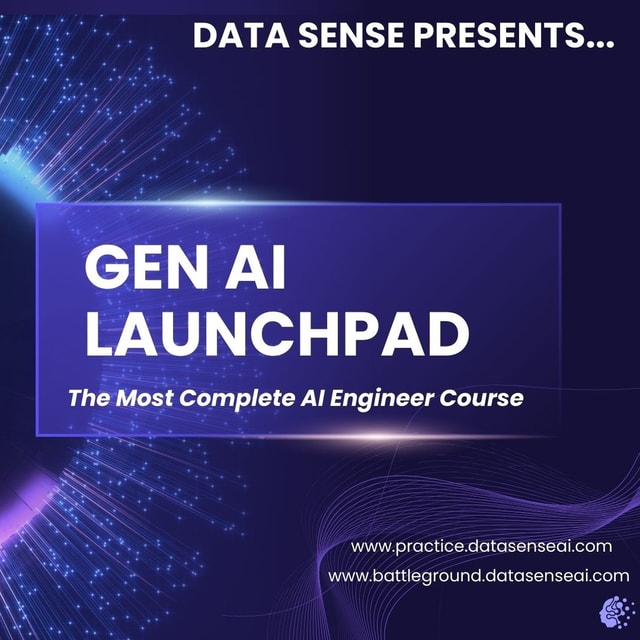
Gen AI LaunchPad - Complete AI Engineer BootCamp
Gen AI Project 5: AI-Powered ETL Agents
Gen AI Project 3: MongoDB MCP Agent
SQL Projects - Mar'26
The Auth Wall: Adding SSO to Your AI App
Agent Builder- Build Agents with Langchain
AI Project 3: Chat with CSV | Starts June 16
Python BootCamp - Live Course
Resume Preparation from scratch
About me
- Join Us Now !!https://chat.whatsapp.com/DYgDxOA8nBvJp4tPz5J6ox

- Datasense Practicehttps://practice.datasenseai.com/

Frequently asked questions
What is data analytics and data science?
Data analytics is about examining existing data to answer business questions using tools like SQL, Excel, Python, and dashboards. Data science covers all of that plus statistics, machine learning, and building predictive models. In short, analytics explains what happened and why, while data science predicts what is likely to happen next — many beginners start with analytics and add data science skills as they grow.
How does data analytics work?
It follows the data analytics life cycle: define the business problem, collect data from relevant sources, clean and organize it, analyze it using queries or statistical methods, and finally present the findings through dashboards and reports so teams can act on them.
How to learn data analytics as a beginner?
Start with spreadsheets and SQL, since writing queries is the core skill for most analyst roles. Then add a visualization tool like Power BI or Tableau and basic Python. The fastest way to learn is by doing — work through real case studies and small projects such as a sales analysis or an expense dashboard, and publish them in a portfolio instead of only watching tutorials.
What is a data analytics job?
A data analytics job involves collecting, cleaning, and studying data to help a business make decisions. Day-to-day work usually includes writing SQL queries, building dashboards, preparing reports, and presenting insights to stakeholders. Common titles include Data Analyst, Business Analyst, and Marketing Analyst, and these roles exist across banking, e-commerce, healthcare, and IT services in India.
What is a data analytics course?
A data analytics course teaches the tools and workflow analysts actually use — typically SQL, Excel, Python, statistics, and visualization tools like Power BI or Tableau. Before enrolling, check whether it is project-based with hands-on case studies, doubt-solving support, and guidance on building real dashboards, so you finish with a portfolio rather than only certificates.
How do I get data analytics jobs with no experience?
Focus on proof of skill instead of past job titles. Build 3–4 portfolio projects on public datasets, upload them to GitHub, and share your findings on LinkedIn. Many people in India break in through a data analytics internship, freelance dashboard work, or by volunteering analytics for student teams and small businesses. Tailor your resume around measurable project outcomes and be ready to defend every decision in the interview.
What SQL projects can I do?
Good options include a retail sales analysis, a customer churn report, an inventory management system, a fraud detection project using SQL triggers, and an employee or library database built with constraints and stored procedures. Pick projects that answer a real business question — for example, "which products drive the most revenue?" — because recruiters value business context more than the number of queries you write.
How to do SQL projects for beginners?
Pick one simple, real dataset (sales, orders, or student records), load it into MySQL or PostgreSQL, and start exploring it with SELECT, WHERE, GROUP BY, and JOINs. Then add depth using aggregate functions, subqueries, CTEs, and window functions, and finish by documenting your findings. Beginners progress fastest when each project has one clear goal and is completed end to end.
How to show SQL projects on a resume?
Add a "Projects" section with 2–3 strong projects, and for each one mention the business problem, the SQL techniques you used (joins, CTEs, window functions, triggers), and a measurable result or insight. "Built a fraud detection project using SQL triggers that flagged suspicious transactions" reads far better than a plain list of tools. Also upload your code and link it, so hiring managers can view your SQL projects on GitHub directly from your resume.
What is machine learning in simple words?
Machine learning is a way of teaching computers to learn patterns from data instead of programming every rule manually. For example, instead of writing rules to detect spam emails, you show the system thousands of spam and non-spam emails and it learns to tell them apart. Anything that predicts — recommendations, fraud alerts, demand forecasts — usually runs on machine learning.
How does machine learning work?
A model is trained on historical data, finds patterns in it, and then uses those patterns to make predictions on new data. The process is: collect and prepare the data, choose an algorithm, train the model, test its accuracy, and keep improving it. For instance, a model trained on past sales data can predict next month's demand.
How to learn machine learning with Python?
Get comfortable with Python basics first, then move to libraries like NumPy, pandas, and scikit-learn. Learn the core concepts — regression, classification, clustering, and model evaluation — by coding small projects such as house price prediction or customer segmentation. A structured path of Python fundamentals → classic algorithms → end-to-end projects works much better than jumping straight into advanced topics.
How to become a machine learning engineer?
Build four foundations: Python programming, mathematics (statistics and linear algebra), core machine learning algorithms, and supporting tools like Git and SQL. Then create end-to-end projects rather than only notebooks — deploying a model as an API or building an AI agent shows companies you can ship working systems. Many people enter through data analyst or data science roles and move into ML engineering as their project portfolio grows.
What should I look for in a machine learning course?
Look for one that builds fundamentals first, offers live or mentor-led doubt clearing, and evaluates you on real projects you can show in interviews. Check that the syllabus is current — topics like Gen AI, RAG, and AI agents are increasingly expected in AI roles — and prefer project-based learning over slide-only content, because interviews test what you have actually built.
What machine learning interview questions are commonly asked?
Expect concept questions on the bias-variance tradeoff, overfitting, precision vs recall, and the difference between supervised and unsupervised learning, along with hands-on questions on algorithms like linear regression, decision trees, and clustering. Interviewers also ask you to walk through your projects, so be ready to explain the problem, your approach, and your results — practicing with mock interviews helps you answer confidently under time pressure.