Testimonials
Services
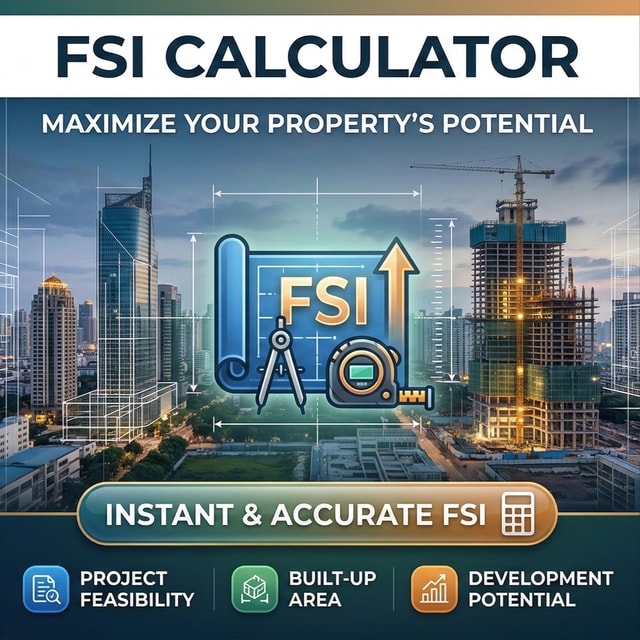

Property Feasibility Call (45 Mins)



Society Redevelopment Roadmap (30 Mins)
About me
Frequently asked questions
What is FSI in construction?
FSI (Floor Space Index) — also called FAR in some states — is the ratio of a building's total built-up area to the total plot area. For example, a permissible FSI of 2 on a 4,000 sq ft plot allows up to 8,000 sq ft of built-up construction. The FSI you actually get depends on the plot's zone, land use and abutting road width, and in Maharashtra it is regulated as per the UDCPR.
How to do FSI calculation for a plot in Maharashtra?
The basic formula is FSI = total built-up area ÷ net plot area. So if your plot measures 6,000 sq ft and the permissible FSI is 1.5, the maximum built-up area you can construct is 9,000 sq ft. Keep in mind that under UDCPR certain areas — such as parking at stilt level (subject to conditions) and specified ancillary areas — can be partly or fully excluded from FSI, so the real buildable area is often higher than what the raw formula suggests.
Is there a free FSI calculator online that works as per UDCPR?
Yes, you can find an FSI calculator online, and some are built specifically on UDCPR inputs such as plot area, zone, road width and land use. Whichever tool you use, make sure it reflects the current UDCPR provisions for your city, because permissible FSI changes with zone and road width. For a redevelopment or new-project decision, have the output cross-checked by an expert, since exclusions and premiums can materially change the final number.
Is there an FSI calculator in square feet?
Yes. Since plot and built-up areas in India are normally measured in square feet, most tools work as an FSI calculator in square feet — you enter the plot area and the proposed built-up area in sq ft and it returns the FSI directly. FSI itself is a unitless ratio, so the result is the same whether you calculate in square feet or square metres.
Do I need a different FSI calculator for Mumbai and Pune?
Yes. Mumbai is governed by its own development control regulations (DCPR 2034), so an FSI calculator for Mumbai is based on different norms, while an FSI calculator for Pune, Nashik or Nagpur works on the UDCPR. Using the wrong one can misstate your permissible built-up area significantly, so always match the calculation to the city where the plot is located.
What are UDCPR rules and regulations?
UDCPR stands for the Unified Development Control and Promotion Regulations — a single, standardised set of development control rules applicable across Maharashtra's municipal corporations and councils (Mumbai, which has its own regulations, is the main exception). UDCPR rules and regulations govern FSI, marginal distances (setbacks), building height, parking, ancillary area calculations and similar provisions that decide what and how much can legally be built on a plot.
What is the society redevelopment process in Maharashtra?
In broad sequence: structural audit and feasibility study → special general body meeting → consent of at least 75% of members → appointment of a project management consultant (PMC) → invitation and scrutiny of developer tenders → selection of developer and signing of the development agreement → building-plan approvals, followed by demolition and reconstruction. Every stage is governed by the government directives for redevelopment of housing societies, so the order matters — societies should not sign development agreements before the consent and tendering stages are properly completed.
Are society redevelopment rules in Pune different from the rest of Maharashtra?
The society-level framework — the government directives, the consent requirement and the tendering process — is the same in Pune as elsewhere in Maharashtra. What differs locally is the development entitlement: permissible FSI, marginal distances and plan approvals for your plot are worked out under the UDCPR through the Pune Municipal Corporation or PCMC. So while the process your society follows won't change, the buildable area your redevelopment can generate depends on Pune's UDCPR parameters.
What are the documents required for society redevelopment?
Keep the society registration certificate and bye-laws, property register card or 7/12 extract, conveyance or lease deed in the society's name, sanctioned building plans, occupancy or completion certificate, property tax receipts, the latest audit report, a structural audit report and the current member list ready. Developers and consultants ask for these at the feasibility and tendering stages, and missing papers — especially a pending conveyance — can stall the whole redevelopment, so verify the document set right at the start.
After how many years can a society go for redevelopment?
There is no fixed statutory age that triggers redevelopment automatically. In practice, societies start discussing redevelopment once a building is around 30 years old, because at that stage structural audits and government norms generally treat the building as a candidate for redevelopment when major repairs are no longer viable. Even then, redevelopment can only proceed through the prescribed general body process with the required member consent — the age of the building alone gives nobody the right to force it.
How to stop redevelopment of society in Maharashtra?
Remember that a developer needs the consent of at least 75% of members, so you cannot be compelled to sign. To oppose it, attend every general body meeting and get your objection recorded in the minutes, ask for the structural audit, feasibility report and draft development agreement to be circulated in advance, verify the carpet area and compensation being offered, and if there are procedural irregularities, complain to the Deputy Registrar of Co-operative Societies or seek relief through the consumer commission or civil court. Acting before the consent threshold is crossed is the most effective way to protect your position.
Where can I find society redevelopment rules in Marathi?
The primary sources are the Maharashtra co-operation department's redevelopment directives and related government resolutions (GRs), which are published in Marathi. For society redevelopment rules in Marathi in a simplified, plain-language form, members usually rely on Marathi guides or consultations, since the original circulars are long and technical. It is also fair to ask your society to circulate the developer's draft terms and key general body notices in Marathi so every member clearly understands what they are consenting to.