Testimonials
Services
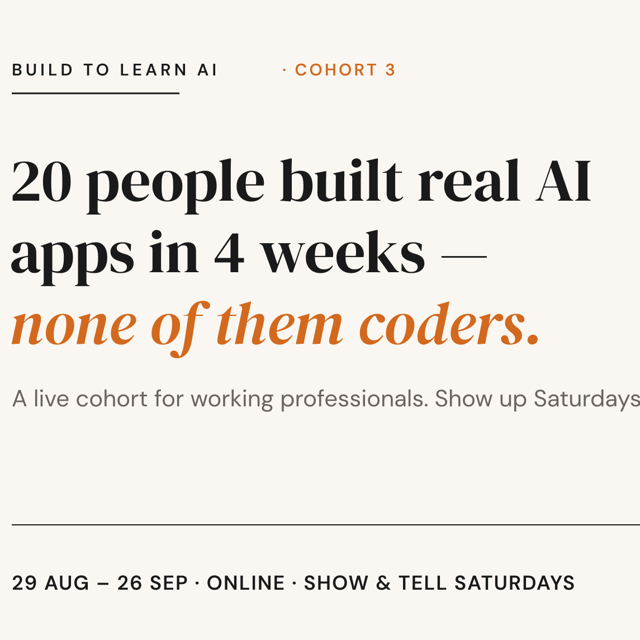
Cohort #4 - Build to Learn AI - 22 Nov - 19 Dec
Read Better Faster Smarter 1:1 Coaching
1:1 Introductory Call
About me
Frequently asked questions
How to learn AI for free in India?
Start with free courses and tutorials from platforms like Google, Microsoft, and YouTube, then practise using free tiers of AI tools such as ChatGPT, Gemini, and Perplexity. The fastest way to retain what you learn is to build small things — automate a daily task, summarise documents, or create a simple workflow — instead of only watching videos. Joining a free community or study group also keeps you consistent when motivation drops.
How to learn AI skills step by step as a beginner?
Begin with everyday AI tools, learn to write good prompts, and then apply AI to real tasks like writing, research, planning, and analysis. Once comfortable, pick one direction — automation, content, or data — and build small projects around it. A structured roadmap with weekly milestones works far better than jumping between random tutorials.
How to learn AI tools like ChatGPT for everyday work?
Pick one tool and use it daily for genuine tasks — drafting emails, summarising notes, planning your week — rather than binge-watching tutorials about it. Explore features gradually, such as custom instructions, file uploads, and reusable prompts, and maintain a personal list of prompts that work for your role. After a few weeks of daily use, the tool becomes a natural part of your workflow.
Can I learn AI from scratch without a coding background?
Yes. Modern AI tools are largely no-code, so you can learn AI from scratch by using them for practical tasks and gradually understanding how they work behind the scenes. Focus on problem-solving and daily consistency first; if you later want to go deeper into automation or data work, you can pick up Python at that stage instead of forcing it upfront.
What are the most valuable AI skills to learn right now?
The most useful AI skills to learn today are prompt writing, AI-assisted research and writing, workflow automation, and knowing which tool fits which task. Pairing these with a domain you already work in — marketing, finance, teaching, or operations — makes you far more valuable than learning AI tools in isolation.
Should I join an AI skills course or learn on my own?
Self-learning works if you are disciplined and follow a clear roadmap, but most beginners stall because of overwhelm and inconsistency. A structured AI skills course or cohort helps when you want a defined path, deadlines, and a group learning alongside you — especially if you have already tried and quit self-learning once.
What is habit forming and how long does it take to build a habit?
Habit forming is the process of turning a repeated behaviour into an automatic routine through a consistent cue, repetition, and a sense of reward. Research suggests the average habit takes around two months to become automatic — not the popular "21 days" — and the time varies with how difficult the behaviour is and how consistent your trigger is.
How to build a habit that actually sticks?
Start absurdly small — two minutes a day — attach the habit to an existing routine, and never miss twice in a row. Track your streak, remove friction from your environment, and add accountability such as a partner or a group where you report daily, since follow-through improves dramatically when someone is watching your streak.
How to build a habit of reading books every day?
Fix a daily time and a tiny target — 10 pages or 10 minutes — keep the book visible where you usually sit, and mark your streak somewhere you can see it. Reading sprints, buddy reads, or a reading accountability group help you push through the weeks when motivation dips and the habit hasn't set in yet.
How to build a habit tracker in Notion?
Create a database with one row per day and a checkbox for each habit, then add a streak count or a weekly completion-rate view to see progress at a glance. Limit it to three to five habits, review it at the same time every day, and pin it to your Notion homepage so opening and checking it becomes automatic.
Does using a habit building app actually help you stay consistent?
A habit building app helps with reminders, streaks, and visible progress, but it works best when combined with accountability — reporting to a person or a group — and a small, realistic daily target. The app tracks the habit; the system of cues and accountability around it is what actually makes you repeat it.
Which habit building books should I read first?
Atomic Habits by James Clear is the best starting point for practical systems, Tiny Habits by BJ Fogg is excellent for starting small, and The Power of Habit by Charles Duhigg explains the science of cues and routines. Read one, apply it for a few weeks, and only then move to the next instead of reading them all back to back.