Testimonials
Services

1:1 Life Coaching Session

About me
Frequently asked questions
What is life coaching all about?
Life coaching is a structured, judgment-free conversation process where a trained coach helps you get clarity on what you actually want — in your career, relationships, parenting, or personal life — and build a concrete path to get there. Unlike advice from friends or motivational content, a coach asks the questions most people avoid, reflects back patterns you can't see yourself, and holds you accountable for real movement. A good session ends with decisions and next steps, not vague inspiration.
Is life coaching in India worth it for working professionals?
It can be, if you're at a genuine crossroads — a stalled promotion, a switch you keep postponing, burnout you can't shake, or work stress spilling into your relationships. When evaluating life coaching in India, check three things: a recognised credential such as ICF certification, real-world experience that matches your situation, and a direct, structured style rather than purely motivational talk. One honest, well-facilitated session often creates more clarity than weeks of scrolling advice threads.
Does a life coaching certification matter when choosing a coach?
Yes, more than most people realise. Coaching is an unregulated field, so a life coaching certification is the most reliable signal that a coach has been trained properly. The gold standard is the International Coaching Federation (ICF): an ICF ACC (Associate Certified Coach) credential means the coach has completed verified training, logged real coaching hours, and is bound by an ethics and confidentiality code. Alongside credentials, weigh practical experience — a coach who has led teams and made high-stakes decisions understands the terrain you're navigating.
What is the meaning of career transition?
The meaning of career transition is broader than "changing jobs." It describes any significant shift in your professional direction — moving to a new function or industry, stepping from an individual-contributor role into leadership, returning after a career break, or leaving employment to build something of your own. It also covers the internal side: the uncertainty, identity questions, and fear that come with leaving a known path. That's why the mental gridlock around a transition is usually harder than the logistics, and where a coach helps most.
When should I work with a career transition coach?
A career transition coach is most useful at decision points: you're torn between two paths and going in circles, you've outgrown your role but can't name what's next, you're returning after a break and unsure how to position yourself, or you've been passed over and don't know why. The rule of thumb is simple — if you've been circling the same career question for more than a few weeks without a decision, an outside, structured perspective saves you months. Friends and managers are too close to the situation; a coach is neutral, confidential, and focused entirely on your move.
Is 30 too late to change careers in India?
No. Most people searching how to change careers at 30 are earlier in the pivot than they think — at 30 you still have more working years ahead than you've already completed. What matters more than age is approach: audit your transferable skills, test the new direction through stretch projects or side experiments before quitting, build proof of capability in the new field, and plan your finances for the transition window. The real risk at 30 isn't changing too late; it's staying five more years in a role you already know is wrong for you.
What are burnout symptoms, and how are they different from ordinary tiredness?
The core signs are exhaustion that sleep and weekends don't fix, growing cynicism or detachment toward work you once cared about, and a visible drop in performance despite working longer hours. Physical echoes are common too — poor sleep, irritability, brain fog, frequent headaches, and dread on Sunday evenings. Ordinary tiredness recovers with rest; burnout doesn't, because the cause is structural — workload, boundaries, or lost meaning — not just fatigue. If several of these have persisted for weeks, take them seriously instead of pushing through.
How long does burnout recovery take?
There's no fixed timeline, but two factors decide it most: how deep the burnout is and how early you intervene. Mild burnout caught early can ease within a few weeks of genuine rest and boundary changes. Burnout built over years — running on adrenaline while ignoring the warning signs — often takes several months of structured recovery. What stretches the timeline the most is half-recovery: taking a short break and returning to exactly the same workload, habits, and boundaries. Recovery that changes real behaviour is what prevents relapse.
What are the different burnout recovery stages?
Most people move through recognisable burnout recovery stages: first, the push-through phase, where warning signs are ignored; second, the crash, when body and mind force a stop; third, rest and withdrawal, where energy is genuinely low and that's normal; fourth, rebuilding — restoring sleep, boundaries, and a sustainable workload; and finally, re-engagement, returning to work with limits that protect you. Knowing your current stage matters because the biggest mistakes happen when someone in the rest phase pushes to perform, or in the rebuild phase rushes back to the same intensity that caused the problem.
How do I build a burnout recovery plan that actually works?
An effective burnout recovery plan covers four layers. Immediate relief: real time off, protected sleep, and cutting non-essential commitments. Boundaries: renegotiating workload, switching off after hours, and deciding what you will no longer do. Support: depending on severity, a doctor or therapist, a coach for the work-and-life structure, or at minimum one honest conversation with your manager. Re-entry: a staged return with fewer priorities in the first weeks. The most common failure is planning only the rest — rest without boundary and structural change is just a pause, not recovery.
How to speed up burnout recovery without quitting your job?
You can't out-discipline burnout, but you can shorten it. The fastest levers: cut decisions and commitments aggressively for a few weeks, protect sleep as a non-negotiable, take at least one genuinely disconnected break, renegotiate scope with your manager instead of silently absorbing everything, and get an outside perspective — a coach or mentor helps you separate what's structural in the situation from what's self-imposed. What slows recovery most is doing all of this halfway. Small but complete changes beat big but abandoned ones.
What does a burnout recovery coach actually do?
A burnout recovery coach helps you do what rest alone cannot: find the real source. Together you map whether the exhaustion comes from workload, unclear boundaries, perfectionism, people-pleasing, or a mismatch between your role and your values — then rebuild how you work and live, not just how you rest. A coach differs from a well-meaning friend, who is too emotionally close, and from a manager, who is part of the system creating the pressure: coaching sessions are neutral, structured, and confidential. One important note — if symptoms are severe or clinical, a coach should work alongside a doctor or therapist, not replace them.
Is life coaching the same as therapy?
No — they solve different problems and often complement each other. Therapy generally works with healing: past wounds, trauma, anxiety, and mental health conditions, delivered by licensed clinicians. Life coaching is present-and-future focused: decisions, goals, habits, relationships, and the patterns holding you back from what you want next. A good coach won't attempt to treat clinical issues and will refer you to a therapist when that's the right tool. If your core question is "what's next, and how do I get there," coaching is usually the better fit.
How do I convert my internship into a PPO?
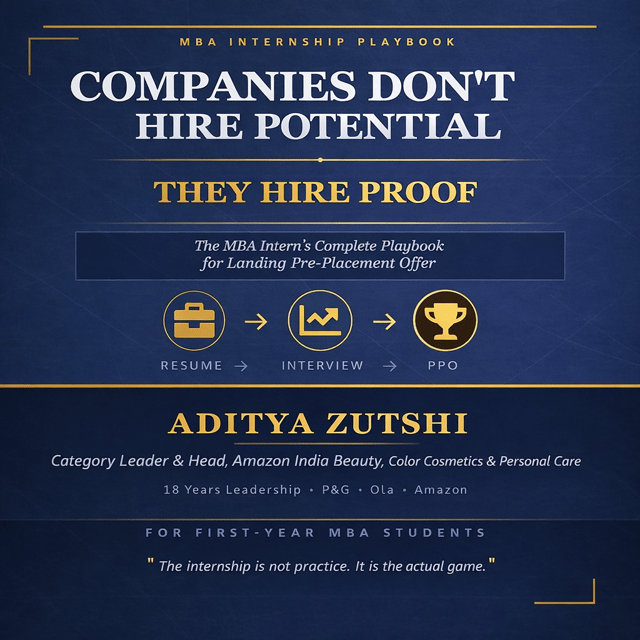
Treat the internship as a multi-week interview. Converting an internship into a pre-placement offer (PPO) usually comes down to four things: taking end-to-end ownership of at least one measurable project, making your work visible to the people who decide on offers — not just your immediate buddy — asking for structured feedback at fixed intervals instead of waiting for the final review, and learning your team's actual conversion criteria early. Reliability and how you handle feedback often matter as much as raw output. For a step-by-step version, Aditya's digital product "Prove It: The Intern's PPO Playbook" breaks the entire process into a concrete playbook.
What should I do when I feel completely stuck in my career?
Start by naming what kind of stuck it is — stalled growth, the wrong environment, a money ceiling, lost meaning, or fear disguised as confusion. Each has a different fix, which is why generic advice rarely helps. Then make one small, real move this week: a conversation with someone living the role you want, a stretch project, a focused skill sprint, or an honest audit of the last two years of your work. Feeling stuck feeds on avoidance; momentum breaks it. For a structured way through, "Unstuck: 21 Moves to Level Up Career" — Aditya's digital product — gives you specific moves, and a 1:1 life coaching session helps you apply them to your exact situation.