Testimonials
Services
Quick Chat
1:1 practical Kaggle Guide
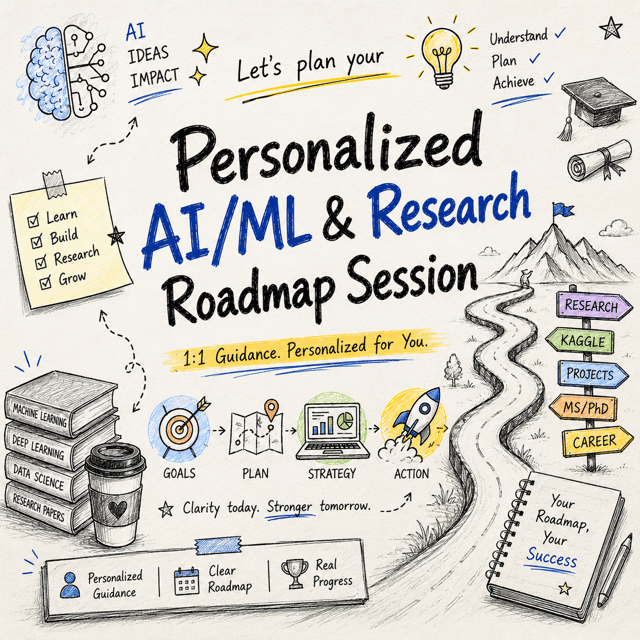
Personalized AI/ML & Research Roadmap Session
1:1 Mentorship Call
ML/AI Research Mentorship & Thesis Topic Guidance
About me
- Zulqarnain Ali is highly praised for his friendly, knowledgeable guidance in machine learning and research, making complex topics accessible and boosting learners' confidence.
 AI-generated based on testimonials
 - Cost a barrier for a meeting? Just DM me on LinkedIn. If you can't afford it, we'll work it out!
Frequently asked questions
How to win Kaggle competitions?
Learning how to win Kaggle competitions is about a repeatable process, not luck. Understand the evaluation metric first, build a simple baseline immediately, then iterate with solid cross-validation, feature engineering, and ensembling. Read winning write-ups from past competitions, stay active in the discussion threads, and team up when the domain is new to you. Most Grandmasters climbed medal by medal, so treat every competition as practice with feedback built in.
How to submit a Kaggle competition?
Before you submit a Kaggle competition entry, read the competition's rules and data description, then download the sample submission file. Train your model, produce predictions in exactly that format, and upload the file from the "Submit" tab — or run a notebook that generates the file if it is a Code Competition. Watch the daily submission limit and validate on your own split, because chasing the public leaderboard is the most common beginner mistake.
What is Kaggle competition ranking?
Kaggle competition ranking refers to the tier system on your profile: Novice, Contributor, Expert, Master, and Grandmaster. You move up by earning medals in competitions, with higher tiers requiring more and more valuable medals. Your tier is publicly visible and is often used by employers and universities as a quick signal of hands-on machine learning ability.
Are Kaggle competitions worth it?
The short answer to "are Kaggle competitions worth it" is yes, if you treat them as structured practice. They expose you to real, messy datasets, force honest validation, and give you a public medal record that strengthens your CV, portfolio, and graduate applications. Just balance them with fundamentals and projects, since competitions alone do not teach deployment or data engineering.
What are the best Kaggle competitions for beginners?
The safest Kaggle competitions for beginners are the ongoing Playground series plus classic starters like Titanic and House Prices, because thousands of public notebooks let you study every step. Get comfortable with the full workflow — data, model, submission, leaderboard — there first, then move to active featured competitions to chase your first medal.
How does Kaggle competition prize money work?
Kaggle competition prize money is offered on featured competitions funded by host companies. When the deadline passes, final standings are locked on the private leaderboard and the pool is split among top teams according to the rules, after winner verification. Be realistic, though: payouts go to a tiny fraction of participants, so most competitors bank skills, medals, and visibility long before any cash.
What is the best machine learning roadmap for beginners?
A practical machine learning roadmap for beginners looks like this: Python fundamentals, then math essentials (linear algebra, probability, statistics), then data handling with pandas and visualization. Next learn classical ML with scikit-learn — regression, classification, clustering, and evaluation — before moving into deep learning with PyTorch or TensorFlow. Reinforce each stage with small projects and finish with a specialization such as NLP, computer vision, or generative AI.
How to become a machine learning engineer?
If you are wondering how to become a machine learning engineer, the well-trodden path is: master Python and SQL, build the math and ML foundations, then go deep on a framework like PyTorch. Build three to four original portfolio projects, compete on platforms like Kaggle for verifiable proof of skill, and learn basic deployment with tools like Docker and a cloud provider. Then target internships or junior data/ML roles with a clean resume and a strong GitHub.
What is the difference between machine learning and deep learning?
The difference comes down to scope. Machine learning is the broad field of algorithms that learn patterns from data — including linear models, random forests, and gradient boosting — while deep learning is the subset built on multi-layer neural networks. In practice, classical ML often wins on smaller tabular datasets, while deep learning needs more data and compute but dominates images, text, audio, and modern generative AI.
What are some good machine learning research topics for undergraduates?
The most workable machine learning research topics for undergraduates have accessible datasets and a narrow scope: sentiment analysis for low-resource languages, crop disease detection from leaf images, air quality or traffic prediction, deepfake detection, or transfer learning in medical imaging. Aim to read 10–15 recent papers, reproduce a baseline, and add one small improvement — that is realistic for a final-year project and can even lead to a workshop publication.
What are strong machine learning research topics for masters students?
Strong machine learning research topics for masters students need a genuine gap, not just an application. Current high-potential areas include parameter-efficient fine-tuning of LLMs, retrieval-augmented generation, interpretability and fairness, self-supervised learning, and domain-specific deep learning for remote sensing, agriculture, or healthcare. Pick something where data is available, your supervisor has expertise, and an honest small contribution fits your timeline.
What are some good ML project topics?
Good ML project topics mirror real problems instead of repeating tutorial datasets: resume screening, fake news detection, churn prediction, demand forecasting for a local business, flood or crop monitoring with satellite imagery, or a RAG chatbot over your university's documents. A strong project has a clear problem statement, a real dataset, honest evaluation, and a short write-up — that combination impresses far more than another 99%-accuracy notebook.
Where can I find ML project topics with source code?
The best places to find ML project topics with source code are GitHub (curated project lists and repos that ship datasets, notebooks, and documentation together), Kaggle notebooks you can fork and modify, and Papers with Code, which links research papers to their implementations. Treat source code as a starting point: re-implement it, change something, break it, and document what you learned.
Where can I find a machine learning roadmap PDF?
You can find a machine learning roadmap PDF on GitHub and community sites, and roadmap.sh lets you export its interactive ML roadmap as a PDF. Just treat any static PDF as a checklist rather than gospel — the field moves fast, and a generic document cannot account for your background, goals, or gaps. Use it to track progress, not to replace thinking.
Is there a machine learning roadmap with free resources?
Yes — a complete machine learning roadmap with free resources is absolutely doable: Kaggle Learn micro-courses for a hands-on start, freeCodeCamp and YouTube university lectures for Python and deep learning, official framework documentation, and public datasets for projects. The one thing free resources rarely provide is accountability and personalized feedback, which is exactly where a mentor speeds things up.