Testimonials
Services
React Internals: The Complete Guide
Career guidance
Mock interview (JS/Machine Coding/HLD)
Resume review
Discovery Call
About me
Frequently asked questions
What is React and why is it used?
React is a JavaScript library for building user interfaces, especially for apps where the screen updates frequently without full page reloads. It's used because it breaks UIs into reusable components, updates the DOM efficiently through reconciliation, and has a huge ecosystem of tooling and libraries. Most product companies in India — from startups to large travel, e-commerce and fintech platforms — run on React, which is also why React depth dominates frontend hiring.
What's the best way to do a React internals deep dive?
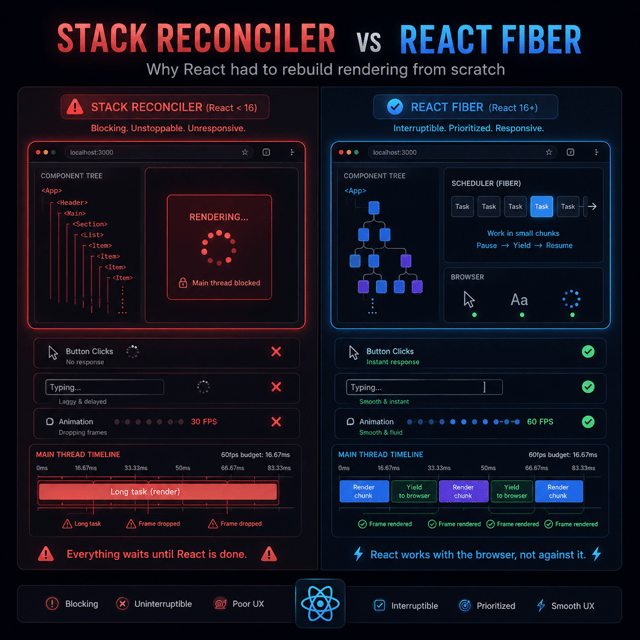
Start with the fundamentals — how React renders, commits, and reconciles — and then move into the Fiber architecture, the render and commit phases, how hooks actually work, and concurrent rendering. Useful methods include reading React's source code, building a tiny React of your own, and following structured deep-dive resources instead of scattered blog posts. Tie everything you learn to real debugging scenarios, because internals knowledge sticks only when connected to actual rendering problems.
Which React internals book should I read to understand how React works under the hood?
There is no single canonical book, and free material is scattered, so judge resources on coverage: reconciliation, Fiber, render/commit phases, and hooks implementation with real code examples. If you'd rather follow a structured React internals course instead of piecing things together, pick one authored by someone who works on production React at scale — for example, Yugantar Kumar's React Internals: The Complete Guide, built specifically to explain the why behind React, not just the how.
What is React __secret_internals_do_not_use_or_you_will_be_fired?
It's an internal export from React's renderer packages (such as react-reconciler) that exposes the internals object used by React DOM and by libraries like testing tools to hook into React's internals. The name is literally a warning: it is not a public API, it can change or break between versions, and importing it into application code is a serious anti-pattern. If you've seen it in stack traces or while debugging, it usually means a library is touching internals — which is a good reason to understand how React works underneath.
What are React compiler internals, and why do they matter now that the compiler is stable?
The React Compiler automatically memoizes components and values, removing a lot of manual useMemo, useCallback, and React.memo work. Its internals — how it analyzes and transforms your components, and the assumptions it makes — matter when you're debugging unexpected behavior or writing compiler-friendly code. And no, the compiler doesn't make React internals knowledge obsolete: it optimizes re-renders, but you still need to understand why components re-render to reason about performance and correctness.
How to optimize frontend performance?
Start with the biggest wins: reduce and code-split your JavaScript bundle, compress and serve images in modern formats, lazy-load below-the-fold content, tree-shake unused dependencies, cache aggressively, and avoid long tasks that block the main thread. Then profile with browser tooling to find what is actually slow for your specific app instead of guessing. In India, where a large share of users are on mid-range Android devices and patchy 4G, mobile-first optimization is not optional.
How to measure frontend performance, and which metrics matter most?
Measure in two ways: lab testing with tools like Lighthouse and WebPageTest, and field data from real users through real-user monitoring. The frontend performance metrics that matter most are the Core Web Vitals — LCP for loading, INP for interactivity, and CLS for visual stability — along with FCP and TTFB. Track them at the 75th percentile on real traffic, because lab scores alone can hide what your actual users experience.
Which frontend performance testing tools should I use?
Use Lighthouse for quick audits and CI checks, the Chrome DevTools Performance panel for finding runtime bottlenecks like long tasks and layout thrash, and WebPageTest for testing on real devices and network conditions. Add Lighthouse CI or a bundle-size check to your pipeline so regressions get caught before release rather than after.
Is there a frontend performance checklist I should follow before shipping to production?
Yes — a practical frontend performance checklist covers: bundle analyzed and code-split by route, images compressed and correctly sized, fonts preloaded, critical CSS inlined, third-party scripts deferred, caching headers set, and Core Web Vitals within budget on a mid-range device over a slow network. Making this checklist part of every release, not a one-time audit, is what keeps performance from slowly regressing.
How do I become a frontend performance engineer?
Almost nobody enters through a junior "performance engineer" title — engineers grow into it. Learn the browser rendering pipeline, JavaScript execution and the event loop, profiling tools, and the Core Web Vitals; then take ownership of performance in your current app by measuring, optimizing, and documenting the wins. Product companies in India — especially in e-commerce, travel, and fintech — hire specifically for this specialization because page speed directly affects conversion and revenue.
What are the most common frontend interview questions for freshers?
Expect HTML and CSS layout questions, JavaScript fundamentals such as closures, hoisting, the event loop, promises and async/await, DOM manipulation, and basic React topics like components, props, state, and hooks — plus small live-coding exercises. For freshers, interviewers judge JavaScript depth and problem-solving far more than the number of frameworks listed on the resume.
How are frontend interview questions for experienced candidates different from fresher interviews?
The focus shifts from syntax to systems: architecture decisions, state management at scale, performance trade-offs, testing strategy, and accessibility, along with machine coding rounds and frontend system design. At the experienced level, interviewers expect you to justify trade-offs and share lessons from real projects, not recite standard answers.
What frontend interview questions for 5 years experience should I expect in product companies?
At around five years, expect frontend system design (HLD) problems, machine coding rounds where you build a working feature in 60–90 minutes, deep React internals questions on reconciliation, Fiber, and hooks gotchas, performance war stories from real projects, and discussions on mentoring and ownership. Practicing realistic mock interviews — JS, machine coding, and HLD — with detailed feedback usually moves the needle more than reading another list of questions.
Which frontend interview questions on React are asked most in product companies?
The most common frontend interview questions on React cover the virtual DOM and reconciliation, the Fiber architecture, keys and re-render behavior, hook rules and pitfalls like stale closures and dependency arrays, useMemo/useCallback versus React.memo, controlled versus uncontrolled components, state management choices, and increasingly concurrent rendering and Suspense. Interviewers at product companies typically push one layer deeper than the standard answer to check whether you understand the why.
Are frontend interview questions PDFs enough to crack a product company interview?
A frontend interview questions pdf is useful for revision and for understanding the breadth of what gets asked, but product company interviews test applied depth — you will be made to code, debug, and defend trade-offs live. Use the PDF to organize your preparation, then spend most of your time building, practicing machine coding rounds, and doing mock interviews where you get honest, detailed feedback on where you're actually weak.