Services
JLPT N5: 15-Day Score Booster
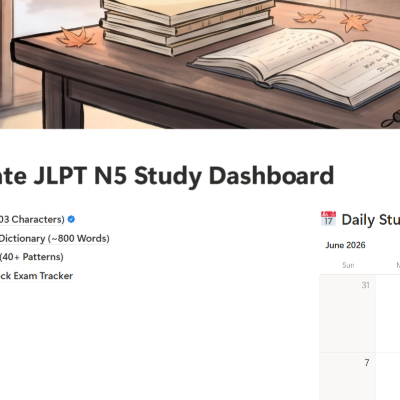
Ultimate JLPT N5 Study Dashboard

About me
Frequently asked questions
What is the JLPT exam and how many levels does it have?
The JLPT (Japanese-Language Proficiency Test) is the most widely recognised certification of Japanese language ability, accepted by employers and universities in Japan and abroad. It has five levels — N5 (easiest) up to N1 (hardest) — and tests vocabulary, grammar, reading and listening through multiple-choice questions, with no speaking or writing sections. In India, most test centres hold it twice a year, in July and December, and N5 or N4 is the usual starting point for beginners.
What is JLPT N5 and how hard is the JLPT for a complete beginner?
JLPT N5 is the entry level of the exam. It expects you to read hiragana and katakana, recognise around 100 kanji, know roughly 800 basic words, follow simple everyday conversations and read short passages. At this level the JLPT is very manageable — the difficulty ramps up from N4 onward — so beginners who study consistently for a few months usually find N5 within reach. The most common problems are skipping listening practice and cramming kanji randomly instead of following a structured list.
What is JLPT N4 and is it a big jump from N5?
JLPT N4 is the second-lowest level and builds directly on N5. The jump is noticeable but steady: you move from roughly 100 to around 300 kanji, from about 800 to roughly 1,500 words, grammar becomes longer and more layered, listening gets faster and reading passages grow. Most learners who cleared N5 can target N4 in their next one or two attempts if they maintain a regular study routine instead of starting from scratch each time.
How to prepare for JLPT N5 step by step?
Master hiragana and katakana first until you can read them instantly. Then work through the N5 syllabus in small daily chunks: core vocabulary, the basic kanji set and elementary grammar patterns, adding short listening practice every day. In the final weeks, shift to timed mock papers and review every mistake. A structured plan — ideally a dashboard or planner that tells you exactly what to study each day — works far better than collecting random grammar sheets and textbook PDFs and never finishing any of them.
How to pass JLPT N5 on the first attempt?
Understand the scoring first: you need to clear an overall minimum and also meet minimum scores in each section, so a strong vocabulary score cannot rescue a neglected listening score. Make sure kana recognition is automatic, lock down the core N5 kanji, vocabulary and grammar, practise listening daily since it is the section most self-studiers neglect, and solve at least two or three full timed papers before exam day. If your mock scores are consistently above the pass line, you can walk in confident.
How long to study for JLPT N5?
It depends on your starting point. Complete beginners commonly need somewhere around 300–450 hours of study, which works out to roughly three to six months at one to two focused hours a day. If you already read kana or know some basic Japanese, you can cut that down considerably. Short daily sessions beat long weekend marathons — consistency is what actually moves the score.
How many kanji are in the JLPT N5 kanji list?
Around 100 kanji, along with roughly 800 vocabulary words that use them. Learn each character inside example sentences rather than as an isolated symbol, group them by radical or theme, and revise them on a fixed daily cycle. A simple kanji tracker or habit checklist helps enormously here, because the biggest failure mode is re-learning the same characters again and again instead of moving forward.
Where can I get a JLPT N5 sample paper?
The official JLPT body publishes free sample questions and an N5 practice workbook, and most preparation books include at least one full mock paper in the same format. Several test-prep platforms also offer downloadable mocks. Whichever source you use, solve at least one paper under strict exam timing — the listening and reading pacing feels very different when the clock is running, and it exposes your weak sections early.
When is the JLPT N5 exam date 2026?
The JLPT is normally held on the first Sunday of July and the first Sunday of December, so for 2026 expect one sitting in early July and one in early December. The JLPT N4 exam date 2026 will be the same day, since all five levels run on the same test date in separate sessions. Exact dates, centres and registration windows are announced a few months in advance, and seats at popular Indian centres fill quickly — so register as soon as your centre opens applications.
What are the JLPT N5 exam fees in India?
There is no single national fee — each host institution or test centre in India sets its own, so JLPT N5 exam fees vary slightly by city and are revised from time to time. As a rough guide, budget a few thousand rupees. Always confirm the current fee in the official admission notice of the specific centre you plan to register with, because older figures circulating online are often outdated.
How can I check my JLPT N5 result?
Results are usually declared online around two months after the test. You will need your registration number to view your score, and the official score report or certificate reaches you later through your test centre. If you appeared in the July test, expect results around late August or early September; December test results generally come out around late January or early February. Keep your admit card and registration details safe until your certificate arrives.
How do I build a JLPT study schedule that I can actually stick to?
Work backwards from your exam date and split the syllabus into weekly targets: a fixed daily slot for kanji and vocabulary, alternating days for grammar and reading, and a short listening drill every single day. Keep one session each week for revision and, closer to the exam, a full mock test. A JLPT study planner or dashboard with daily checkboxes makes a huge difference, because most people who fail to stick to a JLPT study schedule are not short on motivation — they just never decided what to study today.
What should a good JLPT study guide include?
At minimum: clear grammar explanations with example sentences, a level-tagged kanji and vocabulary list, listening practice with audio and transcripts, and full mock papers in the real exam format. Whether you use a printed book or a JLPT study guide PDF, check that it is written specifically for your level — N5 and N4 guides are very different — and that the listening component includes actual audio, not just scripts.
Should I join a JLPT preparation course online or is self-study enough?
Many people clear N5 and N4 through pure self-study, so a course is not compulsory. A structured JLPT preparation course — live classes or a guided self-paced dashboard — becomes worth it if you keep losing momentum, don't know what to study next, or keep scoring poorly in listening and reading mocks. If you choose self-study, commit to one complete plan end to end instead of jumping between random apps, videos and PDFs; that resource-hopping is the most common reason candidates run out of time before the exam.
Are JLPT preparation books better than a JLPT preparation app for N5 and N4?
They solve different problems, so the honest answer is "both, in different roles". JLPT preparation books give you structured grammar, graded reading passages and full mock papers, while a JLPT preparation app is best for spaced-repetition drilling of kanji and vocabulary in spare minutes. Use a book or a structured dashboard as your backbone, the app for daily revision, and add timed mock papers before the exam — relying on any single resource alone is usually what holds people just below the pass line.