Services
Career Guidance from a Senior IT Architect
About me
- Vishal is skilled in JavaScript, Angular, React, micro frontends & UI design. He learns fast, takes initiative, and delivers quality—highly recommended for frontend & architecture guidance.Recommended by Aditya Pratap Singh on

Frequently asked questions
How to become a full stack developer?
Start by mastering one frontend stack (HTML, CSS, JavaScript, plus React or Angular), then learn a backend technology like Node.js, Java, or Python along with SQL and NoSQL databases. Add version control (Git), REST APIs, and basic deployment, then build 2–3 real projects that you can demo and deploy live. Consistent project building matters more than collecting certificates.
How to become a full stack developer with no experience?
Begin with a structured learning path — free documentation, YouTube, or a course — and build projects from day one, even simple clones of apps you use. Publish everything on GitHub, deploy your projects, and create a portfolio website so recruiters can verify your work. Then target internships, freelance gigs, or open-source contributions to gain the first line of real experience, and expect roughly 8–18 months of consistent effort before landing your first role.
How long does it take to become a full stack developer?
For most self-taught learners in India, it takes around 9–18 months of consistent daily practice to become job-ready, while CS/IT students with basics can get there in 6–12 months. Bootcamp-style intensive learning can compress this to 4–6 months if you already know programming basics. Remember, "job-ready" means you can build and deploy a working application — mastery keeps growing on the job.
Why are full stack developers in demand?
It's easy to see why full stack developers are in demand: startups and product teams in India prefer engineers who can own a feature end to end — frontend, backend, database, and deployment — without waiting on multiple specialists. This makes small teams faster and more cost-efficient. Flexibility across the stack also makes these developers valuable during early-stage product building and rapid iterations.
What is the full stack developer salary in India?
The full stack developer salary in India typically starts around ₹4–8 LPA for freshers at service-based companies, and product-based companies often pay freshers ₹8–12 LPA or more. With 2–4 years of experience, salaries commonly range between ₹10–20 LPA, and senior developers at top product companies can cross ₹25–40 LPA. Your stack, city, portfolio quality, and company type make a big difference.
How can freshers find full stack developer jobs or a full stack developer internship?
Apply consistently on LinkedIn, Naukri, Internshala, Cutshort, and Wellfound, and don't rely on portals alone — referrals through LinkedIn networking, college placement cells, hackathons, and open-source contributions convert much better. Keep your resume to one page with live project links and a GitHub profile. A full stack developer internship is often the fastest entry route, since many companies convert good interns into full-time offers.
What are the most common full stack developer interview questions?
Expect a mix of: JavaScript fundamentals (closures, event loop, promises), framework questions (React hooks or Angular lifecycle), REST API design, SQL queries and database schema design, and easy-to-medium DSA problems. Interviewers also deep-dive into your projects, so be ready to explain architecture decisions and trade-offs. Practicing answers aloud or in a mock interview setting makes a noticeable difference in the real room.
What is micro frontends architecture, and why use micro frontends?
Micro frontends architecture splits a large frontend application into smaller, independently developed and deployed apps that are composed into a single user experience. Teams use micro frontends so multiple teams can work, release, and scale separately without breaking each other's code, and even use different frameworks where needed. The trade-off is added complexity, so it works best for large products and large teams rather than small apps.
How to create micro frontends in Angular?
Start with a host (shell) application and one or more remote applications, then connect them using Module Federation (via the @angular-architects/module-federation builder) or Native Federation, which works with Angular's modern esbuild-based builder. Define which components each remote exposes, configure shared dependencies like Angular itself so they load only once, and compose everything through routing. Each app then gets its own repo, pipeline, and deployment cycle.
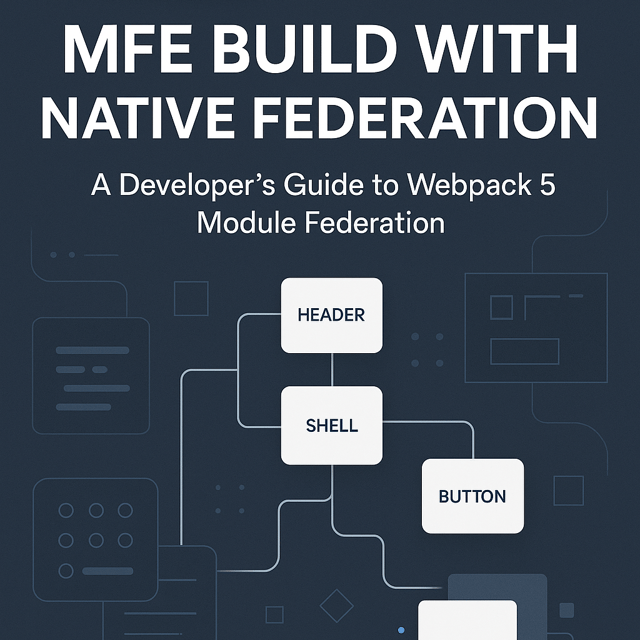
How do I build micro frontends with Angular and native federation?
Native Federation uses standard browser capabilities like ECMAScript modules and import maps instead of relying on webpack, which makes it the recommended approach for modern Angular projects using esbuild. You set up a host and remotes, add the native federation configuration to each project, expose and load remote components at runtime, and mark shared dependencies as singletons. Each micro app can then be built and deployed independently — this is exactly the workflow covered in most Angular micro frontend guides and ebooks.
How do I build micro frontends in React?
The most common approach is webpack 5 Module Federation, where a host application loads remote components exposed by separately deployed React apps, with react and react-dom shared as singletons. Alternatives include single-spa for framework-agnostic composition, or simpler iframe/web-component wrappers for isolation. Focus on shared state strategy, version alignment of common libraries, and independent CI/CD pipelines for each app.
What is a mock interview?
A mock interview is a practice session that simulates a real job interview — same question style, format, and pressure — followed by honest feedback on your answers and communication. It can be conducted by a mentor, a peer, or an AI tool. The goal is to find gaps in your technical explanations and delivery before a real interviewer finds them, which is especially valuable for freshers facing their first interviews.
How to mock interview with AI?
You can use tools like ChatGPT by pasting a job description along with your resume and asking it to act as the interviewer, asking one question at a time and rating your answers afterward. It works well for rehearsing explanations, DSA reasoning, and HR questions cheaply and repeatedly. The limitation is that AI can't fully replicate real interviewer pressure or company-specific nuance, so combine it with occasional human-led mock interviews.
How long does a mock interview last?
A typical mock interview lasts 30–60 minutes: technical rounds usually run 45–60 minutes, while HR or behavioral mock sessions take around 20–30 minutes. Add 10–15 minutes of feedback afterward, since the feedback is where most of the improvement happens. The best practice is to match the duration and format of the actual interview you're preparing for.
How to practice interview questions?
Study common questions for your target role first, then practice answering out loud — ideally recorded — rather than reading solutions silently. For technical roles, mix timed DSA practice, framework concepts, and system design basics, and rehearse behavioral answers using the STAR method. The fastest improvement comes from a feedback loop: attempt questions under time pressure, get critiques from a mentor or mock interview, and rework weak areas before the next round.