Testimonials
Services
SLD Handbook

HVAC System Handbook
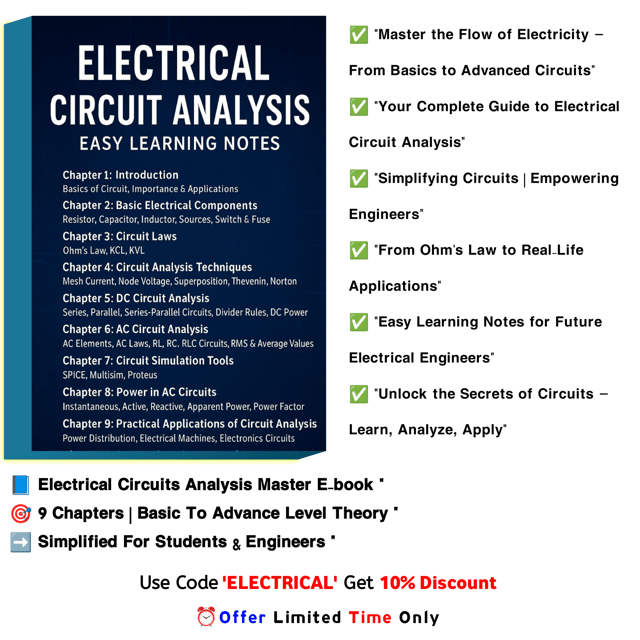
Electrical Circuits Analysis
Electrical Engineering Roadmap Series
Electrical Panel Wiring Mastery
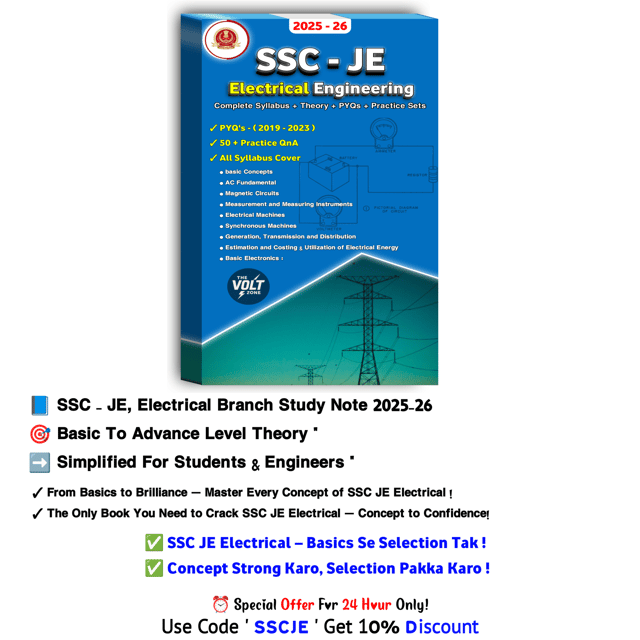
Master SSC JE Electrical – Complete Study Notes
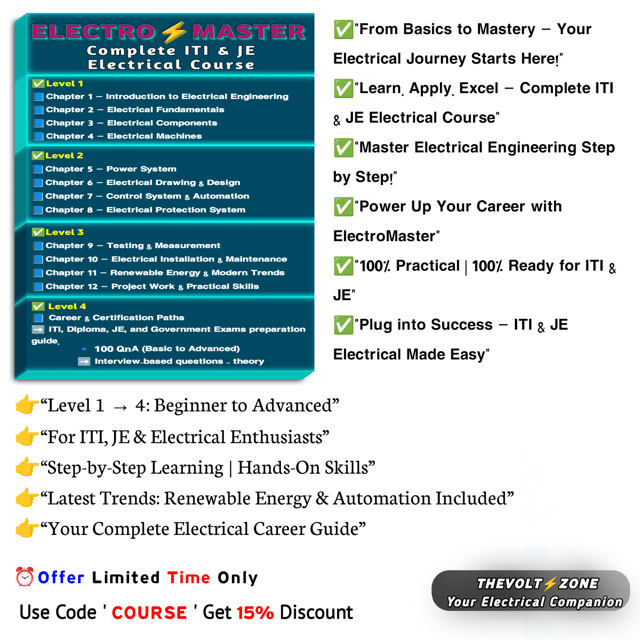
ElectroMaster: Complete ITI & JE Electrical Course
About me
- Get 30% discount Use Code - SEPTEMBER

Frequently asked questions
How to do house wiring?
Start with the fundamentals — identify the phase, neutral and earth wires, understand how supply flows from the meter through the MCB and distribution board to each point, then practise one circuit at a time: light point first, then fan, then 5A and 16A sockets. The basic house wiring materials you need for practice are 1.5 sq mm and 2.5 sq mm copper wire, switches, sockets, ceiling rose, insulation tape, tester and a screwdriver set. Always switch off the main supply before touching any wire, and learn under an experienced electrician before taking up full house wiring independently.
Is house wiring AC or DC?
House wiring in India is always AC (alternating current), supplied at 230 V and 50 Hz for single-phase domestic connections, while heavy loads like motors may run on three-phase AC. DC is not used for domestic wiring because AC voltage can be easily stepped up or down using transformers and transmitted efficiently over long distances. Appliances such as chargers and TVs internally convert this AC supply into low-voltage DC only where needed.
How do I make a house wiring diagram?
Start by drawing the floor layout and marking every light, fan, switchboard and socket point, then connect them using standard electrical symbols to show the phase, neutral and earth runs back to the distribution board. Keep lighting and power socket circuits separate and label the wire size and MCB rating on each circuit — for example, 1.5 sq mm with a 6A MCB for lights and 2.5 sq mm with a 16A MCB for sockets. The fastest way to learn is to study ready-made house wiring diagram layouts and then redraw them yourself.
Which house wiring wire size should I use?
For a typical Indian home, 1.5 sq mm copper wire is used for light and fan circuits, 2.5 sq mm for 6A socket circuits running TVs and mixers, 4 sq mm for 16A points like air conditioners and geysers, and 6 sq mm or above for the main line depending on total load. Always match the house wiring wire size with a correctly rated MCB so the cable never carries more current than it can safely handle. Copper is preferred over aluminium because it carries higher current with less heating.
How to connect a light switch in house wiring?
In a standard one-way connection, the phase wire from the supply is connected to one terminal of the switch and the wire going to the bulb holder is connected to the other terminal, so the switch makes and breaks the phase wire. The neutral runs directly to the bulb holder, and the earth, where provided, goes to the holder's earth terminal. Never wire a switch into the neutral line — the circuit then remains live even when the switch is off, which is a serious shock hazard.
Where can I find a good house wiring PDF?
Look for a house wiring PDF that explains every circuit with simple diagrams — light and fan circuits, two-way switching, staircase wiring, godown wiring and distribution board wiring — in easy language rather than heavy theory. Affordable wiring notes written in simple Hindi-English by experienced electrical engineers, such as those available on Topmate, are far easier for freshers and ITI students to follow than standard textbooks. Be careful with random free downloads, as many contain outdated or unsafe practices.
How to learn electrical basics from scratch?
Begin with the core concepts — voltage, current, resistance, Ohm's law, AC vs DC, series and parallel circuits, and basic safety rules — then move to practical skills like using a multimeter, identifying wires and reading a single-line diagram. Study daily from one structured source instead of jumping between random videos; a good electrical basics course or ebook in simple language keeps your learning in the right sequence. Finally, apply each concept on a small practice board or under supervision, because electrical is a skill-based subject, not just theory.
What is basic electrical engineering?
Basic electrical engineering is the foundation subject of the field, covering fundamental electrical concepts such as Ohm's law, Kirchhoff's laws, series and parallel circuits, AC fundamentals, electromagnetism, DC machines, transformers and measuring instruments. It is the first subject taught in engineering, diploma and ITI courses because every advanced topic — machines, power systems, panel wiring and protection — builds on it. Once this subject is clear, the rest of electrical engineering becomes much easier to understand.
Which electrical basics book is best for beginners?
The right electrical basics book is one that explains concepts in very simple language with diagrams and practical examples instead of dense university-style theory. For electrical basics for beginners, choose a book that covers circuits, AC/DC fundamentals, wiring, safety and machines step by step — ITI and diploma-level books, or easy-language ebooks written by practising engineers, work much better at the start than thick reference texts. If English-heavy books feel difficult, bilingual Hindi-English material helps concepts settle faster.
Where can I download electrical basics PDF notes?
Pick electrical basics PDF notes that present theory in short points with diagrams and also include electrical basics questions for practice after each topic, since that combination works best for interviews and exams. Simple Hindi-English notes written by experienced engineers are available affordably on platforms like Topmate and are easier for freshers to follow than standard textbooks. Check a sample page or review first to confirm the depth and language match your level.
How to crack SSC JE electrical in first attempt?
To crack SSC JE electrical in first attempt, follow one fixed cycle — complete the syllabus topic-wise, solve previous year papers to learn the question pattern, and then attempt full-length mocks under timed exam conditions. Give extra revision time to high-weightage areas like basic electrical, electrical machines, power systems and measurement. Prepare reasoning and general awareness weekly alongside technical subjects, because the non-technical part of Paper 1 decides many selections.
What is the syllabus for SSC JE electrical?
The exam has two papers: Paper 1 covers General Intelligence & Reasoning, General Awareness and General Engineering (with the electrical section), while Paper 2 is fully technical, covering electrical circuits, machines, power systems, utilisation, estimation and basic electronics. The technical portion closely follows the diploma-level electrical curriculum, so transformers, induction motors, synchronous machines, transmission and distribution carry strong weightage. Always download the latest official syllabus PDF from the current year's notification before planning your preparation, as small changes happen year to year.
Which SSC JE electrical book should I study from?
Instead of relying on one thick SSC JE electrical book, most successful candidates combine a standard theory book for each subject with previous year papers and short revision notes. Concise, well-organised notes in simple language are especially effective if you are preparing alongside a job or college, since they save valuable revision time. Whatever you choose, make sure it matches the latest exam pattern and includes objective practice questions after every chapter.
How useful are SSC JE electrical PYQ papers?
SSC JE electrical PYQ papers are the most valuable resource in preparation because question patterns and core concepts repeat every year, and they show exactly how a theory topic is twisted into an objective question. Solve at least the last 8–10 years of papers — first subject-wise to build concepts, then as timed full mocks to build speed. Maintain an error notebook from every paper so your final revision focuses only on weak areas.
What is the work of an SSC JE electrical?
An SSC JE electrical works in central government departments such as CPWD, MES and BRO, handling planning, supervision and maintenance of electrical installations — preparing estimates and drawings, checking quality of work, verifying materials and managing the site team. It is a Group 'B' technical post with structured career growth. The SSC JE electrical salary is fixed at Pay Level 6 of the 7th Pay Commission with a basic pay of ₹35,400, so total monthly in-hand pay generally comes to around ₹45,000–₹60,000 depending on the posting city and allowances.