Testimonials
Services
Think like a PM To Become a PM
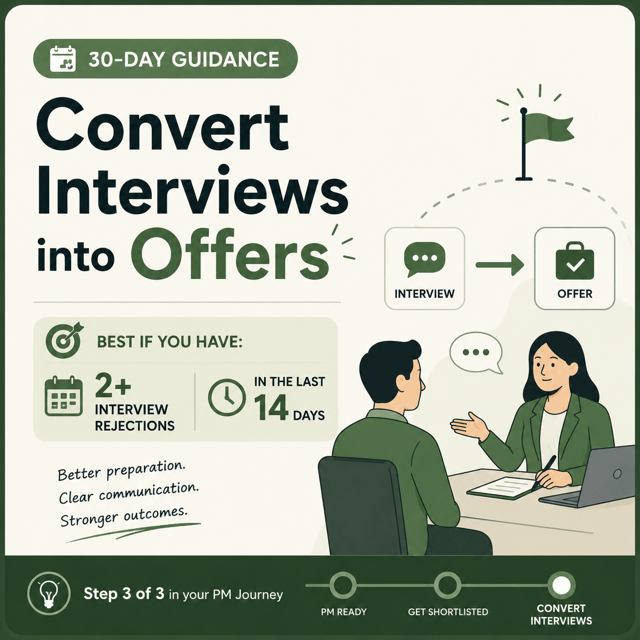
30-Days Guidance: Convert Interviews into Offers
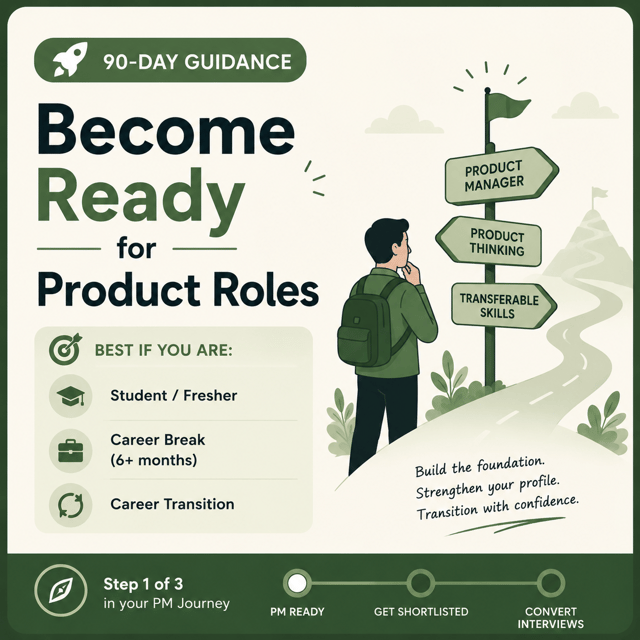
90-Days Guidance: To Become Ready for PM Roles
Why Am I Not Getting Shortlists?
How Do I Prepare for My Interview?
How Do I Start My Prep for PM Roles?
60-Day Access: Premium Dashboard for Product Roles
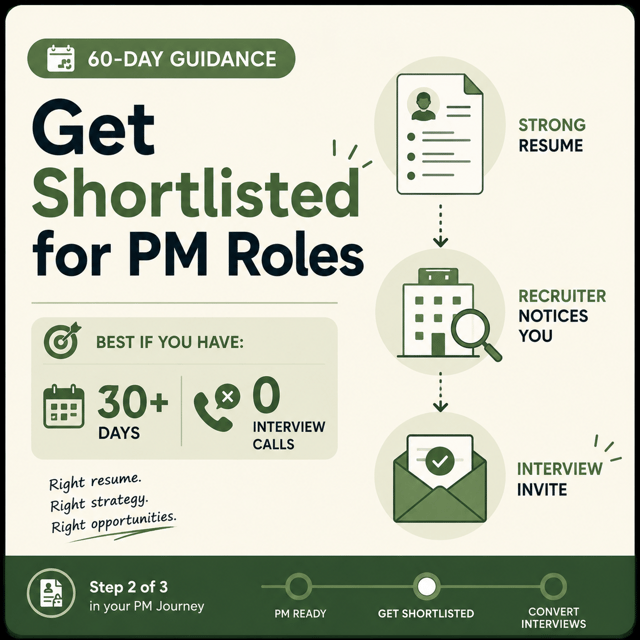
60-Days Guidance: Get Shortlisted for PM Roles
Why Is My Interview Not Going Well?
Should I Continue My PM Journey?
How Do I Write My Resume Pointers?
About me
- Find the right next step for your PM journeyhttps://thefintechpms.com/aspiringpm

Frequently asked questions
How do I prepare for a product management interview?
The smartest way to think about how to prepare for a product management interview is to work backwards from the rounds: product sense and case studies, guesstimates, execution and metrics, and behavioral. Study two or three products deeply (preferably from the companies you are targeting), practise structuring answers out loud, and build a small set of reusable frameworks instead of collecting dozens of resources. Schedule mock interviews in the final weeks so you get feedback on communication, not just content. Six to eight weeks of consistent, focused preparation usually beats last-minute cramming.
How do I crack a product manager interview?
Most guides on how to crack a product manager interview overemphasise frameworks, but what actually separates candidates is clarity of thinking. Interviewers want to see you clarify the problem, identify the right user and pain point, prioritise instead of listing everything, and defend your trade-offs when challenged. Practise with real case prompts, review interview experiences of your target companies, and improve one weak area at a time. Treating every answer as a mini product decision — user, problem, solution, metric — is the habit that converts interviews into offers.
How do I answer product management interview questions?
Learning how to answer product management interview questions starts with structure, not memorised content. A reliable pattern is: restate the question and confirm scope, define the target user and the problem, explore options with trade-offs, commit to a recommendation, and close with success metrics. Never jump straight to a solution — the thinking process is what is being scored. For behavioral questions, keep answers to about two minutes using a situation–action–result format.
What is a product manager interview like?
If you are wondering what is a product manager interview like, expect a collaborative problem-solving conversation rather than a formal Q&A. A typical process has three to five rounds: a recruiter or hiring manager screen, one or two product case rounds, possibly a guesstimate or analytics round, and a behavioral round. You may be asked to improve a familiar app, estimate a market size, or debate a product decision you have made. Interviewers deliberately push back on your answers to see how you handle feedback and defend or revise your assumptions.
What are the common product management interview questions for freshers?
The product management interview questions for freshers usually test potential rather than experience. Expect prompts like "Design a product for college students," "How would you improve a popular app you use daily?" "Estimate the number of food orders in a day in your city," and "Why do you want to move into product management?" Freshers are also probed on how they think about users and trade-offs with no prior PM role. Practising fifteen to twenty such questions aloud with a fixed structure is far more effective than reading answer PDFs.
How do I write a product manager resume?
If you are unsure how to write a product manager resume, treat it like a product: the resume is the product, the recruiter is the user, and the interview is the conversion goal. Lead with a crisp summary, write impact-driven bullets in a problem–action–result format with numbers, and include a compact skills section covering domains and tools relevant to PM roles. Cut responsibilities that show no ownership or measurable outcome. Keep it to one page, or two pages if you have eight-plus years of experience.
What should a product manager resume look like?
The clearest answer to what should a product manager resume look like is: one page, reverse-chronological, with a short summary, quantified achievement bullets, a focused skills section, and links to your LinkedIn or portfolio. Each bullet should show scope (users, revenue, scale) and outcome (adoption, conversion, efficiency gains). Avoid tables, photos, graphics, and long paragraphs, because both ATS parsing and a six-second recruiter scan decide whether you get shortlisted.
How is a product manager resume for freshers different from an experienced PM's resume?
A product manager resume for freshers is judged on potential, not on PM job titles, so it must showcase evidence of product thinking from elsewhere. Internships, college projects, case competitions, hackathons, and side projects all count if you frame them around a user problem, a solution you proposed, and a result you measured. Even non-PM work experience can be reframed around prioritisation, user research, and impact. Experienced PM resumes lean on business metrics and product outcomes; fresher resumes must prove structured thinking and ownership instead.
How do I tailor a product manager resume for India-based companies?
A product manager resume for India follows mostly global norms — one page, reverse chronological, metrics-heavy bullets — but a few local touches help. Use clean, standard section headings that ATS platforms parse easily, and skip photos, date of birth, and full addresses. Highlight familiarity with the Indian digital ecosystem such as UPI, e-commerce, lending, or edtech when it is relevant to the role, and quantify scale in terms Indian hiring managers recognise, like monthly active users or transactions. Keep your LinkedIn profile consistent with your resume, since Indian recruiters almost always cross-check it.
How do I solve a product case study?
Knowing how to solve a product case study comes down to following a disciplined flow instead of racing to features. Start by clarifying the goal and constraints, define the target users and their top pain points, narrow down to the most critical problem, generate solution options with trade-offs, recommend one, and finish with success metrics and risks. Say your structure out loud so the interviewer can follow your reasoning. Practising ten to fifteen varied prompts with this flow makes it second nature under pressure.
How do I answer product case study questions when I am stuck in the interview?
The difference between candidates who know how to answer product case study questions and those who freeze is visible communication. Think aloud, check in periodically ("Should I explore another user segment, or go deeper here?"), and prioritise visibly rather than listing ten ideas. If you get stuck, return to the user and the problem statement instead of going silent — recalibrating is a PM skill interviewers actually reward. An imperfect but well-structured answer scores far higher than a brilliant one delivered in a jumble.
What is a product design case study?
A product design case study is an interview prompt that asks you to design or redesign a product or feature — for example, "Design a split-bill feature for a UPI app" or "Design a fitness app for elderly users." Unlike strategy or guesstimate cases, it focuses on user needs, core user flows, feature prioritisation, and success metrics. The evaluation is less about the final idea and more about how logically you move from the user problem to the solution. Practising eight to ten design prompts with a consistent structure is the fastest way to improve.
Which product case study framework should I use in interviews?
A product case study framework is scaffolding, not a script, so pick one flexible structure and adapt it to any prompt. A dependable one is: clarify the goal → define users and segments → identify pain points → prioritise the core problem → propose solutions with trade-offs → recommend one → define success metrics and risks. Interviewers can immediately tell when a framework is being recited, so tie every step back to the specific prompt you were given. Mastering one flexible structure beats juggling five.
What are some good product case study examples to practise with?
Working through real product case study examples is the most effective preparation for PM interviews. Good practice prompts include "Improve the IRCTC ticket booking experience," "Reduce checkout drop-offs for an e-commerce app like Flipkart," "Design a feature that increases repeat orders on Zomato," and "How would you improve Google Pay for small merchants?" Solve them aloud first, then compare your approach with published case studies or discuss it with a peer or mentor. Rotate across fintech, e-commerce, edtech, and healthtech so no domain feels unfamiliar on interview day.
What do interviewers evaluate in a product case study interview?
In a product case study interview, interviewers evaluate structured thinking, problem clarification, user empathy, prioritisation, business sense, and communication — roughly in that order. They watch whether you ask the right questions before solving, whether your assumptions are sensible, and how you respond when they challenge a choice you made. A polished solution delivered without structure scores lower than a reasonable solution reasoned through clearly. The only reliable way to improve across all these dimensions is to practise out loud and get specific feedback on each attempt.