Testimonials
Services

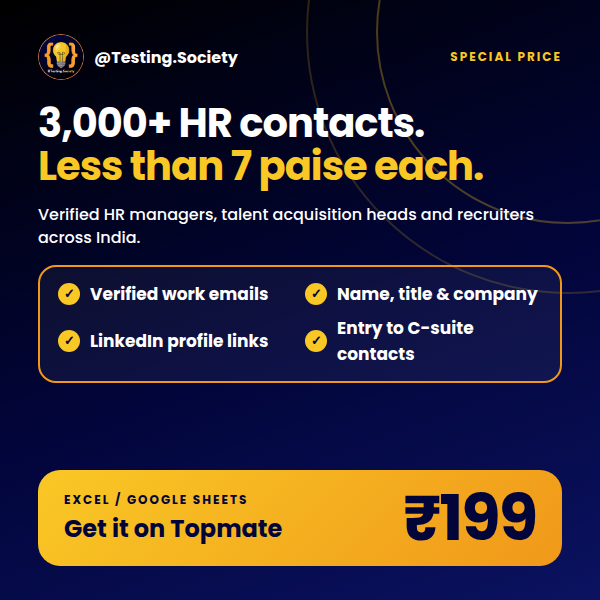
Email HR Directly: 3,000+ Verified Recruiters
Premium Material By Testing Society
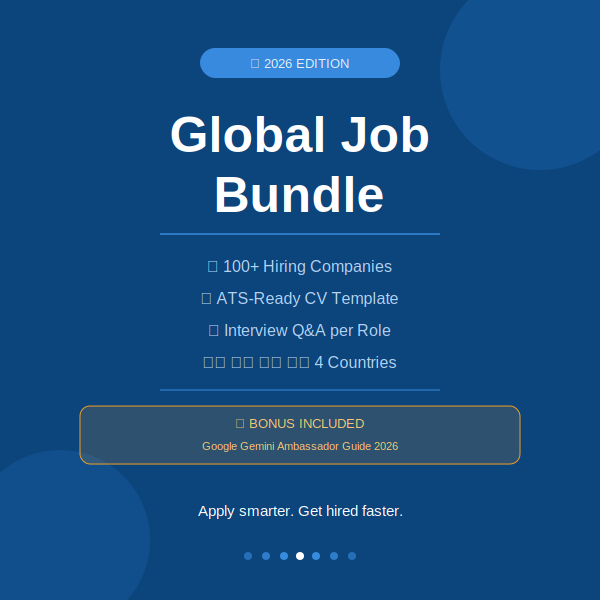
Global Job Bundle 2026 – 100+ Companies + CV
Ultimate Premium Package
Premium Group
About me
- The Testing Society excels in supporting job seekers with valuable insights and guidance, leading to successful outcomes and high user satisfaction.
 AI-generated based on testimonials
Frequently asked questions
What questions are asked in a QA interview?
Most QA interviews in India start with fundamentals: the difference between QA, QC and testing, SDLC and STLC, writing test cases and test scenarios, the defect life cycle, severity vs priority, and testing types such as smoke, sanity, regression and UAT. For automation roles, expect Java or Python coding questions, Selenium concepts, framework questions and basic SQL. Interviews usually end with scenario questions like "How would you test a login page?" or "What would you do if a bug is not reproducible?"
What are testing interview questions for manual testing roles?
Manual testing interviews focus on test case design techniques such as boundary value analysis and equivalence partitioning, the difference between a test plan and a test strategy, bug report writing, defect triage, compatibility and exploratory testing. Many companies in India now also ask manual testers basic SQL queries and API testing questions, so it helps to prepare those even for non-automation roles.
Where can I get QA interview questions and answers with practical examples?
You can prepare from question banks shared by testing communities, interview experience posts and curated interview material — for example, Testing Society offers prepared interview material for testers along with daily tips. The key is to practise answering the top 40–50 questions out loud and then adapt each answer with an example from your own project, since interviewers in India quickly spot memorised answers.
What are the most common QA interview questions for freshers?
Freshers are usually asked: what is software testing and why is it needed, verification vs validation, test case vs test scenario, black box vs white box testing, the bug life cycle, priority vs severity, and what a good bug report contains. For automation trainee roles, there may be simple Java or Python programs like reversing a string or swapping two numbers. Also prepare "Why did you choose QA?" and carry a small project or practice test suite to show initiative.
How are QA interview questions and answers for experienced testers different from freshers?
For experienced testers, interviewers go beyond definitions into real project depth: how you designed or improved your automation framework, handling flaky test failures, API testing with Postman or Rest Assured, database validation using SQL, CI/CD integration, BDD with Cucumber, and how you estimated testing effort under release pressure. Your answers should be structured around actual situations you handled, with measurable results.
What are the most common QA interview questions for 3 years of experience?
At around 3 years, expect a blend of manual and automation: Java OOPs and collections, Selenium locators and waits, TestNG annotations, handling dropdowns, frames and windows, Postman basics, SQL joins, Git and Maven, plus a detailed walk-through of your framework and your specific contribution to it. Interviewers often ask how you debugged an intermittent test failure or handled a missed defect, so keep two or three such stories ready.
How do I prepare for QA interview questions and answers for 5 years of experience?
At the 5-year level, interviews test architecture and leadership: designing a framework from scratch (hybrid, data-driven or BDD), tool selection trade-offs, parallel and cross-browser execution, Jenkins or Azure DevOps integration, reporting, test strategy, estimation and mentoring juniors. Prepare a one-page architecture diagram of your framework, quantify your impact (for example, execution time or defect leakage reduced), and be ready to defend why you chose your tech stack.
How can I get a software testing job as a fresher in India?
Build strong manual testing fundamentals, learn one automation stack (Java with Selenium or Python with PyTest), practise writing test cases for everyday apps, and complete two or three small projects. Create an ATS-friendly resume, apply to openings daily through job portals, and join tester communities for referrals — Testing Society, for instance, shares daily job openings and a Global Job Bundle listing 100+ companies along with CV support. Consistency in applications combined with referral outreach usually makes the difference.
How do I switch from manual testing to automation testing?
Start with one programming language — Java or Python — and get comfortable writing small programs before touching tools. Then learn Selenium or Playwright, TestNG or PyTest, API automation with Rest Assured, and Git with basic CI concepts. Build a small framework around a live website and, if possible, automate a few scenarios in your current project so you can discuss real implementation in interviews. Most automation interviews in India include a live coding or framework discussion round, so practise that in advance.
How do I find the latest software testing job openings in India?
Set daily alerts on LinkedIn and Naukri, check the career pages of IT services and product companies regularly, and follow testing communities that post verified openings — Testing Society, for example, posts daily job openings for testers across experience levels. Always read the experience requirement before applying, since many posted openings target senior testers, and tailor your resume to each job description to improve your shortlist chances.