Testimonials
Services
Azure Data factory 500 interview questions only
Azure Data factory 500 interview questions&answers
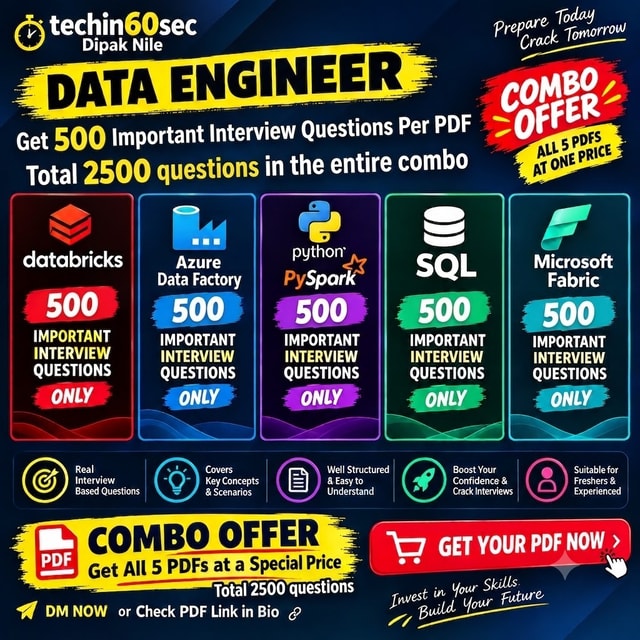
2500 Data engineer interview questions only combo
Databricks optimization techniques with Q &A
Databricks Master interview book
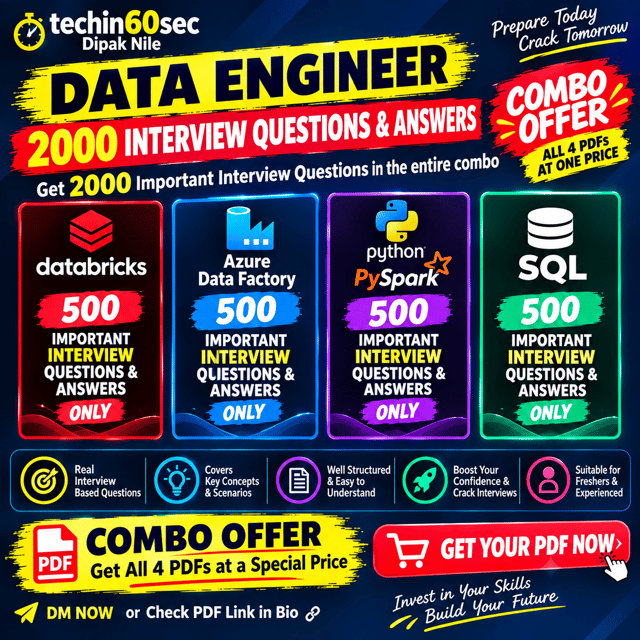
Data engineer 2000 v.imp int questions and answers
Frequently asked questions
How to crack a data engineer interview?
Most data engineer interviews in India test five core areas: advanced SQL (joins, window functions, query optimisation), Python, Apache Spark or Databricks, data modelling and warehousing concepts, and at least one cloud platform like Azure or AWS. Build one or two end-to-end pipeline projects you can explain in depth, because interviewers dig deep into the decisions you made. If you are unsure how to prepare for a data engineer interview, work backwards from the job description — master the tools mentioned there first, then practise explaining your projects in a structured way: problem, architecture, your role, and the outcome.
What are the most common data engineer interview questions and answers?
The most frequently asked data engineer interview questions and answers revolve around SQL scenarios (finding duplicates, second-highest salary, deduplication), Spark transformations vs actions, batch vs streaming processing, structured vs semi-structured data, star schema design, and tool-specific topics like ADF pipelines or Delta Lake. For each one, interviewers expect a definition, a real example, and a trade-off. Prepare every answer in this three-part structure and practise saying it out loud instead of only reading it.
What are the common data engineer interview questions for 10 years experience?
At the 10-year level, questions shift from coding syntax to architecture and leadership. Expect design questions like building a petabyte-scale lakehouse, handling late-arriving data, cost optimisation of cloud pipelines, choosing between Databricks, Snowflake or Synapse, CDC strategies, and migrating legacy ETL to the cloud. Also prepare for questions on mentoring, on-call incident handling and stakeholder communication, since senior roles are judged on judgement and ownership as much as technical depth.
Why do you want to be a data engineer?
Interviewers ask this to check genuine motivation, so avoid generic lines like "I love data". A strong answer connects three things: what draws you to the field (building the pipelines that make raw data usable), what you enjoy in the day-to-day work (SQL, automation, performance tuning, solving scale problems), and where you want to grow, such as mastering Databricks or streaming systems. Tie it to the company's data maturity or tech stack so the answer sounds specific rather than rehearsed.
What is the data engineer salary in India?
Salaries vary widely by city, company and stack, but indicative ranges are roughly ₹4–8 LPA for freshers, ₹10–18 LPA at 3–5 years, and ₹20–40 LPA for senior engineers with 8–10+ years, with product companies and GCCs often paying more. Skills in Databricks, Spark, Azure or AWS and streaming usually push offers toward the upper end of the band. Treat these as ballpark figures and cross-check current openings for your exact experience level.
What is Databricks in simple terms?
Databricks is a cloud platform where teams store, process and analyse very large volumes of data in one place. Think of it as a single workspace that combines a data lake (cheap storage for raw data) with a data warehouse (fast querying) — often called a "lakehouse". It is built on Apache Spark, so it handles huge batch and real-time workloads, and it also supports machine learning and dashboards. For a data engineer, it is mainly used to build, schedule and optimise ETL pipelines using notebooks, Delta Lake tables and workflow jobs.
What are the common Databricks interview questions for experienced professionals?
For experienced candidates, expect questions on Delta Lake internals (ACID transactions, time travel, OPTIMIZE and Z-ordering), Spark performance tuning (partitioning, skew handling, broadcast joins, caching), medallion architecture design, structured streaming, Unity Catalog governance, and orchestration with Databricks Workflows. Interviewers usually frame these as "how did you solve X in your project", so prepare two or three real optimisation stories with measurable results, such as reduced pipeline runtime or compute cost.
What are the most common Databricks interview questions for freshers?
Freshers are usually tested on fundamentals: what Databricks is, the difference between a data lake, warehouse and lakehouse, RDDs vs DataFrames, transformations vs actions, Delta Lake basics, cluster types, and simple PySpark or SQL coding tasks. You are not expected to know advanced tuning, so focus on one small end-to-end project — ingest, clean, aggregate, visualise — and be able to explain every step. Clear basics plus one well-explained project beats scattered knowledge.
How do I prepare for scenario-based Databricks interview questions?
Scenario-based Databricks interview questions test how you design and fix real pipelines, so practise problems like handling late-arriving files with Autoloader, incremental processing with change data feed and MERGE, fixing data skew, recovering failed jobs, and choosing partitioning strategies. Answer in a fixed pattern: clarify requirements, propose the architecture, explain the approach step by step, then mention trade-offs and monitoring. Rebuilding a small sample pipeline yourself and deliberately breaking and fixing it is the fastest way to build confidence.
What is Azure Data Factory and how does it work?
Azure Data Factory (ADF) is Microsoft's cloud-based ETL and orchestration service used to move and transform data at scale. It works through pipelines, which are logical groups of activities; each activity can copy data from a source using linked services and datasets, transform it with Mapping Data Flows, or call external compute like Databricks. Integration runtimes provide the connectivity and compute, and triggers schedule pipelines on time, tumbling-window or event-based schedules. In most architectures, ADF orchestrates the movement of data into storage such as ADLS Gen2, while engines like Databricks handle heavy transformation.
How to learn Azure Data Factory as a beginner?
The quickest path is hands-on: create a free Azure account and follow a structured Azure Data Factory tutorial that walks you through building your first copy pipeline. Then progress to Mapping Data Flows, parameters, ForEach looping, event-based triggers, and connecting ADF to Databricks or Synapse. Build two or three small real-world pipelines — for example, daily file ingestion into ADLS with incremental loading — since both ADF interviews and real project work revolve around practical pipeline design rather than theory.
Azure Data Factory vs Databricks: which should you learn first?
They solve different problems, so it depends on your goal. Azure Data Factory is primarily an orchestration and data movement tool, ideal for pipelines that pull data from multiple sources on a schedule, while Databricks is a Spark-based lakehouse engine for large-scale transformation, streaming and machine learning. If you are starting out, learn ADF basics first since it needs less coding, then move to Databricks and PySpark — most real projects use both together, and job descriptions in India commonly list the combination.
What are the most asked Azure Data Factory interview questions?
The most common Azure Data Factory interview questions cover integration runtime types (Azure, self-hosted, SSIS), pipeline vs activity vs trigger, linked services vs datasets, Copy activity vs Mapping Data Flows, tumbling window vs schedule vs event triggers, and scenario questions on incremental loading or handling pipeline failures. Practise explaining one complete pipeline you have built end to end, because interviewers typically move from definitions to "how would you design this" within minutes.
Is the Azure Data Factory certification worth it for data engineers?
There is no standalone Azure Data Factory certification — ADF skills are tested within Microsoft's broader data engineer certification exams. Pursuing one is worthwhile if you are early in your career or switching into data engineering, because it forces structured learning and helps your resume clear HR filters. That said, hiring managers in India weigh hands-on pipeline experience and project depth above certificates, so treat certification as a supplement to real practice, not a substitute.
What is the medallion architecture in Databricks?
The medallion architecture, also called the multi-hop architecture, organises a lakehouse into three layers of Delta tables: Bronze holds raw, unprocessed data exactly as ingested; Silver stores cleansed, deduplicated and conformed data; Gold contains business-level aggregates ready for dashboards and machine learning. It improves data quality, traceability and incremental processing, and lets different teams consume data at the right level of refinement. It is one of the most frequently asked design topics in Databricks interviews, so be ready to sketch all three layers and explain what transformations happen between them.