Testimonials
Services
Top 100 Java Interview Questions
55 Java DSA + Stream API Interview Guide
Stop Preparing Randomly for Java Interviews
Stop Getting Ignored: Get More Interview Calls
23 Design Patterns + Java Interview PDF
Mock interview
Discovery Call
Java Backend Interview Mastery Guide
90 Spring Boot JPA & Hibernate Interview Guide
Quick chat
Java Developer Job Switch Blueprint
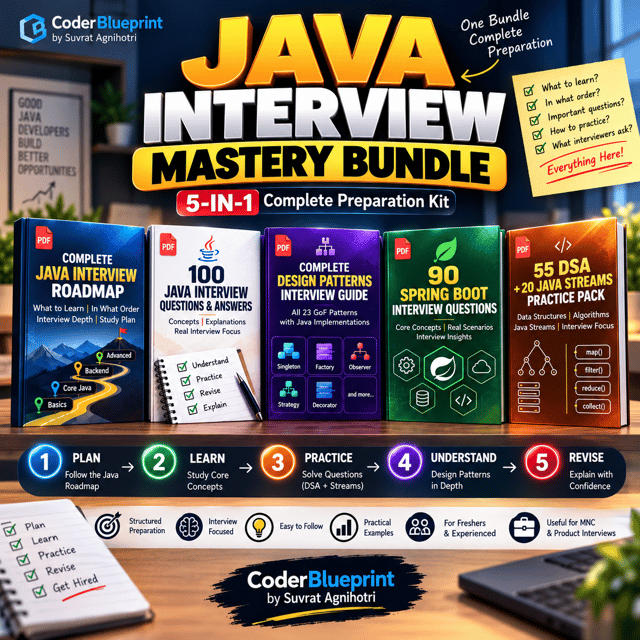
Java Interview Bundle: Roadmap + 100 Qs
Mock Interview + Java Bundle: Roadmap + 100 Qs
About me
Frequently asked questions
What are the most commonly asked Java interview questions for freshers?
Java interview questions for freshers mostly cover OOP concepts (inheritance, polymorphism, abstraction, encapsulation), String handling and immutability, Collections such as ArrayList vs LinkedList and how HashMap works internally, exception handling, access modifiers, and basic multithreading. Interviewers also give small coding tasks like reversing a string, checking for palindromes, or finding duplicate elements. Since follow-up questions always go one level deeper, it is better to understand the reasoning behind each concept instead of memorising definitions.
Can I crack a Java interview by just memorizing Java interview questions and answers?
Memorising Java interview questions and answers helps only in the first few minutes of an interview. In India especially, interviewers quickly move to project deep-dives, "why did you choose X over Y" questions, and live coding, where prepared answers fall apart. A stronger strategy is to pick one good question bank, learn the concept behind every answer, practise explaining solutions out loud, and then test yourself in a mock interview so you can handle unexpected follow-ups confidently.
How are Java interview questions for 5 years of experience different from fresher interviews?
Java interview questions for 5 years of experience shift from definitions to depth and judgement. Expect JVM internals and performance tuning, concurrency (thread pools, volatile, ConcurrentHashMap), Spring and Spring Boot internals like bean lifecycle and auto-configuration, microservices patterns with Kafka, database design decisions, and at least one low-level design or system design round. Interviewers also probe your own projects heavily, so be ready to justify every technology choice you made.
What are the most asked Spring Boot microservices interview questions?
The most common Spring Boot microservices interview questions include: why use microservices instead of a monolith, how services communicate, what an API gateway and service registry do, the database-per-service pattern, handling distributed transactions with saga or outbox patterns, circuit breakers and fault tolerance, and how Kafka enables event-driven communication. Scenario questions like "one service is down and the entire flow is failing — what do you do?" are also very frequent, so prepare a real project story around these topics.
What is Spring Boot microservices architecture?
Spring Boot microservices architecture is a way of building an application as a set of small, independently deployable services, each created with Spring Boot and responsible for one business capability with its own database. The services interact through REST APIs or messaging tools like Kafka, while an API gateway, service registry, and centralized configuration handle routing, discovery, and settings. Teams prefer it when different modules need to scale and release independently, though it adds complexity around deployment, monitoring, and data consistency.
What is an API gateway in Spring Boot microservices?
An API gateway in Spring Boot microservices is a single entry point placed in front of all services. Clients call the gateway instead of individual microservices, and it routes each request to the correct service while also handling cross-cutting concerns like authentication, rate limiting, logging, and SSL termination. In the Spring ecosystem this is typically implemented with Spring Cloud Gateway, which keeps these concerns out of individual services so each one stays focused on its business logic.
How to scale Spring Boot microservices?
First keep every service stateless so multiple instances can run behind a load balancer. Then scale horizontally with Docker and Kubernetes or AWS autoscaling groups, add read replicas or sharding for the database, use Redis-style caching to reduce repeated queries, and increase Kafka partitions so consumer services can scale independently. Since each microservice scales on its own, you size capacity per service based on its actual traffic instead of scaling the entire application.
How to deploy Spring Boot microservices in AWS?
The standard approach is to containerize each service with Docker and run it on Amazon ECS or EKS, with an Application Load Balancer routing traffic to each service. Around that, you typically use Amazon RDS for databases, ElastiCache for Redis, MSK for Kafka, Secrets Manager for credentials, and a CI/CD pipeline such as GitHub Actions or CodePipeline to build and roll out images automatically. For smaller setups, deploying the JAR directly on EC2 behind a load balancer is a perfectly fine starting point.
How to create a Spring Boot microservices project from scratch?
Start with two small Spring Boot services that each own one domain, such as order and payment, and give each its own database. Connect them with synchronous REST calls (WebClient or OpenFeign) and asynchronous Kafka events, then add Spring Cloud Gateway, Eureka for service discovery, and Docker Compose so the whole setup runs with a single command. Before finalising your structure, study a well-documented Spring Boot microservices project on GitHub to see how real codebases organise modules, error handling, and inter-service communication, then build your own version with those practices.
What is the best way to start learning Spring Boot microservices?
Get comfortable with plain Spring Boot first — REST APIs, Spring Data JPA, validation, and exception handling — because microservices are built on those fundamentals. Next, learn Spring Cloud building blocks like Eureka, Spring Cloud Gateway, and Config Server, then bring in Kafka and Docker one at a time. Following one structured Spring Boot microservices tutorial end to end and then modifying or extending that project yourself teaches far more than jumping between random videos.
How does communication happen between Spring Boot microservices?
Spring Boot microservices communication happens in two main ways: synchronously through REST calls using WebClient, RestTemplate, or OpenFeign, and asynchronously through a message broker like Kafka or RabbitMQ. Synchronous calls are simple but create tight coupling, so teams use asynchronous events when one service should notify others without waiting for a response. Most real systems use a mix of both, chosen based on whether the caller needs an immediate answer.
How to prepare for a system design interview?
Build fundamentals first — load balancing, caching, SQL vs NoSQL, indexing, sharding, replication, message queues, and consistency trade-offs. Then learn a repeatable framework: clarify requirements, estimate scale, define the API, sketch the high-level design, and deep-dive into bottlenecks. Practise this on classic problems like a URL shortener, rate limiter, chat app, or a food delivery system similar to Swiggy or Zomato, and rehearse explaining your design out loud, because communication matters as much as the solution in a system design interview.
How to practice for a system design interview without real-world experience?
Treat practice as simulation: pick a well-known system — URL shortener, WhatsApp, BookMyShow, or an IRCTC-style ticket booking platform — and design it on paper in 40–45 minutes, covering requirements, capacity estimates, API design, and data modelling. Compare your design against reference architectures, note the gaps, and repeat with new problems. Presenting designs out loud in mock interviews with a senior engineer is the fastest way to improve, since most candidates struggle with articulation and trade-off reasoning rather than knowledge itself.
What are the most common system design interview questions?
The most frequently asked system design interview questions include designing a URL shortener, a rate limiter, a chat or messaging app, a social media news feed, a notification system, a ticket booking platform like BookMyShow, and a food delivery app. In India, interviewers often add scale-specific variations such as handling UPI payment traffic or IRCTC Tatkal booking rushes. For each problem, focus on requirements clarification, capacity estimation, database choice, caching, and how the system handles failures.
Which is better for interview preparation — Grokking the System Design Interview or the System Design Interview book by Alex Xu?
Both are excellent but suit different stages. Grokking the System Design Interview is a course built around classic problems with a simple, repeatable framework, which makes it ideal for beginners who want guided structure. The System Design Interview book by Alex Xu (Volumes 1 and 2) goes deeper into each design with detailed diagrams and trade-offs, so it works better once you know the basics. Many candidates use one to learn patterns and the other for depth, and then reinforce everything through mock interviews and by designing systems on their own.