Testimonials
Services

Mock Interviews Manual & Automation
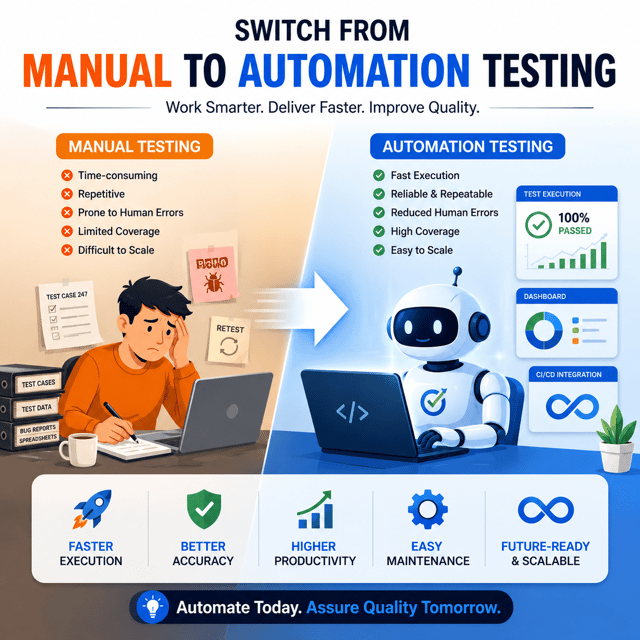
Switch From Manual Testing To Automation Guide

Resume Format (Zip File Extract and Edit)

General Discussion with Free Notes
About me
Frequently asked questions
What is automation testing in software testing?
Automation testing means using scripts and tools to execute test cases automatically instead of a tester performing every step manually. It is mainly used for repetitive checks such as regression, smoke, and data-driven testing, where running the same flows after every build is too time-consuming by hand. Teams typically build these scripts with tools like Selenium, Playwright, or Cypress using languages such as Java, Python, or TypeScript, and run them through CI tools like Jenkins.
What is the difference between automation testing and manual testing?
In manual testing, a tester executes test cases step by step and validates results themselves, which suits exploratory, usability, and one-time checks. Automation testing uses scripts that run unattended, making it far faster for large regression suites and repeated builds. The difference between automation testing and manual testing comes down to speed, coverage, and repeatability rather than one replacing the other — most mature teams use a healthy mix of both.
How to learn automation testing as a manual tester?
Start with one programming language — Java, Python, or JavaScript — then pick a tool like Selenium or Playwright and practice locators, waits, and basic scripts. Following one structured Selenium WebDriver tutorial end to end works better than jumping between random videos. After that, learn a test runner like TestNG or JUnit, Git for version control, and Jenkins for CI/CD, and convert real test cases from your current manual project into automated scripts — that practical portfolio is what interviewers actually value.
Do I need to join automation testing courses to switch from manual testing?
Not necessarily. Automation testing courses help with structure and accountability, but many testers switch successfully through self-study, official documentation, and consistent practice on real scenarios. What actually decides the switch is hands-on framework-building experience, feedback on your code, and interview readiness. If you learn better with guidance, a mentor-led or short focused course works well; if you are self-driven, a clear roadmap plus daily practice is enough.
Which automation testing tools should I learn first?
In India, Selenium with Java remains the most demanded combination in job descriptions, so it is the safest first choice. Playwright and Cypress are growing rapidly for modern web applications and are worth adding next. Along with the tool itself, learn a runner like TestNG or JUnit, Git for version control, and Jenkins basics, because employers want end-to-end capability rather than tool knowledge alone.
How to install Selenium WebDriver?
You do not install Selenium WebDriver as a single program — you add the language bindings and a matching browser driver. For Java, create a Maven project and add the Selenium WebDriver Maven dependency to your pom.xml; for Python, run pip install selenium. Recent Selenium versions include Selenium Manager, which automatically downloads the correct ChromeDriver or GeckoDriver for you. Verify the setup with a small script that opens a browser and navigates to a website.
What is Selenium WebDriver used for?
Selenium WebDriver is used to automate real browsers — opening pages, clicking buttons, filling forms, and verifying results exactly the way a user would. Teams rely on it for cross-browser testing on Chrome, Firefox, and Edge, building regression and smoke suites, and data-driven validation of web applications. It plugs into frameworks like TestNG or JUnit and integrates with Jenkins so the suite runs automatically on every build.
How does Selenium WebDriver architecture work?
Since Selenium 4, WebDriver follows the W3C protocol. Your test script uses client libraries in Java, Python, or JavaScript, and each command travels as an HTTP request to the browser driver, such as ChromeDriver, which then controls the real browser natively and returns the response. Every session gets a unique session ID, and the script–driver–browser layering is exactly what interviewers expect you to explain when asked about Selenium WebDriver architecture.
Which automation testing practice websites are best for hands-on learning?
Demo applications that imitate real products work best — sites with e-commerce flows, login forms, dynamic tables, alerts, and iflets let you rehearse the exact scenarios interviews test. Popular examples include SauceDemo, AutomationExercise, and OrangeHRM demo instances. Use automation testing practice websites to build a small Page Object Model framework, then extend it with reporting and data-driven tests so the same project doubles as a portfolio piece on your resume.
How to automate testing with AI?
AI is changing automation in two ways: script generation and maintenance. Tools like TestRigor let you write tests in plain English, AI assistants help generate Selenium or Playwright scripts and test data, and self-healing locators reduce breakage when the UI changes. RPA tools such as UiPath extend this to business-process automation. Start by using AI to speed up script creation, but keep validating results manually — locators, waits, and framework design fundamentals still separate strong automation engineers from tool users.
How to automate API testing?
Begin by learning request methods (GET, POST, PUT, DELETE), status codes, headers, and authentication, then automate validations on response codes, body, schema, and response time. API tests are far more stable than UI tests because interfaces change less often, so they become the backbone of a reliable regression suite. Chain dependent requests, manage test data properly, and hook the suite into Jenkins so APIs are verified on every build — that combination is what teams expect from API automation.
What questions are asked in a QA interview for freshers?
Fresher rounds usually begin with manual testing fundamentals — SDLC and STLC, the bug life cycle, severity versus priority, and test design techniques like equivalence partitioning and boundary value analysis. Expect basic SQL queries, simple logic or coding questions, and scenarios such as testing a login page. Most QA interview questions for freshers also check tool awareness — Jira, Selenium basics, and API concepts — along with how clearly you explain your answers.
How do I prepare for automation testing interview questions with 5 years of experience?
At that level, QA interview questions for 5 years of experience move beyond definitions into designing frameworks from scratch, handling flaky tests, parallel execution, CI/CD integration, and code quality. Automation testing interview questions will also probe live debugging scenarios, estimation, and mentoring experience, so prepare concrete examples — regression cycles you shortened, defects your suite caught, frameworks you built. Rehearsing these stories in mock interviews makes a bigger difference than reading more question banks.
What are the most asked Selenium WebDriver interview questions?
The most common Selenium WebDriver interview questions cover locators and writing robust XPath or CSS selectors, implicit versus explicit waits, handling dropdowns, alerts, frames, and multiple windows, and the Page Object Model. Many rounds also test core Selenium WebDriver methods such as findElement, sendKeys, click, getText, and isDisplayed, plus tricky scenarios like stale element exceptions and dynamic elements. Prepare short, example-based answers from your own scripts instead of memorized definitions.
How do I prepare for automation testing jobs in Pune?
Pune employers typically expect strong Selenium skills with Java or Python, API testing basics, SQL, and Git, along with a GitHub portfolio containing at least one working framework with reporting. Tailor your resume to each job description, quantify impact such as regression time saved, and keep your LinkedIn profile active since much of the hiring happens there. Because the market moves fast, rehearsing coding rounds and framework discussions through mock interviews significantly improves your conversion rate.