Testimonials
Services
Finance Career Clarity Call
Resume Guidance
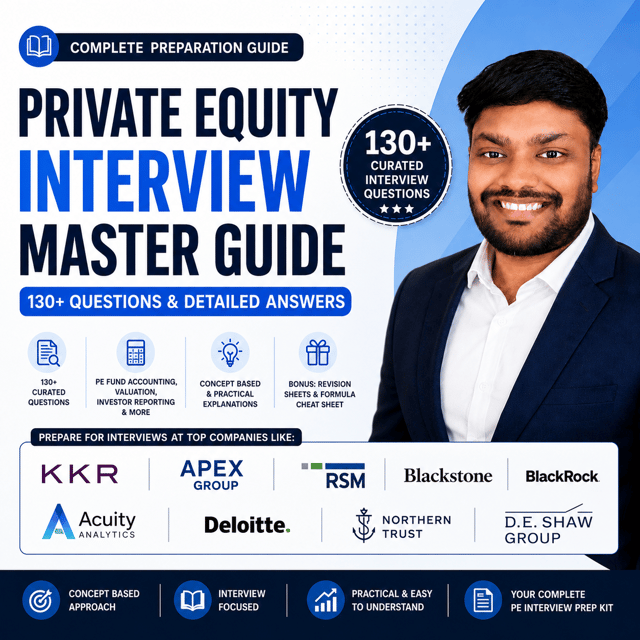
Private Equity Interview Master Guide | 130+ Q&A ⭐
Finance Career Transition & Switch Strategy
Finding jobs in finance
Interview prep & tips - Video session (Finance)
Complete Finance Roadmap Session
About me
Frequently asked questions
What is an investment banking interview like?
Most investment banking interviews in India run two to four rounds and mix technical questions with fit and HR rounds. Early rounds usually test accounting, valuation, financial modeling concepts, and market awareness, while later rounds with senior bankers focus on your story, genuine interest in deals, and cultural fit. Freshers may also face aptitude tests, guesstimates, or a group discussion before the final stage.
How to crack an investment banking interview?
The surest way to crack an investment banking interview is to master the technical core first — the three financial statements, DCF, comparable company analysis, precedent transactions, and basic LBO mechanics. Build a sharp resume story, follow live deals and market news (especially Indian transactions), and rehearse answers out loud through multiple mock interviews. Networking for referrals alongside preparation materially improves your odds, since many shortlists in India come through connections.
What are the most common investment banking interview questions?
The most common investment banking interview questions fall into four buckets: fit questions like "Tell me about yourself" and "Why investment banking"; accounting questions on the three statements and how changes flow through them; valuation questions on DCF, trading comparables, and precedent transactions; and deal or market awareness questions where you discuss a recent transaction you followed. In India, expect at least one "walk me through your resume" and often a guesstimate or brainteaser.
How to answer investment banking interview questions?
Answer with structure: give a direct headline first, then the reasoning, then a short example or number to back it up. For technical questions, walk through the logic step by step instead of jumping to the final answer, and if you do not know something, say so and reason aloud rather than guessing. Practicing answers out loud, ideally with feedback from mock interviews, matters far more than silently re-reading notes.
What are the common investment banking interview questions for freshers?
Investment banking interview questions for freshers tilt heavily toward fundamentals and trainability: the three financial statements, simple valuation (DCF and comparables), basic Excel skills, "Why investment banking?", and questions about internships, college projects, and finance coursework. Market awareness is also tested — recent IPOs, mergers, or big deals in India — so recruiters can judge genuine interest despite the lack of full-time experience. One or two self-built models help a fresher stand out quickly.
What are private equity interviews like?
Private equity interviews are usually longer and more technical than investment banking interviews, often spanning multiple rounds with associates, VPs, and partners. You will typically face LBO questions, a paper LBO or quick modeling exercise, deal discussions where you defend an investment idea, and probing fit questions about why you want to be an investor. Since most private equity roles in India hire from investment banking, consulting, or transaction advisory backgrounds, expect your prior deal experience to be examined in depth.
How to prepare for private equity interviews?
Start with the technical core — accounting, valuation methods, and especially LBO mechanics, since buyout math drives most technical rounds. Build a paper LBO routine you can run in minutes, prepare two or three deals you can discuss in depth (sector, entry multiple, returns, risks), and craft a "why private equity" story that connects your background to investing. Four to six weeks of structured private equity interview prep, combined with mock interviews, is usually enough to compete seriously.
What are the most common private equity interview questions?
The most common private equity interview questions include "Walk me through an LBO", "What makes a company a good LBO candidate?", "Why private equity?", "How would you value a company?", and a paper LBO where you estimate returns under time pressure. You will also get deal discussion questions — which company would you buy, at what multiple, and how you would generate returns — plus questions on IRR versus MOIC and how leverage affects equity returns.
What private equity interview technical questions should I expect?
Private equity interview technical questions typically cover the three financial statements, valuation methods (DCF, trading comps, precedent transactions), and LBO mechanics — entry and exit multiples, debt paydown, IRR, and MOIC — along with how leverage amplifies or destroys equity returns. Many interviews add a paper LBO or a short modeling exercise, so practice calculating returns mentally under time constraints. For India-based roles, questions on sector themes and recent buyouts are increasingly common.
How do I prepare for a private equity interview case study?
Treat a private equity interview case study as a mini investment decision: understand the business model first, then size the market, assess competitive positioning, and stress-test the financials before forming a view. Structure your answer as investment highlights, key risks with mitigants, and rough returns math covering entry multiple, exit assumptions, and value creation levers. Practising two or three timed case studies beforehand — ideally with feedback from someone who has worked on deals — makes your approach look structured rather than improvised.
What should a good private equity interview guide include?
A strong private equity interview guide should cover LBO modeling step by step, a large bank of technical questions with model answers, frameworks for fit and "why PE" questions, and worked examples of paper LBOs and case studies. A guide with 100+ practice questions is especially useful for focused revision in the final week before interviews. Pair it with a few mock interviews, because reading alone rarely builds the speed and structure PE interviewers expect.
What is a financial modelling and valuation course?
A financial modelling and valuation course teaches you to build models in Excel — typically a three-statement model, DCF valuation, comparable company and precedent transaction analysis, and scenario or sensitivity analysis. It is one of the most job-relevant skills for investment banking, equity research, private equity, and FP&A roles in India, since employers test modeling ability directly in interviews and case rounds. Good courses are hands-on and make you build models from scratch rather than only watch demonstrations.
What is the best financial modeling course in India?
The best financial modeling course is less about the brand name and more about four checks: instructors with real industry or transaction experience, live model-building practice rather than only recorded theory, coverage of three-statement modeling, DCF, comparables, and LBO basics, and some form of projects, feedback, or placement support. Read recent student reviews, compare cost against these factors, and prefer a course that leaves you with finished models you can show in interviews.
How much does a financial modeling course cost in India, and how long does it take to complete?
Financial modeling course fees in India generally range from ₹5,000–₹15,000 for self-paced online programs to ₹30,000–₹60,000 for live online or classroom training, with premium programs costing more. The typical financial modeling course duration is one to three months studied part-time, though crash courses run one to two weeks and comprehensive programs with placement assistance can extend to six months. Judge value by hands-on practice, projects, and feedback rather than the price tag alone.
Is a free financial modeling course with certificate enough to get a finance job?
A free financial modeling course with certificate is a good way to test your interest and learn basics like Excel functions and simple valuation, but recruiters in India rarely hire on a certificate alone. What moves the needle is demonstrable skill — two or three self-built models, such as a three-statement model, a DCF, and a simple LBO, that you can confidently walk an interviewer through. Use free resources to start, then invest in structured learning, real projects, and mock interviews when you are ready to apply for core finance roles.