Testimonials
Services
1:1 Connect with Srikanth
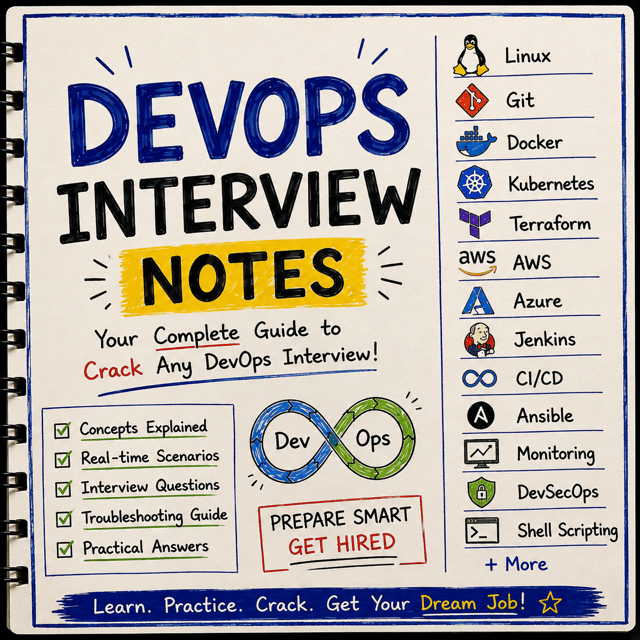
DevOps Interview Notes & Real-Time Scenarios
About me
Frequently asked questions
What are the most common DevOps interview questions and answers?
Most DevOps interview questions and answers revolve around CI/CD pipelines, Docker and Kubernetes fundamentals, Terraform, Linux troubleshooting, Git workflows, and cloud services on AWS or Azure. Interviewers usually begin with concept-based questions, such as the difference between continuous integration and continuous deployment, and then move to practical problems like debugging a failed pipeline or a crashing pod. The strongest answers pair a clear explanation with a real example from your own projects, because interviewers increasingly test application of knowledge rather than memorised definitions.
Is preparing from a DevOps interview questions and answers PDF enough to clear an interview?
A DevOps interview questions and answers PDF is a good starting point, but on its own it is rarely enough. Notes help you cover standard questions quickly, yet interviews, especially for experienced roles, include follow-ups and live scenario problems that need hands-on understanding. Use the PDF to structure your preparation, prefer notes that include real-time scenarios and troubleshooting flows over plain question dumps, and back everything up with labs, personal projects, and mock interviews so you can explain concepts in your own words.
What DevOps interview questions for 3 years of experience should I expect?
DevOps interview questions for 3 years of experience usually blend tooling depth with practical scenarios: building and debugging CI/CD pipelines, Dockerfile optimisation, Kubernetes deployments and services, Terraform state handling, and Linux-level troubleshooting. At this level, interviewers assume you have worked on real deployments, so they will ask what you actually built, what broke in production, and how you fixed it. Prepare two or three detailed stories from your own work, such as an automation you implemented or an incident you resolved, since these decide most interviews at this stage.
What are the important DevOps interview questions and answers for freshers?
DevOps interview questions and answers for freshers focus on fundamentals rather than production depth: what DevOps is and why it exists, basic Linux commands, Git branching and merging, simple Docker usage, CI/CD concepts, and cloud basics. Freshers are also commonly asked about every project, internship, or certification on their resume, so be ready to explain what you did and why. A home lab or a small end-to-end project, such as containerising an app and deploying it through a CI pipeline, immediately separates you from other candidates at the fresher level.
What are some scenario-based DevOps interview questions and answers for experienced candidates?
Scenario-based DevOps interview questions and answers for experienced candidates usually describe a production problem and ask how you would respond, for example a deployment that passed staging but failed in production, a Kubernetes node running out of memory, or a Terraform apply that partially failed. Strong answers follow a clear structure: assess the impact, gather facts from logs and monitoring, form a hypothesis, fix or roll back, and then add a preventive measure. Practising this structure out loud matters more than memorising answers, because interviewers want to see how you think under pressure.
What are Azure DevOps interview questions?
Azure DevOps interview questions focus on Microsoft's DevOps platform rather than general DevOps theory, so expect questions on Azure Pipelines (classic versus YAML), Azure Repos and branch policies, agents and agent pools, service connections, variable groups, and end-to-end CI/CD orchestration. Interviewers often ask how Azure DevOps compares with Jenkins or GitHub Actions, so be ready to explain where each tool fits. Also clarify early whether the role means the Azure DevOps product or DevOps practices on Azure cloud, since candidates frequently mix the two up.
What are the most asked Kubernetes interview questions and answers?
The most frequently asked Kubernetes interview questions and answers cover pods, deployments, and services; the difference between Deployments and StatefulSets; ConfigMaps and Secrets; liveness and readiness probes; resource requests and limits; and troubleshooting issues like CrashLoopBackOff or ImagePullBackOff. For experienced roles, expect follow-ups on networking, rolling updates and rollbacks, and autoscaling. Since Kubernetes interviews move quickly from theory to debugging, practice explaining step by step how you would investigate a failing pod.
Where can I find a reliable Kubernetes interview questions and answers PDF?
A good Kubernetes interview questions and answers PDF should include scenario-based and troubleshooting questions, not just one-line definitions, because real interviews test debugging. Look for notes that cover core concepts, kubectl commands, YAML examples, and real-time production scenarios, and confirm the content has been updated recently since Kubernetes evolves quickly. Whatever material you pick, verify each topic hands-on in a cluster or free playground so the answers actually stick.
What Kubernetes interview questions for 3 years of experience can I expect?
Kubernetes interview questions for 3 years of experience usually go beyond definitions into depth: writing and reviewing YAML for deployments and services, explaining rolling updates and rollbacks, debugging OOMKilled or crashing pods, using ConfigMaps and Secrets correctly, ingress and networking basics, and setting resource requests and limits. Interviewers will also probe what you have personally managed, such as clusters you operated, incidents you handled, or upgrades you performed. Keep a few short stories ready about real issues you debugged with kubectl, because "walk me through how you fixed it" is the default follow-up at this level.
Are Kubernetes interview questions on GitHub enough for preparation?
Kubernetes interview questions on GitHub are useful for discovering the range of topics, but quality varies a lot between repositories. Check when a repo was last updated, whether answers explain the reasoning instead of just listing questions, and whether it includes scenario-based problems matching your experience level. The safest approach is to use GitHub repos for question discovery and then build your own answers with hands-on practice, since copied answers are easy for interviewers to expose with follow-up questions.
If you are wondering how to make a DevOps resume that gets shortlisted, where should you start?
Knowing how to make a DevOps resume stand out starts with achievements over tool lists: open with a summary naming your core stack (AWS or Azure, Kubernetes, Docker, Terraform, CI/CD), then present experience as measurable results such as pipelines migrated, deployment time reduced, incidents resolved, or costs saved. Add a skills section grouped by category, link your GitHub or projects, and mirror keywords from each job description so you clear ATS filters. Keep it to one or two pages, and never list a tool you cannot confidently discuss in an interview.
What should a DevOps resume for freshers include?
A DevOps resume for freshers should highlight fundamentals and proof of hands-on learning, since recruiters know commercial experience will be limited. Include relevant certifications, a skills section covering Linux, Git, Docker, and basic CI/CD, and one or two solid projects, such as containerising an application and deploying it through a pipeline, documented on GitHub. Add a short summary stating the DevOps role you are targeting, and frame even academic or personal projects in DevOps terms instead of padding the resume with unrelated experience.
How should a DevOps resume for 3 years of experience be structured?
A DevOps resume for 3 years of experience should open with a summary naming your primary cloud and toolchain, followed by work experience written as impact statements: tools you implemented, reliability you improved, and manual work you automated. Give space to the technologies you can defend in depth, such as Kubernetes, Terraform, or your CI/CD platform, and quantify results wherever possible. At this tenure, recruiters compare you against many similar profiles, so a specific achievement like cutting deployment time from 45 minutes to 10 stands out far more than a long list of tools.
Should I use a DevOps resume template?
Using a DevOps resume template is fine as a formatting starting point, but the content must be customised to you. Pick a simple, single-column, ATS-friendly layout, avoiding graphics, tables, and multi-column designs that parsers often break, and then replace placeholder text with your actual stack, projects, and metrics. A template only solves structure; getting shortlisted depends on relevant tools, real achievements, and keywords matched to each job description.
How to mention DevOps in a resume so recruiters actually notice it?
A simple rule for how to mention DevOps in a resume: place it where both ATS and human reviewers see it early, in the headline or summary (for example, "DevOps Engineer | AWS, Kubernetes, Terraform"), in a grouped skills section, and inside achievement bullets. Instead of writing only tool names, show the practice, so "built CI/CD pipelines in Jenkins to automate deployments" reads stronger than just "Jenkins". Finally, match the exact terms used in each job description, because resumes are filtered by ATS for those keywords before a recruiter ever reads them.