Testimonials
Services
Design Under Pressure
DE Mentorship / Guidance - 1:1
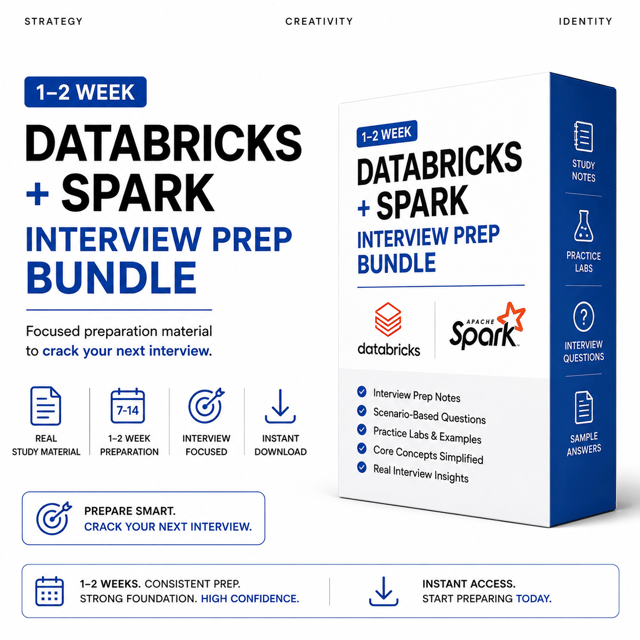
DE Interview Kit 1-2 Week Resource
Interview Ready - 10 Mock Interviews ( 2 Weeks )
Get My Personal Advice
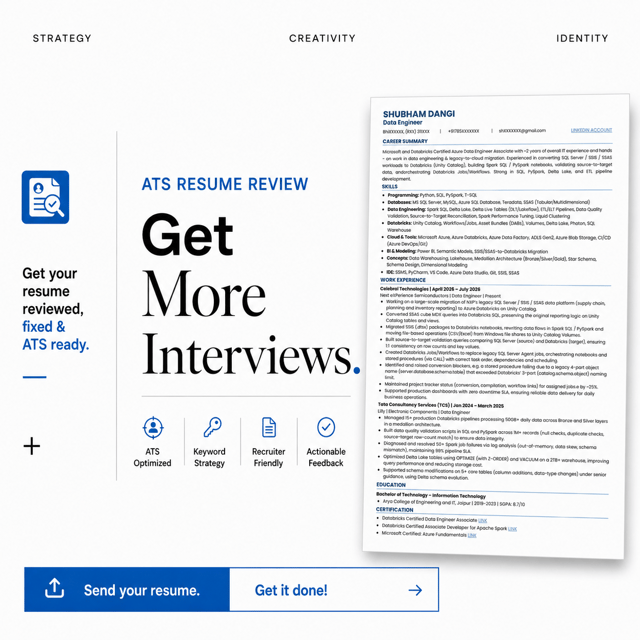
ATS Resume Writing for Data Engineers
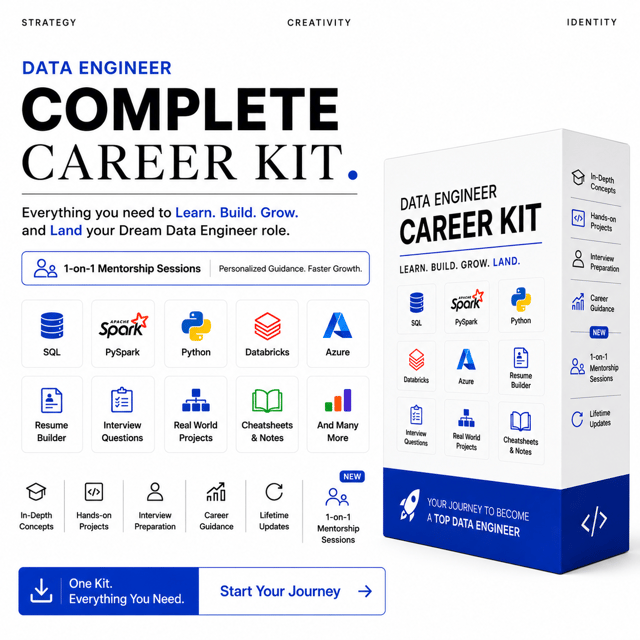
Data Engineer Complete 2 months Kit & 1:1 Guidance
Crack Your Data Engineer Interview in 2 Months
About me
- 10% of proceeds donated to support underprivileged children. @helpingengineers on IG

- Shubham Dangi is highly recommended for his practical insights, clear guidance, and supportive demeanor in data engineering.
 AI-generated based on testimonials
Frequently asked questions
How to become an Azure Data Engineer?
Start with SQL and Python, then learn the Azure data stack — Azure Data Factory for orchestration, Databricks with PySpark for processing, and Delta Lake for storage. Build 2–3 end-to-end projects that follow a real medallion architecture (Bronze/Silver/Gold layers), add a certification for credibility, and prepare a project-heavy resume. Freshers usually need 4–6 months of focused preparation, while ETL, BI, or database professionals can transition faster since their fundamentals already transfer.
What is the Azure Data Engineer role?
An Azure Data Engineer designs, builds, and maintains data pipelines on the Microsoft Azure cloud. Day-to-day work includes ingesting data with Azure Data Factory, processing large datasets with Databricks and PySpark, storing data in Delta Lake or Synapse, fixing pipeline failures, and maintaining SLAs so downstream teams always get clean, reliable data. In India, these roles are common across IT services firms, product companies, banking, retail, and fintech.
What is the Azure Data Engineer salary in India?
Roughly, freshers earn ₹4–8 LPA, engineers with 2–4 years of experience typically get ₹8–15 LPA, and senior engineers with 5+ years often cross ₹20–30 LPA. Product companies and global capability centres generally pay more than service-based firms, and strong hands-on Databricks, PySpark, and ADF skills push offers toward the higher end of the band. Actual figures vary by city, company type, and depth of real pipeline experience.
How to get the Azure Data Engineer certification?
If you're new to the cloud, begin with Azure Data Fundamentals (DP-900), then take the current associate-level data engineering exam Microsoft offers — exams like DP-203 have been retired and replaced as Microsoft moves toward Fabric, so check Microsoft Learn for the live exam before booking. Prepare through the free Microsoft Learn paths, hands-on labs in a free Azure account, and practice tests. Adding a Databricks certification, such as the Databricks Certified Data Engineer Associate, strengthens your profile further since Databricks dominates real job descriptions.
Are Azure Data Engineering courses worth it, or can I learn for free?
You can learn for free — Microsoft Learn, Databricks Community Edition, and documentation cover most concepts. A paid program is worth it only if it gives you a clear roadmap, hands-on pipeline projects, doubt support, and interview preparation, because that structure is what self-learners usually struggle to build. Before paying for any Azure Data Engineering course, check whether it includes real project work and mock interviews, not just recorded videos.
What is Databricks in simple terms?
Databricks is a cloud platform for processing and analysing very large datasets using Apache Spark. In simple terms, it's a single workspace where data engineers bring raw data, clean and transform it, and store it reliably using Delta Lake — often organised into Bronze, Silver, and Gold layers. Companies use it because it handles huge data volumes fast, supports real-time streaming, and lets teams collaborate in notebooks without managing servers themselves.
What are the most common Databricks interview questions for data engineers?
Expect questions on Delta Lake (and why it's better than plain Parquet), medallion architecture, PySpark transformations like repartition vs coalesce, Spark architecture (driver, executors, shuffles), structured streaming, cluster types, caching, and handling small-file problems. Freshers are usually asked definitions and basic transformations, while experienced candidates face internals, optimization, and design questions. Practising each concept in an actual Databricks notebook makes your answers far more convincing.
What are scenario-based Databricks interview questions, and how do I answer them?
Common scenarios include a production Spark job failing after a source schema change, a pipeline slowing down due to data skew, tables bloated with small files, or late-arriving data breaking aggregates. A strong answer follows a pattern: clarify the problem, explain how you'd diagnose it using the Spark UI and logs, give the fix, and add a prevention step like schema enforcement or alerting. Interviewers use scenario-based Databricks interview questions to check whether you've actually run pipelines in production, not just watched tutorials.
What are the most asked Azure Data Engineer interview questions?
The core areas are SQL (joins and window functions), PySpark coding, Azure Data Factory (triggers, integration runtimes, mapping data flows), Databricks and Delta Lake concepts, data modelling, and designing an end-to-end pipeline for a given business use case. Interviewers also dig deep into your resume projects, so be ready to explain every transformation, failure you handled, and design decision you made.
What are the common data engineer interview questions and answers for freshers?
Freshers are typically asked SQL basics (joins, group by, window functions), Python fundamentals, the difference between ETL and ELT, star schema basics, and a detailed walkthrough of one academic or personal project. The best answers connect theory to what you've built — for example, explaining why you partitioned a table or how you handled duplicate records. Recruiters don't expect production experience at the fresher level; they test clarity of fundamentals and honesty about your projects.
What are the common data engineer interview questions for 5 years of experience?
At that level, questions shift from syntax to architecture and judgment: designing pipelines for terabyte-scale data, optimizing slow Spark jobs, cost optimization, handling production failures while maintaining SLAs, choosing between batch and streaming, and migration projects like moving legacy SSIS workloads to Databricks. Expect deep "why" follow-ups on every decision, plus questions on how you improved reliability or mentored junior engineers.
How to crack a data engineer interview?
Follow a structured 8–12 week plan: practise SQL and PySpark daily, learn ADF and Databricks hands-on, build one solid end-to-end project you can defend in depth, solve previously asked interview questions, and take mock interviews to expose weak spots. Most candidates fail not because of weak theory but because they can't handle follow-up questions on their own projects — so depth on fewer topics beats shallow coverage of everything.
Why do you want to be a data engineer?
Interviewers ask this to separate genuine interest from generic answers like "good salary and growth." A strong response connects your own story to the role — for example, enjoying SQL and Python, liking the challenge of building reliable systems that other teams depend on, and preferring data infrastructure work over only reporting or analysis. Close by linking the role to a specific career goal, such as specialising in big data platforms like Azure and Databricks.
How do I write an Azure Data Engineer resume that gets shortlisted?
Use a clean, single-column, ATS-friendly format and mirror keywords from the job description — ADF, Databricks, PySpark, Delta Lake, SQL, Azure. Quantify everything you can: number of pipelines built, data volume processed, failures resolved, SLA maintained. Freshers should showcase projects with architecture details in place of work experience, list certifications near the top, keep it to one page, and tailor the summary and skills section for every application.
Can freshers get Azure Data Engineer jobs in India?
Yes, though entry-level data engineering is competitive. IT services companies and global capability centres regularly hire freshers into data engineering streams, and your odds improve significantly with strong SQL and Python, 2–3 solid projects on ADF and Databricks, a relevant certification, and referrals. A practical route many take is joining a service-based company in a data role, gaining real Databricks exposure there, and then switching to a product company within 1–2 years at a much better salary.