Testimonials
Services
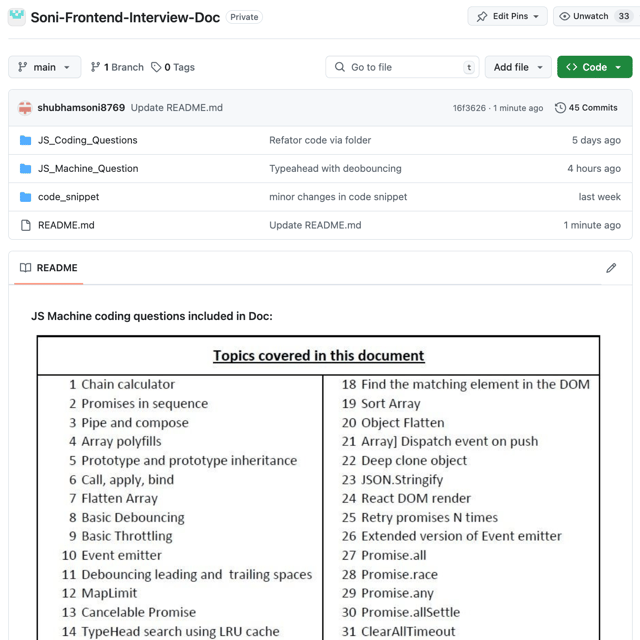
1:1 mentorship + Soni's Frontend document
About me
- Shubham is praised for his role as an effective mentor, creating confidence amongst participants, and offers valuable and practical guidance for interview preparation.
 AI-generated based on testimonials
 - Change the World With Your Time. Come and Join Us!https://topmate.io/join/shubham_soni

Frequently asked questions
What are the most common front end developer interview questions?
The most common front end developer interview questions cover HTML semantics and accessibility, CSS layouts such as flexbox and grid, and JavaScript fundamentals like closures, hoisting, the event loop, and prototypes, followed by framework-specific rounds in React or Angular. For senior roles, expect additional questions on performance optimization, browser rendering, and building UI components from scratch.
What javascript interview questions and answers should I prioritize for a frontend role?
The javascript interview questions and answers that matter most revolve around closures, hoisting, the event loop, promises and async/await, `this` binding, prototypes, debouncing and throttling, and ES6+ features. Prepare each concept with a small code example, because explaining a concept through working code is what separates strong candidates from average ones.
What do javascript interview questions for experienced candidates usually cover?
JavaScript interview questions for experienced candidates go beyond definitions into output prediction, event loop ordering puzzles, memory leaks and garbage collection, module patterns, and writing utilities like debounce or deep clone from scratch. Interviewers also connect these concepts to your projects, so know the reasoning behind your own code thoroughly.
Which javascript interview questions for freshers come up most often?
JavaScript interview questions for freshers concentrate on data types, == vs ===, var, let and const, scope, arrays and string methods, and basic DOM manipulation. Freshers most often lose marks by reciting definitions without coding, so write a small program for every concept you revise.
How do I revise javascript basic interview questions in the final week before my interview?
In the final week, group javascript basic interview questions by topic — types and coercion, scope and closures, arrays, strings, and events — and solve two or three output-prediction problems daily instead of passively reading. A short mock interview at the end of the week helps you spot gaps you cannot notice while studying alone.
How do I answer promise in JavaScript interview questions?
Promise in JavaScript interview questions typically start with the definition — an object representing the eventual completion or failure of an asynchronous operation — and then move to chaining, Promise.all vs Promise.race vs Promise.allSettled, error handling, and how async/await sits on top of promises. Practice converting a callback-based function into promise-based code, since that is a common hands-on task.
What react interview questions and answers should I prepare for product-based companies?
Prepare react interview questions and answers on component lifecycle, state management, hooks behavior, reconciliation and the virtual DOM, performance optimization, and error boundaries. Product companies usually chain follow-ups to practical scenarios, so learn each answer as an adaptable pattern rather than memorized text.
How are react interview questions for experienced developers different from fresher-level ones?
React interview questions for experienced developers focus on architecture and trade-offs — scaling state management, profiling and fixing slow renders, code splitting, testing strategy, and refactoring legacy code — while fresher questions stay on fundamentals and small component tasks. With five or more years of experience, interviewers expect project stories that show decision-making, not just syntax knowledge.
Which react interview questions for freshers should I start with?
React interview questions for freshers usually open with JSX, props vs state, functional vs class components, useState and useEffect, and a small live task such as a counter or todo list. Get completely comfortable with these before moving to advanced topics, because interviewers rarely skip the basics even for entry-level roles.
What react hooks interview questions are asked most often?
Frequently asked react hooks interview questions include useState vs useReducer, useEffect dependency arrays and cleanup, the rules of hooks, building custom hooks, and when useCallback or useMemo genuinely help. Interviewers often hand you a buggy hook-based snippet to debug, so practice spotting missing or incorrect dependencies.
What should a practical frontend interview preparation roadmap look like?
A practical frontend interview preparation roadmap runs about 8–12 weeks: strengthen HTML, CSS, and JavaScript core concepts first, go deep into one framework such as React or Angular, practice machine coding and problem-solving rounds, polish your resume and projects, and finish with mock interviews. Weekly milestones keep the plan structured and far less overwhelming.
Are frontend interview preparation GitHub repositories enough to crack a frontend interview?
Frontend interview preparation GitHub repositories are useful for question banks, cheat sheets, and curated topic lists, but reading alone rarely clears interviews. Interviewers evaluate how you think aloud, debug under pressure, and write clean code in real time, so combine repositories with hands-on coding practice and a few mock interviews before the actual round.
How many mock interviews should I take before a frontend developer interview?
Three to five mock interviews spread across the last three or four weeks of preparation works well for most candidates. The quality of feedback matters more than the count, so take them with someone who has cleared frontend interviews at product companies and can review your communication, approach, and code structure in detail.
How to respond to the tell me about yourself interview question?
Knowing how to respond to the tell me about yourself interview question comes down to a simple 60–90 second structure: your current role and tech stack, one or two highlights with measurable impact, and why the role you are interviewing for is the logical next step. Rehearse it out loud until it sounds conversational instead of memorized.
How to respond to interview questions about weaknesses without hurting your chances?
How to respond to interview questions about weaknesses comes down to a simple formula: name a real but non-critical weakness, acknowledge how it shows up in your work, and describe the concrete steps you are taking to improve. Avoid clichés like "I am a perfectionist" and never say you cannot think of one, because interviewers use this question to test self-awareness and honesty.