Testimonials
Services

Personalised ESG Career Strategy & Roadmap

Ebook: ESG Foundations: Structured Learning
ESG Career Starter Bundle
30-minute ESG Career Clarity Call
The ESG Career Starter Playbook
About me
Frequently asked questions
What is CSRD (Corporate Sustainability Reporting Directive)?
CSRD is the European Union's corporate sustainability disclosure law, which replaced the earlier NFRD and came into force in January 2023. It requires companies — including non-EU companies with significant operations in Europe — to publish detailed, externally assured reports on their environmental, social and governance impacts, risks and opportunities using the ESRS standards. Because Indian IT, pharma, manufacturing and services companies with European clients fall within or feed into its scope, it has become one of the most important frameworks for ESG professionals in India to understand.
What are the CSRD reporting requirements?
The main CSRD reporting requirements are: publishing a sustainability statement prepared under the European Sustainability Reporting Standards (ESRS), running a double materiality assessment that covers both the company's impact on people and the environment and how sustainability issues affect the business, disclosing policies, actions, targets and metrics for each material topic, obtaining third-party assurance, and filing the statement in a digital, machine-readable format alongside the annual report.
What is the CSRD reporting framework?
The CSRD reporting framework is built on the European Sustainability Reporting Standards (ESRS), which set out exactly what companies must disclose across environmental, social and governance topics — for example, ESRS E1 covers climate and connects with GHG Protocol emissions data and TCFD-style risk reporting. Companies first run a double materiality assessment to decide which topics are material, then disclose policies, actions, targets and metrics for each one. The final sustainability statement must be assured by an independent provider and published in a digital, tagged format with the annual report.
What are the CSRD reporting thresholds?
The original CSRD reporting thresholds covered large EU companies meeting at least two of three criteria — more than 250 employees, over €40 million net turnover, or over €20 million on the balance sheet — along with listed SMEs and non-EU groups with significant EU turnover or operations. The EU's Omnibus simplification package has proposed raising these thresholds so smaller companies fall out of scope, and the details are still being finalised, so always check the current EU position before deciding whether a company is in scope. In practice, many Indian suppliers, vendors and subsidiaries of European groups are already being asked for CSRD-aligned data even when they are not directly covered.
What are the CSRD reporting deadlines?
The CSRD reporting deadlines are phased by company type. Companies already covered by the older NFRD published their first reports in 2025 for financial year 2024, other large companies follow in later waves, and listed SMEs were scheduled last. The EU's recent "stop the clock" changes have pushed the later waves back by two years, which means the exact date depends on the category a company falls into. Identify which wave a company belongs to and then track the current EU timeline, because the dates have moved during the simplification process.
Is there a CSRD reporting certification?
There is no official CSRD reporting certification mandated by the EU for the people who prepare disclosures. What exists instead are professional courses and certificates in sustainability reporting — GRI-certified training, ESRS-focused programmes, climate and carbon accounting courses, and university diplomas — that signal practical knowledge to employers. Because hands-on CSRD experience is still scarce, combining a recognised certificate with a portfolio piece such as a mock ESRS disclosure or a double materiality assessment is usually enough to stand out for reporting roles.
What is BRSR reporting and which companies must file it in India?
BRSR reporting refers to the Business Responsibility and Sustainability Reporting format mandated by SEBI for the top 1,000 listed companies in India by market capitalisation. It replaced the earlier Business Responsibility Report and requires structured disclosures on environmental, social and governance performance, with assurance requirements for the BRSR Core indicators being phased in gradually. Since listed companies, audit firms and ESG consultants all need people who can prepare and review these filings, BRSR knowledge is one of the most valuable skills for ESG careers in India.
Which ESG reporting frameworks should I learn first?
The ESG reporting frameworks with the strongest demand are GRI (the most widely used global standard), BRSR (mandatory for India's top listed companies), CSRD/ESRS (the EU regime that Indian companies with European exposure must answer to) and CDP (the climate disclosure platform used by thousands of businesses). Adding TCFD-style climate risk reporting and awareness of the ISSB's IFRS S1 and S2 standards rounds out your profile, since Indian disclosure norms are moving in that direction. If you are targeting Indian employers, start with GRI and BRSR, then layer in CSRD/ESRS for roles linked to European clients or consulting firms.
How to start a career in ESG in India?
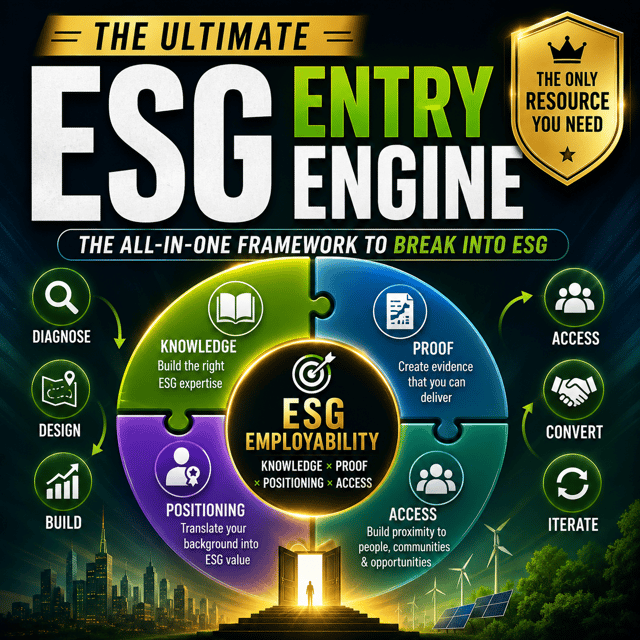
The most practical way to start a career in ESG is to build three layers together: foundational knowledge of frameworks such as GRI, BRSR, CSRD/ESRS and TCFD, applied skills like materiality assessment, emissions data handling and report writing, and visible proof of work such as a mock report, case study or LinkedIn write-up. In India, realistic entry points include ESG analyst roles at consulting firms, sustainability teams at listed companies working on BRSR, ESG research and ratings firms, and CSRD-linked reporting work at companies serving European clients. Positioning your existing domain experience as an advantage, rather than starting from zero, makes the switch much faster.
How to get into ESG with no experience?
The realistic way to get into ESG with no experience is to create evidence of capability before anyone hires you for it. Complete a structured course, then apply it immediately — draft a double materiality assessment for a real listed company, analyse a published BRSR filing, or summarise a CDP response — and publish that work publicly so recruiters can see it. Pair the portfolio with entry-level applications, referrals from ESG communities and informational conversations with practitioners, and you become a low-risk hire even with an empty experience section.
What skills are required for ESG jobs?
The core skills required for ESG jobs fall into four buckets: technical knowledge of frameworks and standards such as GRI, BRSR, CSRD/ESRS, CDP and TCFD; analytical ability, including emissions data handling, materiality assessment and Excel-based reporting; clear writing, since most of the output is reports and disclosures; and project coordination, because ESG data is collected across many teams. Hiring managers consistently value demonstrable applied work over course certificates alone, so build at least one tangible example of each skill before you start applying.
Is ESG a good career in India?
Yes, ESG is a good career in India for the coming decade because demand is being driven by regulation rather than hype — SEBI's BRSR mandate, expanding assurance requirements and CSRD-linked work from European clients all need skilled professionals. The market, however, rewards demonstrated skill over generic interest, so candidates with framework knowledge and a portfolio of real work get hired far faster than those relying on short courses alone. The strongest opportunities are in consulting firms, listed companies, ESG data providers and companies with global supply-chain obligations.
How do I plan an ESG career transition from another industry?
An ESG career transition works best as a bridge from your current expertise, not a full restart. Finance professionals move naturally into sustainable finance, ESG ratings and reporting assurance, engineers into emissions, energy and environmental data, and HR or operations people into the social and governance side of disclosure. Close the knowledge gap with one or two recognised courses, produce a couple of portfolio projects, and target hybrid roles where your domain plus ESG knowledge is a rare combination — most people manage the shift in six to twelve months when they treat it as a structured project.
Which ESG jobs in India are in demand?
The ESG jobs in India seeing the strongest demand are ESG analyst and consultant roles at the Big 4 and boutique consulting firms, sustainability reporting specialists inside listed companies preparing BRSR filings, research and ratings roles at ESG data providers, and CSRD-aligned reporting roles at IT and services companies working with European clients. Growth is being fuelled by SEBI mandates, sustainability questions in global supply chains and EU regulations. Freshers typically enter through analyst or research positions, while experienced professionals from finance, engineering or operations enter faster through reporting and assurance-adjacent roles.
What are the most common ESG interview questions?
The most common ESG interview questions ask you to explain double materiality, compare frameworks such as GRI and CSRD, describe the difference between Scope 1, 2 and 3 emissions, walk through how you would collect and validate sustainability data, and outline the BRSR Core indicators. Interviewers also test judgement with situational questions — for example, how you would respond if a manager wanted to overstate performance — so prepare short, structured answers that show technical clarity and integrity together. Rehearsing a few real examples out loud matters more than memorising definitions.