Testimonials
Services
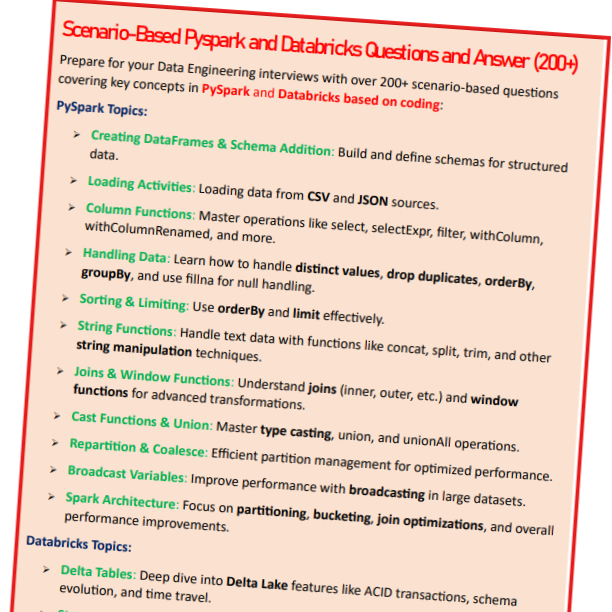
200+ QnA Scenario-Based Pyspark and Databricks
Master Python Interview coding question For DE
Career guidance
Quick notes for Spark
Your Ultimate Interview Prep Bundle
Must do Azure Interview Questions
Quick Notes for ADF for interview
Roadmap for Azure DataEngineer 2025
About me
- Shivakiran Kotur's expertise and dedication make him an exceptional mentor in Azure data engineering, boosting confidence and career growth.
 AI-generated based on testimonials
Frequently asked questions
What is the role of an Azure data engineer?
In simple terms, the role of an Azure data engineer is to design, build, and maintain the pipelines that move data from source systems — databases, APIs, files, and streams — into a cloud data platform where it can be analysed. Day to day, this means creating ingestion and orchestration pipelines in Azure Data Factory, writing transformations in PySpark and SQL on Databricks, modelling tables in a warehouse such as Snowflake or Azure SQL, and managing storage in ADLS Gen2. The job also covers data quality, performance and cost optimisation, and security, along with working closely with analysts and data scientists so clean, reliable data is always available.
How to become an Azure data engineer in India?
There is no single fixed route for how to become an Azure data engineer, but the path that works for most people in 2025 is: get strong in SQL and Python first, then learn the Azure data stack (Azure Data Factory, ADLS Gen2, Databricks with PySpark, Delta Lake, and one warehouse like Snowflake or Azure SQL), build two or three end-to-end projects that ingest, transform, and serve data, and validate your skills with the DP-203 certification. Expect roughly 5–7 months of consistent effort if you are starting from scratch, and target associate-level data engineering roles at IT services companies and Global Capability Centres for your first break.
What is the Azure Data Engineer certification?
The Azure Data Engineer certification is Microsoft's role-based credential for data engineering on Azure — officially Azure Data Engineer Associate — earned by clearing exam DP-203 (Data Engineering on Microsoft Azure). It tests practical skills such as implementing data storage and partitioning in ADLS Gen2, building batch and incremental processing solutions with ADF and Spark/Databricks, optimising and serving data, and securing a data platform. For hiring teams in India, it works as a quick signal that you have hands-on capability with the Microsoft data stack rather than only theoretical knowledge.
How to get the Azure Data Engineer certification?
The practical answer to how to get the Azure Data Engineer certification is a four-step process: cover the DP-203 syllabus through the free Microsoft Learn path, get genuine hands-on practice by building pipelines in ADF, running notebooks in Databricks, and working with Delta tables and ADLS Gen2, take timed practice tests until you are comfortably above the passing mark, and then book DP-203 at a Pearson VUE centre or through the online proctored option available in India. Candidates with working knowledge of SQL and Python typically need 4–8 weeks of preparation. Note that role-based Microsoft certifications require a free online renewal once a year.
How difficult is the DP-203 exam and how long should I prepare?
The DP-203 exam is moderately difficult — not because individual topics are extremely deep, but because it covers a wide surface area (storage design, batch and incremental processing, streaming, security, monitoring) and asks scenario-based questions where two options often look correct. If you already work with ADF or Databricks, three to four weeks of focused revision plus practice tests is usually enough; if you are new to Azure, plan for two to three months including hands-on labs. The most common reason people fail is relying only on theory and dumps without actually building pipelines themselves.
What is the Azure data engineer salary in India?
The Azure data engineer salary in India typically ranges from ₹4–8 LPA for freshers to ₹8–16 LPA for engineers with 3–5 years of experience, with senior roles often fetching ₹18–30+ LPA. Product companies and Global Capability Centres generally pay above services firms, and cities like Bengaluru, Hyderabad, Pune, Chennai, and the NCR have the highest demand. Depth in Databricks, Snowflake, and ADF — backed by certification and strong project stories — is what usually pushes an offer to the higher end of these bands.
Can freshers get Azure data engineer jobs in India?
Yes, freshers can get Azure data engineer jobs in India, though very few entry-level openings carry that exact title. The realistic entry points are graduate and associate roles in ETL or data engineering at IT services companies, consultancies, and Global Capability Centres, or adjacent roles like data analyst. Your odds improve significantly with strong SQL and Python, one cloud stack done end-to-end (ADF + Databricks + a warehouse) with projects on GitHub, the DP-203 certification, and referrals — and many freshers also join in support or analyst roles and transition internally within a year or so.
Can I switch to data engineering from a non-IT background?
Yes — people regularly switch into data engineering from testing, support, mechanical or civil roles, R&D, teaching, and even finance, usually within 6–12 months of focused effort. Start with SQL and Python, add one cloud data stack with hands-on projects, and be ready to explain every design decision in your projects during interviews. Your prior domain experience is actually an advantage in industries like banking, pharma, and manufacturing, where data engineers who also understand the business context are highly valued.
What should I look for while choosing Azure data engineering courses?
Judge Azure data engineering courses on three things: whether you get hands-on labs (actually building ADF pipelines and Databricks notebooks, not just watching videos), whether the learning is project-based so you finish with end-to-end pipelines for your resume and interviews, and whether the content matches the current DP-203 syllabus and real interview topics like ADLS Gen2, Delta Lake, and PySpark. Microsoft Learn is a solid free starting point; paid courses are worth it mainly when they add structured projects, doubt-clearing, and interview preparation on top of the theory.
What should I include in an Azure data engineer resume as a fresher?
A strong Azure data engineer resume for a fresher is one page and leads with a skills section (SQL, Python, PySpark, Azure Data Factory, ADLS Gen2, Databricks, Delta Lake, Snowflake, basic Azure DevOps), followed by two or three projects written in outcome terms — volume of data processed, pipelines built, latency or cost reduced — instead of long tool lists. Add the DP-203 certification if you have it, and mirror the keywords from each job description so the resume clears ATS screening. Recruiters in India spend under a minute per CV, so quantify everything you can.
Which Azure data engineer interview questions are most commonly asked?
The most frequently asked Azure data engineer interview questions cluster around four areas: SQL (joins, window functions, finding duplicates, nth-highest queries), Azure Data Factory (integration runtimes, triggers, mapping data flows, self-hosted IR scenarios), Spark and Databricks (transformations vs actions, lazy evaluation, shuffle, caching, join strategies, skewed data), and Delta Lake (ACID, MERGE for upserts, time travel). Most companies in India also keep one scenario or design round — such as designing an incremental load or handling late-arriving data — plus a short Python coding test.
What are the most common PySpark interview questions for data engineers?
The most common PySpark interview questions for data engineers cover the difference between RDDs, DataFrames, and Datasets; transformations versus actions and lazy evaluation; narrow versus wide transformations; how shuffle works and how to minimise it; broadcast joins; window functions like row_number, rank, and lead/lag; caching and persistence levels; repartition versus coalesce; handling skewed data and small files; and reading/writing formats such as Parquet and Delta. Interviewers rarely stop at definitions — expect follow-ups on why you chose an approach and how you would optimise it, so practice writing the code in Databricks rather than only reading answers.
What are scenario-based PySpark interview questions and how do I prepare for them?
Scenario-based PySpark interview questions hand you a real production problem — a skewed join slowing a nightly job, small files degrading a Delta table, an incremental load with late-arriving records, or a pipeline whose cost has doubled — and test how you diagnose and fix it rather than whether you remember syntax. Prepare by understanding execution internals (explain plans, partitioning), practising on real datasets in Databricks, and working through large banks of scenario-based PySpark and Databricks questions until the recurring patterns — skew fixes, partitioning, broadcast joins, MERGE-based upserts, small-file compaction — become second nature.
What do PySpark interview questions for 5 years of experience focus on?
PySpark interview questions for 5 years of experience focus far less on syntax and much more on architecture and trade-offs: choosing between batch and streaming, partitioning strategy for terabyte-scale Delta tables, tuning shuffles and joins at scale, controlling cluster cost, schema evolution, data quality and reconciliation, and CI/CD for pipelines. At this level, interviewers deep-dive into projects you have owned, so prepare a few stories where you diagnosed a performance problem, quantified the improvement, and can explain why you rejected the alternatives. Experience with design reviews and mentoring also comes up for senior roles.