Testimonials
Services

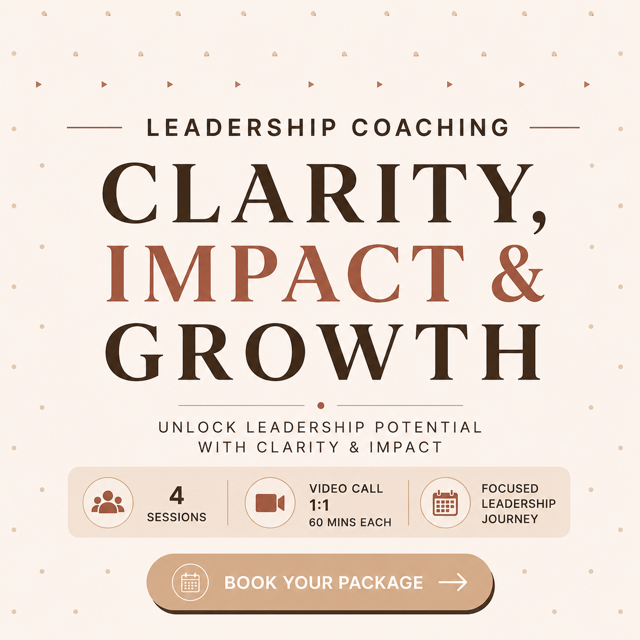
Leadership Coaching – Clarity, Impact & Growth

The Clarity Journey
Leadership Coaching – Clarity, Impact & Growth

About me
Frequently asked questions
What is career counselling and how is it different from career coaching?
Career counselling is focused on helping you understand your options — it usually involves assessing your aptitude, interests, and strengths to suggest suitable career paths, and is most common for students choosing streams, degrees, or their first job. Career coaching is more action-oriented: a coach works with you on specific goals such as switching roles, getting promoted, or moving into leadership, and keeps you accountable through regular sessions. In India the two terms are often used interchangeably, but as a simple rule, counselling suits those still deciding on a direction, while coaching or mentoring suits those who know their field and need help moving forward.
What are career coaching services and what do they include?
Career coaching services are structured one-on-one engagements where a trained coach helps you work through career decisions and challenges. Depending on the coach, they can cover choosing the right career path, planning a switch (for example, from a technical role into management), preparing for promotions or appraisals, improving communication and leadership skills, and setting realistic short-term and long-term milestones. Most coaches in India deliver these through 1:1 video calls, with options ranging from a single clarity session to a month-long mentoring plan, so you can start small before committing to longer engagements.
What is career coaching for students and when should you start?
Career coaching for students helps them understand their strengths, explore career options, and plan the steps between where they are and the career they want. It can cover choosing a specialization, building relevant skills alongside a degree, preparing for campus placements, or deciding between a job and higher studies. The ideal time to start is at least a year before a major decision point — such as the final year of college — so there is enough time to build skills and milestones instead of making a rushed choice. Fresh graduates confused about their first role can benefit just as much as final-year students.
What is a career coaching session and what happens in it?
A career coaching session is a focused one-on-one conversation, usually 30 to 60 minutes, built around one clear objective. A typical session starts with the coach understanding your background and current challenge, moves into structured questioning that helps you articulate what you actually want, and ends with practical next steps or milestones you can act on. Good sessions are less about generic advice and more about helping you think clearly — you can use a single session to resolve a specific doubt, or a series of sessions to work through a bigger transition like a role change.
How to find a career mentor in India?
Start by getting clear on what you need help with — choosing a path, growing into management, or navigating a switch — because the right mentor depends on your goal. Look for someone who has actually done what you aspire to do; for instance, if you are in IT and want to move into a managerial role, a mentor with real corporate delivery and leadership experience will understand your situation far better than a generic counsellor. You can find mentors through your professional network, alumni groups, LinkedIn, or mentoring platforms that let you book 1:1 video calls with experienced professionals. Always check their experience and reviews, and begin with a short discovery call to see if their style works for you.
What is professional mentoring and who should consider it?
Professional mentoring is a relationship in which an experienced professional guides someone at an earlier career stage — sharing practical knowledge, giving honest feedback, and helping them handle decisions the mentor has already faced. Unlike courses or training, mentoring is personalized: the agenda is your specific situation, not a fixed syllabus. It is especially valuable for freshers finding their footing, individual contributors aiming for their first managerial role, consultants and architects deciding on a specialization, and new managers adjusting to leadership expectations. Even seasoned professionals use mentoring when they feel stuck or face a major career decision.
What is a career mentoring program and how does it work?
A career mentoring program is a structured engagement where a mentor and mentee work together over a defined period instead of in a single one-off conversation. A typical program begins with a discovery session to understand your goals, followed by regular 1:1 meetings — weekly or biweekly — where you work on specific milestones such as closing skill gaps, preparing for a role change, or building leadership capability, with progress reviewed at each step. Programs can run from a month to several months and are offered by companies, universities, and independent mentors. If your challenge is complex or long-term, a structured program usually delivers better results than isolated calls.
What is the coaching leadership style and when does it work best?
The coaching leadership style is a way of leading where a manager focuses on developing people rather than only directing tasks. Instead of giving instructions, a coaching-style leader asks questions, listens actively, gives constructive feedback, and helps team members arrive at their own solutions — building their skills and confidence over time. For example, when a team member misses a deadline, a coaching leader explores what blocked them and how to prevent it, rather than simply reprimanding them. This style works best when team members are keen to grow and there is room for longer-term development; in urgent crisis situations, a more directive approach is needed.
How to be a coaching leader as a new manager?
Moving from an individual contributor to a manager is one of the toughest career transitions, and adopting a coaching mindset makes it much smoother. In practice it means asking more than you tell — guiding your team toward solutions instead of handing them answers; holding regular one-on-ones focused on the person's growth, not just task status; giving specific and timely feedback; and listening without jumping to conclusions. It also means accepting that your success is now measured by your team's output, not your own. New managers who build these habits early handle the IC-to-leadership shift far more confidently, and working with a leadership mentor can speed up that development considerably.
What is ICF leadership coaching?
ICF leadership coaching refers to leadership coaching delivered by a coach credentialed by the International Coaching Federation (ICF), the global body that sets standards for the coaching profession. ICF credentials — ACC, PCC, and MCC — are earned through verified coach-specific training, documented coaching hours, and supervised assessment, so they signal that the coach follows a proven methodology and a professional code of ethics rather than simply using the title. When you are investing in leadership coaching, checking whether the coach holds or is pursuing an ICF credential is a sensible quality filter, though genuine industry and leadership experience matters just as much.
Does a leadership coaching certification matter when choosing a leadership coach?
It matters, but it should not be the only filter. A recognized certification such as ICF's ACC or PCC tells you the coach has been formally trained in structured coaching methods and ethics, which separates professionals from people who simply call themselves coaches. That said, the best outcomes usually come from a combination of credentials and real-world experience: a coach who has actually led teams or delivered large projects will understand challenges like appraisals, delegation, and stakeholder management far more concretely. Check the certification, but also read client reviews and do a discovery call before committing.
What are the most common leadership coaching topics?
Frequently covered topics include the transition from individual contributor to manager, developing leadership presence and communication, delegating effectively, giving feedback, managing conflict, strategic thinking, decision-making, and building influence without authority. Many professionals also use coaching for clarity questions — such as whether management is even the right path for them, how to handle feeling stuck in a senior role, or how to balance career growth with personal priorities. Good coaches tailor the agenda to your situation rather than running a fixed curriculum, so the topics that matter most depend on where you are in your leadership journey.
Should I approach leadership coaching companies or an independent leadership coach?
Large leadership coaching companies primarily serve organizations — they run structured leadership development programs for managers being groomed internally, and access is usually through an employer. If you are an individual professional, say an engineer stepping into your first managerial role, an independent leadership coach is generally the more practical route: you can book a 1:1 call directly, pick a coach whose background matches your industry, and work on your specific goals instead of a standardized program. Company-sponsored programs work well when provided by your employer; for personal clarity and growth, a direct 1:1 engagement usually gives you more attention and flexibility.
Is career coaching online as effective as joining a career coaching centre?
For most working professionals and students, online career coaching is just as effective — and often more practical — because results depend on the quality of the mentor and the structure of the sessions, not the room you sit in. Online 1:1 video calls give you access to mentors with genuine industry experience regardless of which city you live in, save commute time, and make it easy to fit sessions around work or college. Local centres can still be useful for classroom-style needs such as exam preparation, but for personalized, discussion-based guidance on career, leadership, and life decisions, a 1:1 online session with the right mentor usually delivers more value.