Testimonials
Services

AI Prompt Library for Business Analysts | PDF
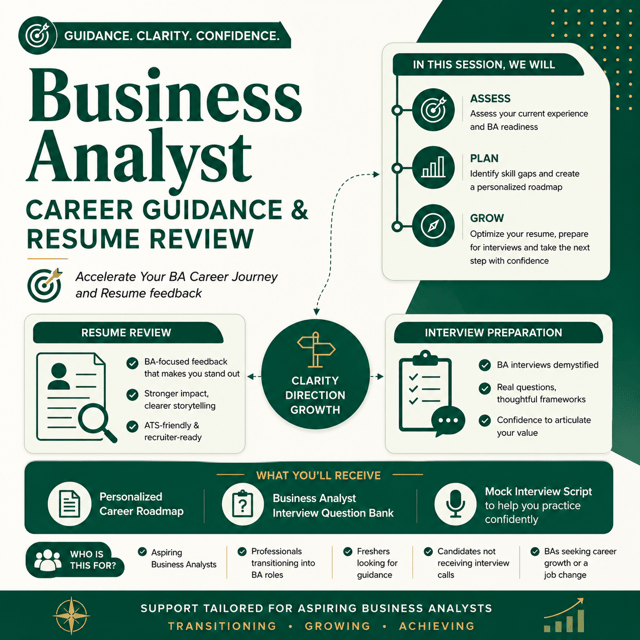
Business Analyst Career Guidance & Resume Review
1:1 Customised BA Consulting & Mentoring
Jira Workflow Guide for BAs
SQL Essentials - The Practical SQL Guide for BAs

Business Analyst Resume & LinkedIn Review

About me
Frequently asked questions
Is business analyst a good career in India?
Yes, business analysis is one of the most accessible and rewarding IT-adjacent careers in India right now. Every digital project in banking, insurance, e-commerce, healthcare, and IT services needs a BA to bridge business needs and technical teams. The role pays competitively, does not demand heavy coding, offers a clear progression into product management or consulting, and welcomes both freshers from any stream and working professionals switching careers. That said, it rewards practical skills — requirement gathering, documentation, and Agile ways of working — over theory alone.
What is a business analyst job role in an IT company?
A business analyst acts as the bridge between business stakeholders and technical teams. Day to day, this usually means eliciting and documenting requirements (BRDs, FRDs, user stories), mapping current and future business processes, analyzing data, participating in Agile ceremonies like sprint planning and backlog refinement, clarifying doubts for developers and testers, and supporting UAT before release. The core of the job is making sure what gets built actually solves the business problem.
How to start a business analyst career with no experience in India?
Start by building the fundamentals: SDLC and Agile/Scrum basics, requirement-gathering techniques, and documentation artifacts like BRDs, FRDs, and user stories. Then learn the supporting tools — Jira, Excel, basic SQL, and API fundamentals. Next, rework your resume and LinkedIn around transferable skills such as communication, analysis, and stakeholder handling, practice scenario-based interview answers, and target entry points like junior BA or product analyst, or an internal move within your current company. A structured learning roadmap or mentorship shortens the trial-and-error phase considerably.
What is the business analyst career path in India, and what salary can you expect at each level?
A typical progression runs: Junior/Associate BA (0–2 years) → Business Analyst (2–5 years) → Senior BA (5–8 years) → Lead BA or BA Manager (8–12 years) → Principal BA, Product Manager, Business Architect, or independent consultant. Business analyst career growth in India is strong because these skills transfer directly into product, data, and delivery leadership roles. Salaries roughly range from ₹4–6 LPA at entry level to ₹8–15 LPA mid-career and ₹18–30+ LPA at senior and lead levels, depending on city, domain, and company.
How do I switch to a business analyst role from a non-IT background?
Many successful BAs come from non-IT backgrounds — banking, operations, teaching, sales, and healthcare. The switch works in three moves: first, learn the BA toolkit — requirement gathering, BRD and user story writing, Agile/Scrum basics, and tools like Jira and SQL; second, reposition your resume around analytical and communication achievements you already have, using the language BAs use; third, target BA roles in your own domain first, because domain knowledge is a genuine advantage employers pay for. A recognized BA certification and mock interviews round out the transition.
How to make a business analyst resume that gets shortlisted?
Keep it to one or two pages and structure it around what recruiters scan for: a sharp summary aligned to the BA role, a skills section covering requirements gathering, Agile/Scrum, user stories, SQL, and Jira, and bullet points that quantify impact (for example, "reduced reporting turnaround by 20%") instead of listing responsibilities. Mirror the keywords from each job description so your resume clears ATS filters, tailor it for every application, and skip generic objective statements. Even non-BA experience can be framed in BA language — analysis, documentation, and stakeholder coordination.
What does a business analyst resume look like when you have no BA work experience?
A business analyst resume for freshers with no experience still follows the standard structure — contact details, summary, key skills, projects, certifications, and education — but the weight shifts to academic projects, internships, and transferable skills. Include class or personal projects where you gathered requirements, built process flows, or analyzed data, along with any certifications in Agile, Scrum, SQL, or business analysis. One page is enough; what matters is demonstrating BA thinking, not job titles.
What are the most common business analyst interview questions for freshers?
Expect a mix of concept and scenario questions: What is business analysis? What is the difference between a BRD and an FRD? What is a user story and its acceptance criteria? What requirement elicitation techniques do you know? Walk me through the SDLC. Agile vs Waterfall? How would you handle conflicting stakeholder requirements? Along with these, brush up on basic SQL and simple case studies. Prepare short, example-backed answers and rehearse them aloud or in mock interviews rather than memorizing definitions.
How to answer business analyst interview questions?
Structure beats memorization. For theory questions, give a crisp definition followed by a practical example. For scenario-based business analyst interview questions, use the STAR method — Situation, Task, Action, Result — and think aloud while answering, because interviewers assess how you reason, not just your final answer. Always clarify assumptions before diving in, ground your answers in real or academic project examples, and close by connecting your action to business value.
Do you need SQL to become a business analyst?
You do not need to be a programmer, but basic SQL has become close to mandatory for BA roles in India. Most job descriptions list it, and in practice BAs use simple queries — SELECT, JOIN, GROUP BY, and aggregations — to pull and validate data, verify reports, and communicate confidently with development teams. Deep database administration skills are never expected; a practical grounding in SQL essentials is usually enough for interviews and day-one work.
Do business analysts need to know Agile and Scrum?
Yes — the majority of BA roles in Indian IT companies operate in Agile environments, so you should understand Scrum roles, sprint ceremonies (planning, daily stand-up, review, retrospective), product backlogs, and how user stories and acceptance criteria flow through a sprint. You do not need to be a certified Scrum Master to get hired, but knowing the vocabulary and mechanics is assumed in most interviews, and a formal certification can strengthen a fresher's profile.
Will AI replace business analysts?
No — AI is changing what BAs do, not eliminating the role. AI tools now speed up drafting BRDs, generating user stories, summarizing stakeholder discussions, and preparing test scenarios, but the outputs still need a human to validate accuracy, probe hidden requirements, and manage stakeholders — the parts of the job that are fundamentally human. The practical takeaway: BAs who learn to use AI well, including writing effective prompts and reviewing AI-generated documentation, are becoming noticeably more valuable than those who ignore it.