Testimonials
Services
Angular Interview Roadmap™
Developer Job Switch System™ | Career Toolkit
Resume Scorecard™ (24-Hour Review)
Frontend Developer → AI Developer Blueprint
Senior Frontend System Design Interview Sprint
Mock Interview + Career Feedback
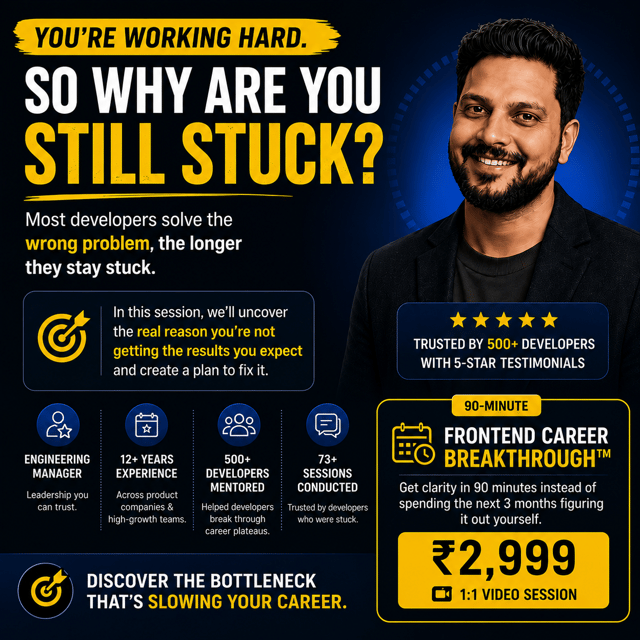
Frontend Career Breakthrough Session™
I Learned to Code Before AI
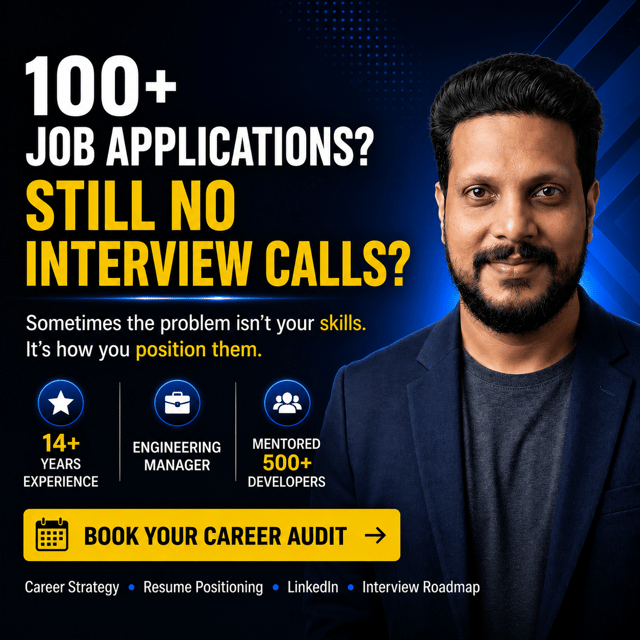
Career Audit – Find Your Biggest Bottleneck
Developer Communication Playbook – Master Edition
The Modern Developer Upgrade™
Frontend → Full-Stack Roadmap
Resume Fix + Mock Interview
About me
- Sandip Jaiswar is praised for his practical resume and interview coaching, providing clear, actionable insights that boost confidence and improve job search strategies.
 AI-generated based on testimonials
 - Why Developers Don't Get Interview Callshttps://www.youtube.com/watch?v=_ux-Iyj5z3U&t=23s

- Highly recommend Sandip for interview preparation. Before connecting with him, I was struggling to structure and present my skills effectively during interviews. Sandip helped me to identity the gapsRecommended by Raju Yadav on

- WhatsApp Group Invitehttps://chat.whatsapp.com/C72XvW9a0kiLIUhGaoRgCT

Frequently asked questions
How to write a software engineer resume that gets more interview calls?
Start with a crisp summary naming your role, years of experience, and main stack, then describe each job through impact bullets — "cut API response time by 40%" instead of "responsible for backend development". Use skills and tools exactly as the job description words them, keep the layout single-column and clean, and quantify everything you can. Resumes that list responsibilities without outcomes are the most common reason engineers stop getting calls.
How to format a software engineer resume for ATS and recruiters?
Use a reverse-chronological layout with standard headings — Summary, Skills, Experience, Projects, Education. Keep it to one page up to about 8 years of experience (two beyond that), single column, no photo, tables, or graphics, with consistent date formats. Save it as a PDF unless the job portal asks for Word. Clean formatting helps a recruiter skim you in 6–8 seconds and helps software parse you correctly.
What does a software engineer resume look like?
A strong one reads top-to-bottom as: name and contact details with LinkedIn/GitHub, a 2–3 line summary, a grouped skills section, experience bullets showing outcomes with numbers, projects (crucial if you're a fresher), then education and certifications. It usually looks plain — simple fonts, plenty of white space, zero design elements — because the substance sits in the metrics and keywords, not the styling.
What should a software engineer resume for freshers include?
Lead with two or three projects (tech stack, your specific contribution, outcome, and live/GitHub links), then internships, a skills section matched to the roles you're targeting, and education. Add achievements like competitive programming ranks, hackathons, or open-source contributions. Keep it to one page and skip photos, objective statements, and filler like "hardworking team player".
Should I use a software engineer resume template or design my own layout?
A template is fine as a skeleton, but most popular two-column or designer templates break ATS parsing. Pick a simple, single-column layout and spend your effort on the content — impact bullets, the right keywords, clear positioning. Recruiters decide in seconds based on what your resume says, not how fancy it looks.
How to make an ATS resume for software engineering jobs?
Build it with standard section headings, plain fonts, and no tables, text boxes, columns, icons, or headers/footers. Write skills the way job descriptions spell them, include both abbreviations and full forms where relevant, and mirror each job description's keywords honestly. A quick test: copy-paste your resume into plain text — if it still reads in order, an ATS can parse it.
How to pass ATS resume screening at product companies?
Screening software shortlists based on keyword match and parse-ability. Tailor your resume to every job description, use the exact skill names and a job title line that reflects the target role (when truthful), keep the formatting machine-readable, and apply early since many companies review applications on a rolling basis. Remember that a human usually reads it after the robot, so substance still decides the shortlist.
How does an ATS resume checker actually work?
It parses your file, identifies your sections, and scores how well your content matches a job description or general best practices — flagging missing keywords, formatting that breaks parsing, and weak sections. Tools differ, so treat the score as directional feedback, not a verdict. The biggest improvements usually come from keyword alignment and structure, not from chasing a perfect number.
What is a good ATS resume score, and how do I improve mine?
Most checkers use a 0–100 scale, and 75+ is generally considered healthy. If you're lower, the usual causes are missing job-description keywords, sections the tool couldn't read, or bullets with no measurable outcomes. Fix those, keep your headings standard, and re-check — but don't game the score at the cost of readability for the human who reviews you next.
Do I need a special ATS resume template, or is a normal resume enough?
No. Any simple, single-column, text-first resume parses fine, so don't pay for an "ATS-proof" template — that's mostly marketing. What actually gets you through is tailoring keywords to each job description and writing clear, quantified bullets. If you like a template's look, use it only as structure and replace the filler with your own impact.
What is the ATS resume full form?
ATS stands for Applicant Tracking System — the software companies use to collect, parse, and filter resumes before a human sees them. That's why machine-readable formatting and the right keywords decide whether your resume is even shortlisted, and why ATS-friendly resume writing has become standard practice in tech hiring.
What does effective interview preparation for freshers look like?
Give yourself 4–6 weeks: practice DSA daily, revise core fundamentals like OOP, DBMS, OS, and networks, know two or three of your projects well enough to defend every design choice, prepare your introduction and HR answers, and do at least a few mock interviews. Freshers commonly over-invest in collecting study material and under-invest in actually answering questions under pressure.
What are the most important interview preparation questions for software engineers?
Cover five buckets: coding and DSA patterns (arrays, strings, hashing, trees, recursion), language and framework fundamentals, project deep-dive questions, basic system design or LLD if you're experienced, and behavioral questions like "tell me about a time you missed a deadline". Write your answers out and speak them aloud — silently reading question banks is far less effective.
Is an interview preparation course worth it?
It depends on how you study. A course helps if you need structure, deadlines, and feedback on your actual gaps; self-study works if you're disciplined and can arrange mock interviews separately. Judge any program by whether it reviews your resume, identifies your specific weaknesses, and includes realistic mocks — recorded lectures alone rarely move the needle.
Do interview preparation AI tools actually help you crack interviews?
They're genuinely useful for practice reps — generating questions, simulating interviews, and polishing your answers. But AI can't fully reproduce the pressure of a real interviewer, judge your communication the way a person does, or spot positioning gaps in your resume and LinkedIn profile. The strongest approach is AI for daily practice and human mock interviews for realism and honest feedback.