Testimonials
Services
Job Search Tracker
Mock interview
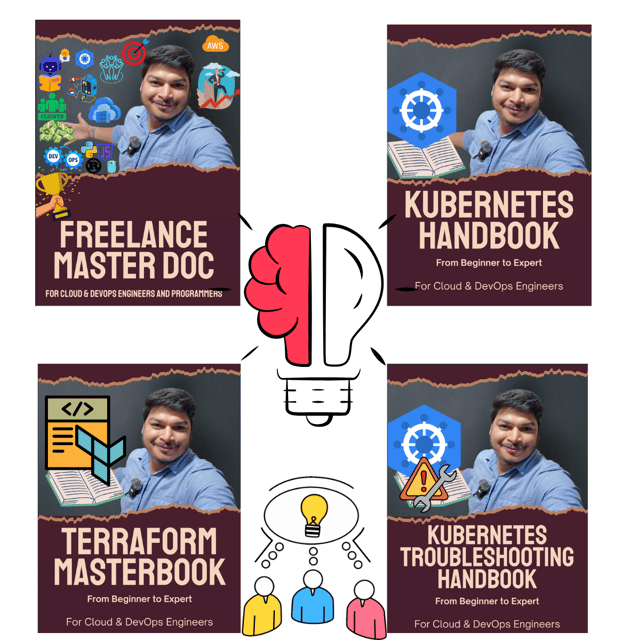
Kubernetes Handbook - From Beginner to Expert
LearnXops Premium Membership for 1 Year
Career Guidance
Consult With Sandip (Business Consulting)
PERSONAL 1:1 Guidance Program (50%off)
Resume review
About me
- https://www.learnxops.comhttps://www.learnxops.com/

- Sandip is praised for his practical advice, career guidance and in-depth understanding of DevOps. His impactful advice, based on current scenarios and future challenges, and his approachable manner we
 AI-generated based on testimonials
Frequently asked questions
How to become an AWS DevOps engineer?
Build the stack in this order: one programming language (Python or Go), Linux and networking fundamentals, AWS core services (EC2, S3, VPC, IAM), Git, Docker, Kubernetes, a CI/CD tool (GitHub Actions, Jenkins or GitLab CI), and Terraform for infrastructure as code. Then prove it with 3–4 end-to-end projects — for example, containerise an app, deploy it on EKS with a full pipeline and monitoring, everything provisioned by Terraform. Freshers in India commonly enter through cloud support or sysadmin roles and transition into DevOps within 1–2 years; a structured roadmap or a 1:1 mentorship call with a working AWS DevOps engineer helps you skip months of random tutorial-hopping.
How to get AWS DevOps certification?
The target exam is the AWS Certified DevOps Engineer – Professional. Download the official exam guide first, then build hands-on coverage of its domains: multi-region deployments on EC2/ECS/EKS, CI/CD pipelines (CodePipeline, GitHub Actions), infrastructure as code (CloudFormation or Terraform), monitoring and alerting with CloudWatch, and incident response. There is no mandatory prerequisite, but 2+ years of hands-on experience is strongly recommended because the questions are scenario-based. Finish with timed practice exams, then schedule the test online or at a Pearson VUE centre.
How long does it take to get AWS DevOps certification?
With existing AWS and DevOps hands-on experience, 6–10 weeks of focused preparation (1–2 hours a day) is a realistic timeline. Starting completely from scratch, expect 4–6 months, because you first need cloud fundamentals, Linux, networking, Docker and Kubernetes basics before the exam syllabus actually makes sense. Hands-on lab time matters far more than passive video-watching when estimating how long it will take you.
Is AWS DevOps certification worth it?
For engineers in India, generally yes. AWS has the largest cloud market share in the Indian job market, and most DevOps job postings list AWS as a core requirement, so the certification meaningfully improves resume shortlisting — especially when switching companies at the mid-level. It works best as a companion to demonstrated skills: certified plus real Kubernetes, Terraform and CI/CD projects is what converts into offers and better salary negotiation. At senior levels, the Professional-level certification mainly validates readiness for lead and architect roles.
What is the typical AWS DevOps engineer salary in India?
In India, an AWS DevOps engineer salary typically ranges from about ₹5–8 LPA for junior engineers, to roughly ₹12–25 LPA with 4–7 years of solid hands-on experience in Kubernetes (EKS), Terraform and CI/CD, and can cross ₹30–45 LPA for senior, lead and architect roles in product companies and MNCs. Bengaluru, Pune, Hyderabad and the NCR region pay the highest, and certifications plus a strong project portfolio reliably push offers toward the upper end of each band.
What are the most common AWS DevOps interview questions?
Expect mostly scenario-based AWS DevOps interview questions: designing a CI/CD pipeline from scratch, Docker vs Kubernetes fundamentals, deploying and troubleshooting workloads on EKS/ECS, Terraform state and modules, VPC networking, blue-green vs canary deployments, autoscaling, CloudWatch alerting, and post-mortems for failed releases. Interviewers increasingly test trade-off reasoning, not definitions. Doing a mock interview with a senior DevOps engineer beforehand is the fastest way to expose weak answers while you still have time to fix them.
Why was DevOps created?
DevOps was created to remove the wall between development and operations teams. Developers wanted to ship changes quickly, while operations owned stability and had to say no — handoffs caused slow releases, blame games and failed deployments. As agile and cloud computing made frequent releases the norm, the industry converged (the term went mainstream around 2009) on shared ownership, automation, CI/CD and continuous monitoring, so smaller changes ship faster without sacrificing reliability. That is also why CI/CD, IaC and observability sit at the centre of every modern DevOps role.
What is AWS DevOps Guru?
AWS DevOps Guru is a fully managed machine-learning service that monitors AWS applications and automatically detects operational anomalies before they turn into outages. It analyses CloudWatch metrics, logs and X-Ray traces against ML models trained on Amazon's own operational experience, then generates insights that highlight abnormal behaviour, the likely root cause and recommended remediation. In practice, it reduces manual dashboard-watching, cuts mean time to resolution, and helps small teams run production systems without a large dedicated SRE function.
What is AWS DevOps Agent?
AWS DevOps Agent is a newer agentic-AI service from AWS that behaves like an automated on-call investigator. When an operational incident hits your AWS environment, it autonomously gathers and correlates signals — CloudWatch alarms and logs, deployment changes, AWS Health events — reconstructs a timeline, performs root cause analysis, and proposes remediation steps for engineers to review and act on. The goal is to compress the hours teams normally spend jumping between dashboards during an outage into a single investigated, explainable report.
What is Terraform and how to use it?
Terraform is an open-source Infrastructure as Code (IaC) tool from HashiCorp that lets you define and provision cloud infrastructure — servers, VPCs, load balancers, databases — in declarative configuration files instead of clicking through consoles. Basic usage: write your resources in .tf files using HCL, run terraform init to initialise the working directory, terraform plan to preview exactly what will change, terraform apply to create or update infrastructure, and terraform destroy to tear it down. Terraform tracks everything in a state file, works across AWS, Azure and Google Cloud, and pairs naturally with Git for reviewable, repeatable infrastructure changes.
Which is the best Terraform tutorial for beginners?
The best Terraform tutorial for beginners is a hands-on, project-based one: install Terraform, deploy a simple EC2 instance and S3 bucket on AWS, then progress to variables, outputs, data sources, remote state (S3 backend with locking), modules and multi-environment setups. Avoid passively collecting tutorials from ten different sites — IaC only clicks when you plan, apply and break real infrastructure. If you prefer one consolidated, structured resource instead of scattered videos and articles, a dedicated masterbook-style handbook covering the full beginner-to-advanced path (a Terraform Masterbook, for example) keeps the learning curve clean.
What is Kubernetes with an example?
Kubernetes is an open-source container orchestration platform that automates deploying, scaling and self-healing containerised applications. Example: your online store runs as six Docker containers and festival traffic suddenly triples — Kubernetes auto-scales the replicas, restarts any container that crashes, spreads traffic across healthy pods and rolls out a new version one pod at a time with zero downtime. Manually doing all of that across dozens of servers is exactly the problem Kubernetes solves, which is why it underpins modern cloud-native and DevOps work.
Is Kubernetes free for commercial use?
Yes. Kubernetes itself is open source, governed by the CNCF, and free to use commercially — including in production — with no licence fees. What costs money is the infrastructure around it: if you self-manage, you pay for the servers; on managed services like Amazon EKS, Google GKE or Azure AKS, you pay a small control-plane fee plus worker nodes, load balancers and storage. Learning Kubernetes costs nothing at all — minikube or kind runs a free single-node cluster on your laptop.
What is a good Kubernetes tutorial for beginners?
A good Kubernetes tutorial for beginners is hands-on and ordered: Docker and container basics → cluster architecture (control plane, nodes, kubelet) → pods, Deployments and Services → ConfigMaps, Secrets and storage → Ingress → scaling and rolling updates → Helm, and finally a managed service like EKS — all practised first on a free local cluster such as minikube or kind. Pick one structured resource and finish it end to end; if you would rather have a single consolidated handbook than scattered videos, the Kubernetes Handbook on LearnXops follows exactly this beginner-to-expert path.
Where can I find a good Kubernetes tutorial PDF?
The official Kubernetes documentation is free online, but if you prefer offline study material, choose a Kubernetes tutorial PDF that follows a complete, structured path — container fundamentals, cluster architecture, pods, Deployments, Services, ConfigMaps, Secrets, Ingress and Helm — rather than a random slide-deck dump from an unknown site. Consolidated handbooks written by practising engineers are usually the safest option because they stay updated with current Kubernetes versions; a beginner-to-expert Kubernetes handbook in PDF form works best if you learn well from a single, linear resource.