Testimonials
Services
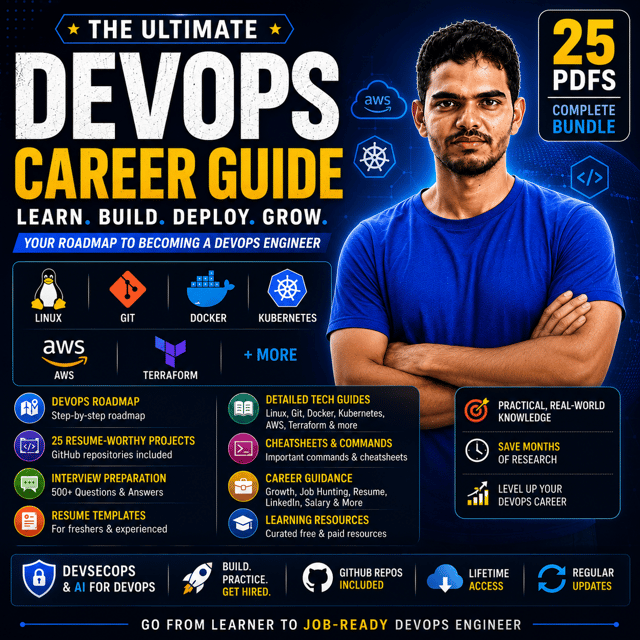
The Only Guide You Need for Your DevOps Career
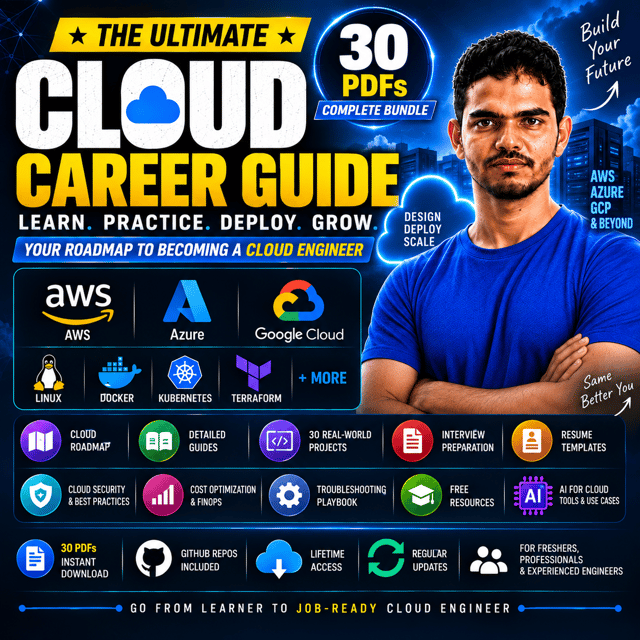
The Only Guide You Need for Your Cloud Career
Frequently asked questions
What is DevOps and why is it important?
DevOps is a way of working where software development and IT operations teams combine their workflows so software can be built, tested, and released faster and more reliably. It is important because companies today ship updates constantly, and DevOps practices like CI/CD, automation, and monitoring reduce failures and downtime. For businesses it means quicker releases and more stable systems, and for engineers it has created one of the most valuable skill sets in software.
What is a DevOps job?
In a DevOps job, you work at the junction of development and operations: you write scripts and pipelines that automate builds, deployments, and infrastructure. A typical day involves CI/CD tools like Jenkins or GitHub Actions, containers like Docker and Kubernetes, cloud platforms like AWS or Azure, infrastructure-as-code with Terraform, and monitoring systems. It is a hands-on engineering role focused on making releases smooth, environments consistent, and systems stable.
How to start a DevOps career?
Start with the foundations — Linux, networking, and Git — then learn a scripting language like Python or Bash. Move on to CI/CD, Docker, Kubernetes, and one cloud platform, building small real projects at every stage instead of only watching tutorials. If you already work in IT as a developer, sysadmin, QA, or support engineer, you can transition by picking up automation and cloud skills and moving toward DevOps responsibilities in your current role. Following a structured plan, or getting guidance from someone already working as a DevOps engineer, helps you avoid months of random learning.
What is the DevOps roadmap for beginners?
A practical DevOps roadmap for beginners usually follows this order: Linux and networking basics → Git and GitHub → scripting with Python or Bash → CI/CD with Jenkins or GitHub Actions → Docker → Kubernetes → one cloud platform (AWS or Azure) → Terraform → monitoring with tools like Prometheus and Grafana. Learn each stage by building something small, like a pipeline or a containerized app, because interviews test practical understanding rather than theory. Community-maintained roadmap guides online list free resources for each of these stages if you want a ready reference.
What does the DevOps roadmap for 2026 look like?
The DevOps roadmap for 2026 keeps the same core foundations — Linux, Git, CI/CD, Docker, Kubernetes, cloud, and Terraform — but puts much more weight on cloud-native and platform-engineering skills. GitOps workflows, DevSecOps practices, observability, and using AI tools to assist with automation and troubleshooting are increasingly expected in job postings. If you are starting now, learn the classic stack first and then layer these newer skills on top.
What does the DevOps career path look like?
A typical DevOps career path starts from roles like system administrator, cloud or support engineer, or junior DevOps engineer, then moves to DevOps engineer, senior DevOps engineer, and onward to lead, SRE, platform engineer, or cloud architect roles. With each stage, you own bigger systems and make more design decisions rather than just executing tasks. Because almost every company running software needs this function, the path exists across IT services, product companies, startups, and non-tech industries alike.
Is DevOps a good career in India?
Yes, DevOps is a good career — it pays above average for software roles, is needed across nearly every industry, and has a clear growth ladder into senior, architect, and platform engineering positions. The trade-off is that it demands continuous learning because tools evolve quickly. If you enjoy automation, cloud infrastructure, and solving problems under pressure, it suits you well; if you prefer pure application development, weigh that honestly before switching.
Is DevOps in demand in India?
Yes, demand for DevOps engineers in India remains strong, driven by cloud adoption across IT services, product companies, banking, and startups. Companies often struggle to find engineers who combine cloud, containers, CI/CD, and automation skills, which is why DevOps openings stay open longer and pay stays competitive. The demand is no longer limited to big tech — mid-size companies now run dedicated DevOps teams too.
Does DevOps pay well in India?
Generally, yes. DevOps engineers are among the better-paid software professionals in India because the role blends development, cloud, and operations skills that are hard to find in one person. Pay depends heavily on hands-on depth — Kubernetes, cloud architecture, and infrastructure-as-code command noticeably higher packages — and the curve rises steeply once you move into senior or lead roles. Freshers start modestly like in any IT role, but growth with proven experience is fast.
What are common DevOps interview questions and answers for freshers?
For freshers, interviewers usually stick to fundamentals: basic Linux commands, networking concepts like DNS, ports, and HTTP, Git workflows, what CI/CD is and why teams use it, the difference between a Docker image and a container, and simple scenarios like "a build is failing — what do you check?" Prepare short, clear answers backed by a project you built yourself, because follow-up questions almost always dig into what you have actually done.
What are the DevOps interview questions for 3 years of experience?
With 3 years of experience, expect depth over definitions: designing a CI/CD pipeline end to end, debugging a crashing Kubernetes pod, rolling back a bad production deployment, writing Terraform modules, and explaining incidents you have handled. Interviewers will go deep into the projects on your resume, so be ready to justify every tool choice you made. Practice explaining trade-offs, not just commands.
What are scenario-based DevOps interview questions and answers for experienced candidates?
Scenario-based DevOps interview questions and answers for experienced candidates usually revolve around real failure and design situations — production outages, pipeline bottlenecks, Kubernetes resource issues, or migrating from manual deployments to automation. A strong answer follows a structure: clarify the problem, explain how you would diagnose it, describe the fix, and state how you would prevent it in the future. Practicing these aloud, ideally in a mock interview with someone who has sat on the interviewer's side, helps far more than reading another question list.
What are Azure DevOps interview questions?
Azure DevOps interview questions focus on Microsoft's DevOps platform — Azure Pipelines (classic vs YAML), agents and agent pools, Boards, Repos, Artifacts, service connections, and how you would migrate an existing build and release process into Azure DevOps. Interviewers usually mix in general CI/CD concepts, so know both the tool specifics and the underlying principles. If the job description mentions Azure, set up a free project and build a small pipeline before the interview.
Can DevOps engineers work remotely from India?
Yes — remote DevOps careers are among the most remote-friendly in software because nearly all the work, from cloud infrastructure to pipelines and monitoring, happens online. Indian engineers work remotely for Indian product companies as well as overseas startups and enterprises, especially with strong Kubernetes, cloud, and automation skills. For remote roles, employers care most about evidence of hands-on ability — real projects, contributions, and clear communication.