Testimonials
Services


The Product Manager’s Interview Playbook
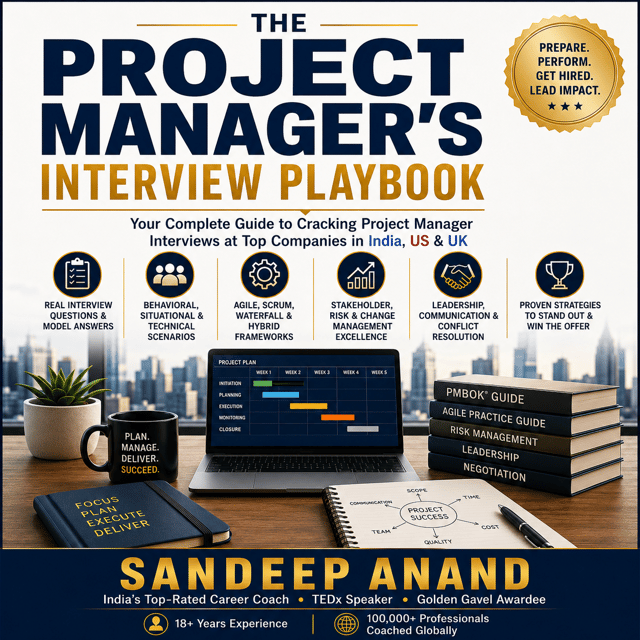
The Project Manager’s Interview Playbook
Bestseller Interview Guides & Career Blueprints
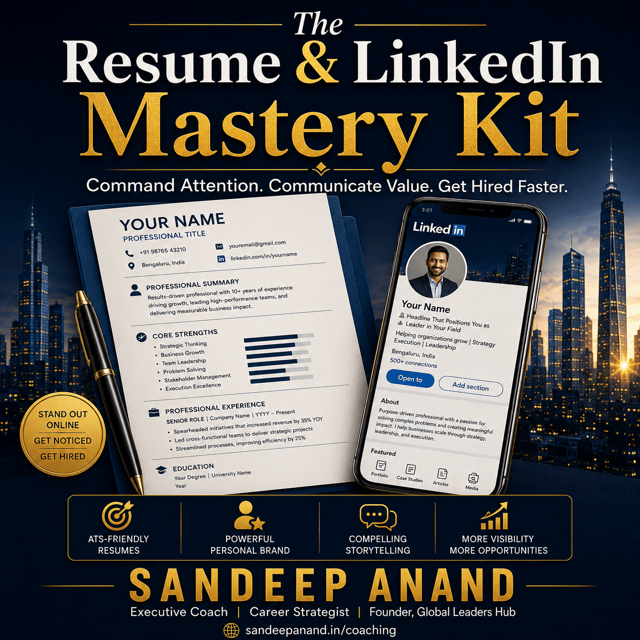
Career Toolkit 2026


Career Clarity Toolkit 2026

Job Search in the Digital Age
Life Coach Discovery Session
Leadership Development and Promotion Pathway
Future-Proofing Your Career




Career Pivot Strategy - In Person (Students)
Career Pivot Strategy - In Person
Career Pivot Strategy - In Person
Career 3.0: Future-Proof Your Career
Work-Life Balance and Career Satisfaction
Career Pivot Strategy
LinkedIn and Personal Branding Mastery
Startup Quick Insight
About me
- Sandeep Anand - Global Leaders Hub Reviews | Read Customer Service Reviews of sandeepanand.inhttps://www.trustpilot.com/review/sandeepanand.in
- Sandeep is a strategic leader with deep expertise in customer experience, quality frameworks, and data-driven execution. He delivers scalable impact, builds strong teams, and drives results across.Recommended by Prakash Panicker on

- Sandeep is an exceptional career coach who brings clarity, structure, and confidence to every session. His guidance is practical, honest, and results-driven, helping professionals make bold, choices!Recommended by Ajay Chandrasekar on

Frequently asked questions
What is the meaning of career transition?
The meaning of career transition is the process of moving from one role, industry, or career stage to another — usually to earn more, grow faster, or find more meaningful work. It can be a small shift, like moving from project management to product management, or a bigger one, like moving from a corporate job to entrepreneurship. A successful transition usually has three parts: clarity on where you want to go, repositioning your resume and LinkedIn for the new direction, and a structured plan to close any skill or experience gaps.
How to change careers at 30 without starting from scratch?
Changing careers at 30 is far more common than people think, and you rarely start from zero. Begin by auditing your transferable skills — communication, analysis, leadership, domain knowledge — and pick a target role where those skills are valued. Then reposition your resume and LinkedIn around that direction instead of your old job title, close your biggest skill gap with one focused course, and build proof through side projects, internal moves, or stretch work. With 25–30 working years ahead of you, a planned 6–12 month transition is completely realistic.
Is it worth working with a career transition coach?
A career transition coach is worth it when you are stuck on direction, not just effort. A good coach helps you pick the right target role based on your background, positions your resume and LinkedIn for it, prepares you for interviews and salary discussions, and keeps you accountable through an execution plan. If you already know exactly what you want and only need to apply, free resources may be enough. But if you have been applying without results, or you are switching fields and unsure how your experience maps, structured guidance usually shortens the journey significantly.
What should a resume for career transition include?
A resume for career transition should open with a summary that states clearly what you are moving into and why your background fits — not a list of past designations. Highlight transferable achievements with numbers, reframe past roles using the vocabulary of your target field, and place relevant skills, tools, and certifications near the top. Show outcomes instead of responsibilities, and add a short projects section to demonstrate you can already handle parts of the new role. Create one tailored version per target role rather than relying on a single generic resume.
What is career transition in LinkedIn, and how do I position my profile for it?
Career transition in LinkedIn means repositioning your profile so recruiters in your new field take you seriously. Update your headline to reflect where you are headed rather than only your current title, rewrite your About section around your target role, add and reorder skills to match it, and use the Career Break feature if you are between roles. Posting about what you are learning in the new field also signals genuine intent. A profile that only reflects your old career will keep attracting old opportunities.
Are career transition courses worth it?
Career transition courses are worth it when they give you structure, accountability, and feedback instead of just recorded videos. They make sense if they help you choose the right target role, close a specific skill gap, or include resume reviews, mock interviews, or mentorship. Before joining, check whether the outcome matches your goal — a certificate alone rarely gets you shortlisted, but a program that pushes you to complete a real project and reposition your profile usually does. If you are self-disciplined and only need knowledge, free resources can work; if you need direction and momentum, structured guidance pays for itself.
How do I find career transition jobs in India?
Start by identifying roles where your current skills transfer naturally — for example, IT professionals often move into product management, business analysis, or program management, while operations professionals move into project or supply chain roles. Then target companies known for hiring from adjacent backgrounds, prioritise referrals over job portals, and use LinkedIn keywords and filters for your new field. Tailor every application to the new role instead of mass-applying with your old profile. Referrals and internal moves remain the two highest-probability routes for career transition jobs in India.
How to crack a product manager interview as an experienced professional?
Cracking a product manager interview comes down to structured product manager interview preparation, not memorising answers. Focus on four areas: product sense (how you would improve or design a product), execution and metrics (defining success metrics and diagnosing drops), strategy (prioritisation and trade-offs), and behavioural stories with clear outcomes. As an experienced professional, interviewers will also test leadership — how you influenced without authority and handled conflicts. Practise answering out loud, use a consistent framework for every product question, and do mock interviews with feedback before the real one.
What is the product manager interview process like in India?
The product manager interview process in India typically has four to five rounds: a recruiter screen, one or two product case rounds covering product design, guesstimates, and metrics, a technical or analytical round depending on the company, a hiring manager or leadership round, and an HR round. Product companies and startups emphasise product sense and execution, while IT and services firms focus more on domain and program experience. Expect questions drawn from your own resume in every round, so be ready to explain the impact and numbers behind each project you have led.
What are the most common product manager interview questions and answers for experienced professionals?
For experienced candidates, product manager interview questions and answers for experienced professionals go deeper than textbook examples. The usual areas are product improvement questions ("How would you improve this app?"), metrics and execution ("A key metric dropped 20% — what do you do?"), strategy and prioritisation ("With limited resources, what do you build first?"), and behavioural questions about stakeholder conflicts, failures, and launches you have owned. Prepare six to eight stories with measurable outcomes, and structure answers around frameworks like user segmentation, need prioritisation, and trade-offs rather than reciting sample responses.
How do I handle salary negotiation with HR?
Treat salary negotiation with HR as a business conversation, not a confrontation. Get the offer in writing first, then respond with appreciation plus a justified counter — for example, "I'm excited about this role, and based on my experience and market benchmarks, I was expecting X." Support your number with market data and the specific value you bring, and negotiate the total package, not just fixed pay — variable, joining bonus, stock, and notice-period buyout are all negotiable in India. Never accept on the call itself; ask for time and confirm the revised offer in writing.
Can you share a salary negotiation with HR conversation example in India?
Here is a simple salary negotiation with HR conversation example in India: HR says, "We can offer ₹18 LPA." You reply, "Thank you — I'm genuinely excited about this role. Based on my eight years of experience and the market range for this position, I was looking at ₹21 LPA. Is there flexibility there?" If HR counters at ₹19–20, you can say, "If the fixed component is capped, could we align on ₹20 with a joining bonus?" The pattern is appreciation, a justified counter, and a flexible close — always collaborative in tone, and never bluff about competing offers.
What are the most effective salary negotiation tips for Indian professionals?
The salary negotiation tips that matter most: research the market range for your role, city, and experience level before the discussion; quote a specific number around 15–20% above your target instead of saying "as per market"; justify it with the impact and numbers from your work; and negotiate only after the offer exists, not during early screening rounds. Negotiate the full package — variable pay, bonus, stock, joining bonus, and appraisal timeline — stay polite but firm, and always respond in writing. Calm patience routinely adds more to an offer than aggression does.
How to negotiate salary in an interview when asked about salary expectations?
When the interviewer asks about salary expectations early, avoid anchoring on your current CTC. Say something like, "Based on the role's scope and market benchmarks, I'm expecting in the range of X to Y" — with a bottom figure you would genuinely accept. If they insist on knowing your current CTC, share it honestly but immediately add, "and I'm looking at a jump appropriate for this role's responsibilities." You can also defer the detailed discussion to the offer stage: "I'd prefer to discuss numbers once I fully understand the role."
What is a salary negotiation letter, and when should I send one?
A salary negotiation letter is a short, professional email in which you respond to a job offer and request better compensation. It thanks the employer for the offer, states your counter figure with justification — your experience, market data, and the value you bring — and optionally proposes alternatives like a joining bonus or an earlier appraisal if fixed pay is rigid. Send it after receiving the written offer and before accepting, keep it under 200 words, and maintain a warm, collaborative tone so the negotiation strengthens rather than strains the relationship.