Testimonials
Services
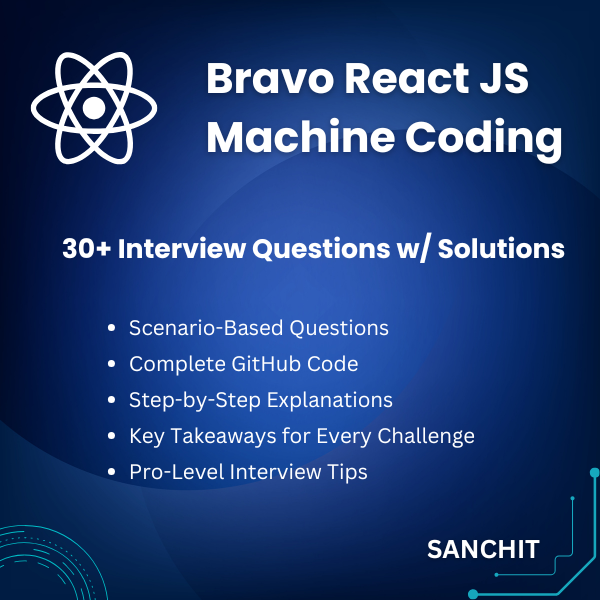
Frontend Development Mentorship
Resume/CV Review
Frontend Development Coaching
Mock Interview
1:1 Mentorship
Discovery Call
About me
- Highly praised for deep programming insights and effective career mentorship by Sanchit.
 AI-generated based on testimonials
Frequently asked questions
What is the full form of MERN stack?
MERN stands for MongoDB, Express.js, React, and Node.js. Together, these four JavaScript-based technologies let you build a complete web application — React handles the user interface, Node.js and Express.js power the backend and APIs, and MongoDB stores the data. Since everything runs on JavaScript, developers can work on both frontend and backend with a single language, which is a big reason the stack is so popular with startups and product companies in India.
What is a MERN stack developer?
A MERN stack developer is a full-stack developer who builds web applications using MongoDB, Express.js, React, and Node.js. They work on everything from designing React-based user interfaces to writing server-side logic with Node and Express and managing data in MongoDB. Because they can handle both client-side and server-side development, MERN stack developers are often hired for full-stack roles where one person owns a feature end to end.
What is MERN stack used for?
The MERN stack is used to build dynamic, scalable web applications such as e-commerce platforms, dashboards, social media apps, booking systems, and SaaS products. React is used for the frontend interface, Node.js and Express.js handle backend logic and REST APIs, and MongoDB stores application data. It is a good fit for single-page applications and products that need real-time updates and fast development cycles.
How to learn MERN stack as a beginner?
Start with the fundamentals — HTML, CSS, and modern JavaScript — since everything in the MERN stack depends on them. Next, learn React to build user interfaces, then move to Node.js and Express.js for the backend, and finally MongoDB for the database. Learn by building: a to-do app, a blog, and a small e-commerce clone are ideal starter projects to showcase on GitHub. Following a structured roadmap and getting your code reviewed by an experienced developer can save months of trial and error.
How to deploy a MERN stack project?
Deploy the frontend and backend separately: host the React frontend on Vercel or Netlify, and the Node.js/Express backend on Render, Railway, or a VPS. Use MongoDB Atlas for the cloud database. Make sure you set environment variables for your database URI and API keys, enable CORS between the frontend and backend, and use the production build (npm run build) for the React app. Free tiers on most platforms are enough for portfolio projects.
Is MERN stack in demand in India?
Yes. The MERN stack is one of the most widely used JavaScript stacks among Indian startups, IT services firms, and product companies, so demand for MERN stack developer jobs remains strong — especially for full-stack roles where one developer can handle both frontend and backend. Because the stack is JavaScript end to end, teams ship faster with smaller headcount, which keeps hiring steady for freshers as well as experienced developers.
MERN stack vs MEAN stack: which one should I learn?
The only real difference is the frontend layer — MERN uses React, while MEAN uses Angular. React has a larger community, a gentler learning curve, and more job openings in India, which is why most beginners are advised to learn the MERN stack first. MEAN still makes sense if you are targeting large enterprise applications built on Angular. Either way, skills like Node.js, Express, and MongoDB transfer between both stacks.
How much does a MERN stack developer earn in India?
The MERN stack developer salary in India depends heavily on experience, city, and company type. Freshers typically start around ₹3.5–6 LPA, developers with 3–5 years of experience commonly earn ₹8–18 LPA, and senior full-stack developers in product companies can cross ₹25 LPA. Strong React skills, solid backend architecture knowledge, and a portfolio of real projects are what push offers toward the higher end.
Which MERN stack interview questions should I prepare?
Expect questions across all four technologies: React (hooks, virtual DOM, state management), Node.js and Express (event loop, middleware, error handling), MongoDB (schema design, indexing, aggregation), and REST API concepts like authentication and status codes. Full-stack roles often include a machine coding round where you build a small working app in limited time, so practice coding under time pressure. Also prepare to explain your projects clearly — interviewers frequently probe what you built and why you made those choices.
Which React JS tutorial should I start with as a beginner?
Start with the official React documentation, which is free, regularly updated, and teaches the modern hook-based approach. Add a project-based course or video series alongside it so you apply concepts immediately, and make sure whatever resource you pick teaches functional components and hooks rather than outdated class components. The biggest mistake beginners make is passively watching tutorials — build small projects as you go so the concepts actually stick.
What is React JS used for?
React JS is used for building interactive user interfaces, especially single-page applications where content updates without reloading the page. It powers dashboards, e-commerce frontends, social feeds, and admin panels across companies of every size, and it is also the foundation of React Native for mobile app development. Its component-based structure makes code reusable and easier to maintain, which has made it the most in-demand frontend library in India's job market.
How to install React JS and set up your first project?
Install Node.js first from the official website, since React tooling runs on it. React itself is not installed standalone — it gets added when you scaffold an app. If you are unsure how to create a React JS project, run npx create-react-app my-app in your terminal (or npm create vite@latest for a faster modern setup), move into the project folder, and start the development server with npm start. Your app will then open in the browser at localhost.
Which React JS interview questions are asked most often?
The most common React JS interview questions cover the virtual DOM, JSX, functional vs class components, props vs state, keys in lists, and hooks like useState and useEffect. Experienced candidates are probed deeper on performance optimization, code splitting, state management, and component design patterns. Interviewers also love scenario-based questions — how you would handle form state, fetch API data, or debug a re-render — so practice explaining your reasoning aloud rather than only memorizing definitions.
What are the most common frontend interview questions for freshers?
Freshers are usually tested on semantic HTML, CSS layout with Flexbox and Grid, responsive design, and core JavaScript — closures, promises, the event loop, array methods, and ES6 features. If React is on your resume, expect basic questions on components, state, and props, plus a small live coding exercise. The best preparation is having 2–3 solid projects you can explain confidently, because interviewers almost always dig into what you actually built and why.
How are frontend interview questions for experienced developers different from fresher interviews?
With experience, the focus shifts from syntax to engineering depth. Expect frontend interview questions on performance optimization, state management with Redux or similar tools, component architecture, accessibility, testing, and frontend system design — for example, architecting a feed or a checkout flow. Interviewers will also deep-dive into your past projects and ask why you made specific technical decisions, so rehearse clear, structured explanations of your real-world work.