Testimonials
Services
Grow Your Founder Brand
About me
- My first gig was $25 for YT scripts. Then, I built a 6-figure agency.https://newsletter.thousandfaces.club/p/sakshi-shukla-interview
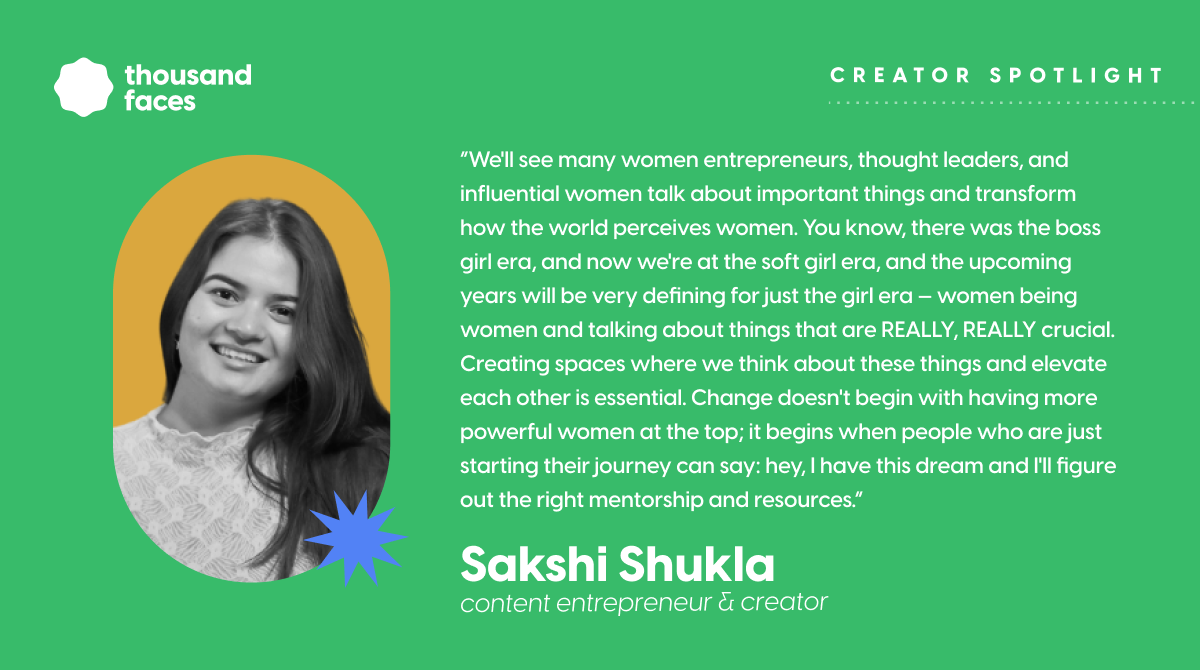
- Sakshi is celebrated for her honest insights, personalized guidance, and commitment to fostering growth.
 AI-generated based on testimonials
Frequently asked questions
How to create a content strategy for social media from scratch?
Begin with the basics most people skip: audience, goal, and pillars. Define exactly who the content is for and what it should achieve — leads, trust, hires, or community. Lock three to four content pillars you can realistically create around, map each pillar to formats your audience already consumes (reels, carousels, long-form posts), and fix a posting frequency you can sustain for 90 days, not a week. Batch-create weekly, track only two or three metrics such as saves, profile visits, and inbound enquiries, and review monthly. Double down on what is working instead of restarting with every trend cycle.
What is content strategy in digital marketing, and how is it different from just posting regularly?
A content strategy is the plan behind everything you publish: who it is for, what it should achieve, which topics and formats you will use, how often you will post, and how success is measured. Within digital marketing, it connects content to business outcomes — so a post is not just "content", it is working towards discovery, trust, or conversion. Posting regularly without a strategy produces noise; with one, every piece has a job, repeats your core message from a fresh angle, and compounds over time. That is why strategists start with audience and goals, never with the calendar.
How to learn content strategy with no formal marketing background?
Yes, it is learnable — and the fastest route is learning by doing, not collecting certificates. Read a couple of foundational books on positioning and audience research, follow breakdowns from working practitioners, and then reverse-engineer ten brands you admire: note their content pillars, hooks, formats, and posting rhythm. The real classroom is a live account — create a 30-day content plan for your own profile or a small business you know, publish for 90 days, and study what gets saved, shared, and answered. A structured course can accelerate the fundamentals, but without real publishing experience the theory will not stick.
What is personal branding and why is it important today?
Personal branding is the deliberate shaping of how people perceive your expertise, values, and personality when they come across you — online or offline. It is important because clients, employers, investors, and media now trust people more than logos: a strong personal brand brings inbound opportunities instead of you constantly chasing them. For founders, it becomes the cheapest distribution channel the company has; for professionals, it compounds into better roles, speaking invites, and credibility that follows you across jobs. Your skills get you started — your personal branding decides how far and how fast you scale.
How to build personal branding when you are starting with zero audience?
Start with clarity, not content. Pick one niche you can talk about for years, rewrite your profile headline and bio to say exactly who you help and how, and then post two to three times a week documenting your real work, lessons, and opinions. Spend more time commenting thoughtfully on other people's posts than scrolling — early visibility comes from conversations, not virality. Show proof as you grow: projects, results, screenshots, testimonials. Done consistently for six to twelve months, this compounds into a brand that pulls opportunities to you instead of you chasing them.
Should I hire a personal branding agency or work with a personal branding coach?
It depends on whether you want to outsource execution or build your own voice. A personal branding agency handles strategy, writing, and posting for you — useful if you have the budget and very little time, though the voice can feel ghostwritten. A personal branding coach works with you 1:1 to sharpen your positioning, storytelling, and content muscle — usually better when the brand is genuinely you, as with founders and CXOs, because audiences connect with authenticity. Many professionals start with a coach to get clarity and a system, then hire execution support once the direction is set.
Do I need a personal branding website if I am already active on LinkedIn?
Not at the start. Social platforms give you attention and distribution for free, so prove your ideas there first. A dedicated personal branding website becomes useful once you need a permanent home for things social media handles poorly: a portfolio, case studies, press features, testimonials, long-form writing, and a clear way for people to hire or contact you. Even a simple one-page site with your bio, best work, and contact details is enough — and it quietly does the heavy lifting when clients, recruiters, or journalists Google your name.
How to write a brand story that actually connects with customers?
Keep the customer at the centre and your brand as the guide. A simple structure: the real problem your customer had, why the usual solutions failed, the moment or insight that led to your brand, what changed for a real customer, and where they are now. Use specific details — names, numbers, places — instead of vague claims like "quality" and "innovation". Write one long version for your website and cut a 100-word version for social media and pitches. The best test: read it aloud, and if a customer could hear their own story in it, it works.
What is brand storytelling in marketing?
Brand storytelling is the use of narrative — characters, conflict, and resolution — across your marketing so people feel something and remember you, instead of just processing features and benefits. In practice it shows up as founder-origin posts, customer before-and-after stories, behind-the-scenes build updates, and a consistent "why" running through your website, ads, and social content. The difference is mechanical: feature-led marketing says "we have X", while storytelling says "here is what life looked like before X, and what it looks like now." Stories get shared and trusted; specifications alone rarely do either.
Which brand storytelling framework works best for startups?
Frameworks exist to stop your messaging from being random. Popular ones include the StoryBrand model (customer is the hero, brand is the guide), Simon Sinek's Golden Circle (start with why, then how, then what), and the Pixar story spine ("once upon a time… every day… until one day…"). For startups, a simple five-beat version works best: the customer's painful problem, why existing options fail, your unique insight, proof it works, and the better life after. Write it once as a one-page narrative and reuse it across your homepage, pitch deck, and social content so every channel tells the same story.
What are some good brand storytelling examples startups can learn from?
Study the patterns rather than copying brands. The strongest brand storytelling examples usually fall into four buckets: founder-origin stories that begin with a personal frustration (very common among Indian D2C and SaaS founders), customer transformation stories with real names and before-and-after numbers, build-in-public updates that share failures and milestones honestly, and "us versus the old way" narratives that position the brand against a slow or outdated default. Pick three to five brands in your space, sort their posts into these buckets, and notice how specific details — prices, cities, screenshots — make each story believable. Then rebuild the pattern with your own facts.