Testimonials
Services
Resume Review/ ATS question
Discovery Call- Insights about FAANGs Hiring
1:1 Career Mentorship
FAANG Hiring |Insights, Doubt session, Q&A
Career Guidance-AMA
Ask Any Query-Your Amazon Application Status
Data Engineer Role- Prep Material
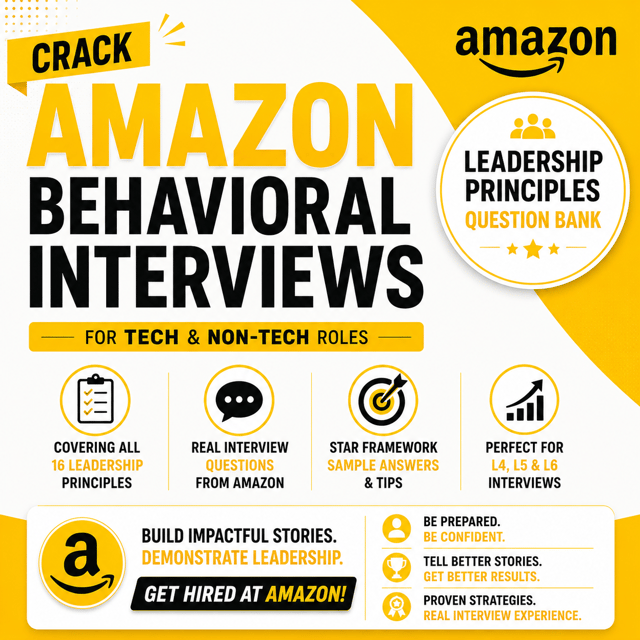
Amazon Edition-Leadership Principles Question Bank
FAANG Interview Prep-Tips and Tricks
How to Increase Application Response |Job search
Bar Raising Questions-System Design Cheat Book
Cheat Book to Crack Amazon (SDE1/2/3) interviews
About me
- I am writing to highly recommend Sakshi for her outstanding recruiting skills and professional demeanor. I had the pleasure of working with her during my hiring process at Amazon.Recommended by Akash Goyal on

Frequently asked questions
How do I prepare for an Amazon interview?
The most effective way to think about how to prepare for an Amazon interview is to split your prep into three tracks: coding and DSA, system design (mainly for SDE2 and above), and Amazon's Leadership Principles. Amazon's loop almost always includes a Bar Raiser round, so structured behavioural answers in the STAR format carry as much weight as your coding rounds. Build real project stories, practise explaining solutions out loud, and finish with timed mock interviews. Since Amazon evaluates candidates against its own internal benchmarks, getting feedback from someone who actually runs Amazon's hiring process — for example, through a 1:1 prep call with an Amazon recruiter — helps you catch gaps that generic online advice misses.
How long does it take to prepare for an Amazon interview?
There is no fixed answer to how long to prepare for an Amazon interview, but most working professionals in India need roughly 8–12 weeks of focused preparation. Candidates already strong in DSA may manage in 4–6 weeks, while SDE2 and SDE3 aspirants should add extra weeks for system design and Leadership Principles stories. If you're preparing alongside a full-time job, plan 1.5–2 hours on weekdays with longer weekend sessions. Start before a recruiter contacts you, because interview loops get scheduled quickly once your profile is shortlisted.
How do I answer Amazon interview questions?
The reliable approach to how to answer Amazon interview questions is to frame every behavioural answer using the STAR method and explicitly connect it to specific Leadership Principles like Ownership, Customer Obsession, and Deliver Results. In coding rounds, clarify requirements, think out loud, and discuss trade-offs before writing code, because interviewers score your reasoning as much as the final solution. Avoid memorised, generic-sounding answers — interviewers probe with deep follow-ups, so your stories must come from work you actually did. Preparing from a proper Leadership Principles question bank makes your answers far more targeted than improvising on the spot.
What is an Amazon interview prep call?
An Amazon interview prep call is a 1:1 session with a mentor — often a current or former Amazon recruiter or interviewer — who explains the full interview process, what each round tests, and where your profile currently stands. It usually covers resume gaps, likely coding and system design questions, Leadership Principles stories, and sometimes your application status or referral strategy. Candidates typically book one a few weeks before their interview loop so they still have time to fix weak areas. Note that it is different from the official call Amazon's own recruiters schedule with you, which mainly covers logistics and role expectations.
What are FAANG interview questions?
FAANG interview questions are the questions asked in hiring processes at Facebook (Meta), Amazon, Apple, Netflix, and Google — a term that now loosely covers all top product-based companies. They fall into three broad categories: data structures and algorithms (arrays, strings, trees, graphs, dynamic programming), system design for experienced candidates, and behavioural or hiring-manager rounds. What sets them apart from typical service-company interviews is the focus on how you think and trade off decisions, not just the final answer. Each company has its own flavour — Amazon weighs Leadership Principles heavily, while Google goes deeper on algorithms and scale.
How do I prepare for a FAANG interview?
A realistic plan for how to prepare for a FAANG interview spans about three months: first lock down DSA fundamentals, then solve 150–200 quality problems by pattern rather than randomly, and finally layer on system design and behavioural prep. Keep a written doc of 8–10 project stories mapped to themes like ownership, conflict resolution, and failure, since every FAANG company runs a behavioural round. Do at least two or three mock interviews, because communication under pressure is where most strong candidates slip. Tailoring your resume for each application also matters, as ATS filters reject many technically capable candidates before a human ever sees the profile.
What are the most common system design interview questions?
The most common system design interview questions include designing a URL shortener, a chat app like WhatsApp, a social media news feed, a rate limiter, a ticket-booking platform like BookMyShow, and a food delivery or ride-sharing service. In India specifically, scalable versions of payment apps and delivery platforms like Swiggy or Zomato come up very frequently in product-company interviews. Within about 40–45 minutes, interviewers expect you to cover requirements, capacity estimation, API design, database choice, caching, and failure handling. Deeply practising 10–15 classic designs beats superficially skimming fifty of them.
How do I prepare for a system design interview?
If you are working out how to prepare for a system design interview, start by learning the core building blocks — load balancers, caching, SQL vs NoSQL trade-offs, message queues, sharding, and CDNs — then apply them to classic problems using a fixed framework: clarify requirements, estimate scale, draw the high-level design, deep-dive into one or two components, and close with bottlenecks. Practise on a whiteboard or shared doc within a 40-minute timer while talking through your decisions out loud. System design usually enters the picture at SDE2 level and above, so senior candidates should dedicate nearly a third of their total prep time to it. One timed mock with detailed feedback teaches you more than a week of passive reading.
What is Grokking the System Design Interview?
Grokking the System Design Interview is a widely used online course that teaches system design through classic questions like URL shorteners, chat systems, and news feeds, breaking each into reusable patterns. It is popular because it gives beginners a repeatable framework instead of scattered theory. That said, clearing Amazon or FAANG design rounds usually needs more — supplement it with open-ended practice, estimation drills, and mocks with real feedback. Many candidates pair such a course with a condensed cheat sheet of bar-raiser-style questions for revision in the final weeks.
Where can I find a good Amazon interview preparation guide PDF?
A lot of candidates hunt for an Amazon interview preparation guide PDF on GitHub, Telegram groups, and Reddit, but most free PDFs in circulation are outdated or stitched together from random sources. A better filter is to use material created by someone who has actually hired at Amazon, because it reflects what interviewers currently check — Leadership Principles questions, recent DSA patterns, and SDE1/SDE2-specific expectations. Structured cheat books prepared from the recruiter's side are usually more reliable than recycled notes. Whichever source you pick, make sure it covers all three areas: coding, system design, and behavioural prep.
Is an Amazon interview preparation course worth it?
An Amazon interview preparation course is worth it mainly if you need structure, accountability, or insider context on how Amazon's hiring actually works. Self-study works well for disciplined candidates who are already strong in DSA, but many people lose months on random resources without knowing what Amazon's interviewers actually evaluate. A course or 1:1 mentorship from a working Amazon recruiter gives you specific feedback on your resume, your Leadership Principles stories, and your system design approach. Given the compensation jump an Amazon offer brings in India, guided prep is usually a reasonable investment — just verify the mentor has real hiring experience.
Where can I find real FAANG interview questions and answers?
The most authentic FAANG interview questions and answers come from LeetCode's company-tagged problems and discussion threads, GeeksforGeeks interview experiences, and recent candidate reports on Reddit and Blind. These reflect what is actually being asked in current loops, which matters because FAANG question banks shift every few months. The catch is that copy-pasting answers does not work — interviewers follow up with variations, so you must understand the underlying pattern. Curated question banks prepared by interviewers or recruiters are useful when you want a filtered, current set instead of digging through hundreds of threads.
Which system design interview book should I read?
The most widely recommended system design interview book is Alex Xu's System Design Interview (Volumes 1 and 2), which covers core patterns like rate limiting, consistent hashing, URL shorteners, and chat systems, with Volume 2 moving into more advanced, real-world designs. For deeper fundamentals, Designing Data-Intensive Applications is the standard follow-up read. Books alone will not get you through the round, though — pair them with timed mock designs and feedback from someone who has actually evaluated these interviews. For Amazon specifically, expect the interviewer to push hard on trade-offs and real-world constraints rather than textbook diagrams.
How do I make my resume ATS-friendly for Amazon and other product companies?
To make your resume ATS-friendly, use a single-column layout with standard headings, avoid tables, graphics, and text boxes, and mirror keywords from the job description naturally in your experience section — the exact languages, systems, and role level matter. Quantify impact with numbers, such as latency reduced, users served, or cost saved, instead of listing responsibilities. Keep it to one page if you have under 8–10 years of experience. Since recruiters only see what the ATS lets through, getting your resume reviewed from the recruiter's side reveals why it may be getting filtered out despite relevant experience.
Why is my Amazon application not getting shortlisted, and how can I follow up on its status?
An Amazon application usually stalls for predictable reasons: the resume did not clear keyword matching, the role drew stronger referral or internal candidates, your profile was pitched at the wrong level (SDE1 vs SDE2), or it simply sat in a high-volume queue. Applying to too many unrelated roles in a short span can also reduce visibility. The fastest fixes are getting a referral, tailoring your resume to the exact job description, and having someone who understands Amazon's internal process review your application status and suggest next steps — a generic "please view my profile" message to a recruiter rarely moves anything.