Testimonials
Services
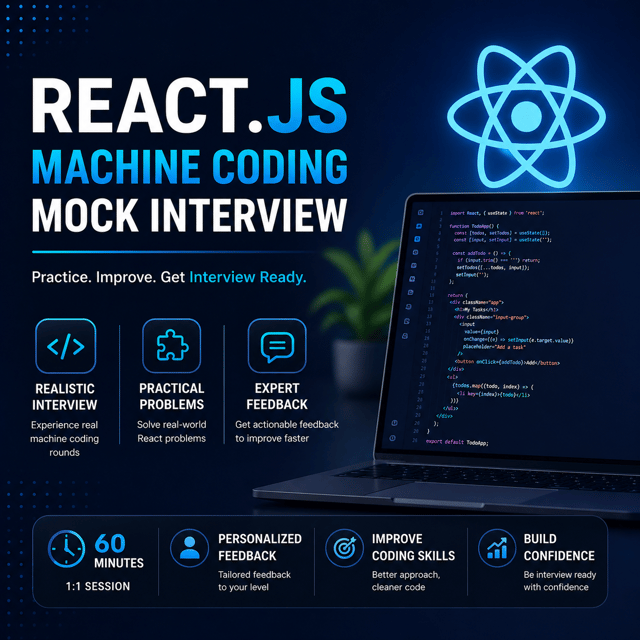
React Machine Coding Mock Interview
Resume Review | Stand Out to Recruiters 🚀

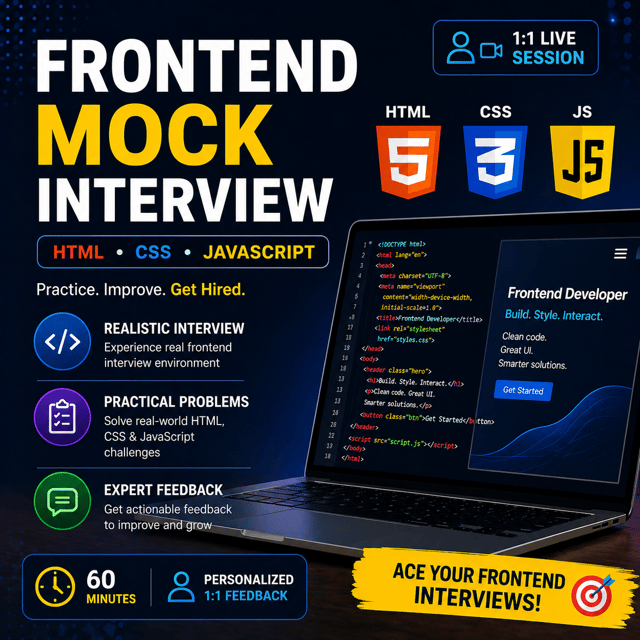
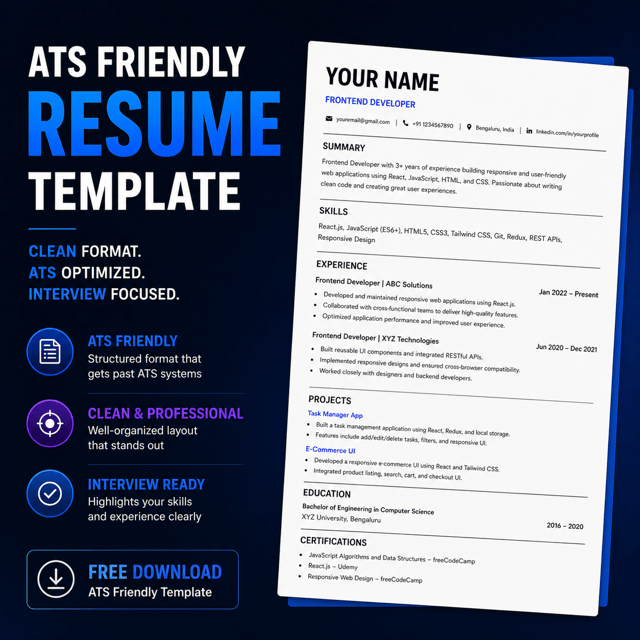
My Resume Template (ATS Friendly)
Ask anything
About me
- Saikumar delivers high-quality work, proactively enhances UX, and improves products. His technical expertise and user-focused mindset make him a valuable asset to any team. Highly recommended!Recommended by Product Owner on

- Saikumar provides professional, insightful, and friendly resume reviews that boost confidence and enhance resumes.
 AI-generated based on testimonials
Frequently asked questions
What are the most common React interview questions and answers?
The most common React interview questions and answers centre on a predictable set of topics: the virtual DOM and reconciliation, JSX, functional vs class components, props vs state, useState and useEffect (especially the dependency array), keys in lists, controlled components, lifting state up, and conditional rendering. For mid-level roles, expect follow-ups on performance optimisation, useMemo vs useCallback, code splitting with React.lazy, and context vs prop drilling. Rather than memorising answers, prepare to explain each concept with a small code example, because interviewers almost always probe one level deeper than the standard answer.
How are React interview questions and answers for experienced candidates different from fresher interviews?
Fresher interviews mostly test definitions and basic building blocks, while React interview questions and answers for experienced candidates go into rendering behaviour, re-render control, state management architecture, performance profiling, micro-frontends, and trade-off decisions. Interviewers also expect you to justify choices made in real projects, not recite theory. If you have around five years of experience, be ready to design a small feature end to end and explain the "why" behind every decision, since that is where most experienced candidates actually get filtered out.
How should a fresher prepare for a React interview?
Start with fundamentals, because most React interview questions for freshers stay close to the basics: what React is and how it differs from plain JavaScript, components, props, state, JSX, lists and keys, and hooks like useState and useEffect, often followed by a simple live exercise such as building a to-do list or a counter. Practise explaining your code out loud while you build, and revise core JavaScript side by side, since interviewers frequently mix JavaScript fundamentals into React rounds for freshers.
What frontend system design interview questions are commonly asked?
Frequently asked frontend system design interview questions include designing a news feed, a chat application, an e-commerce product page, a typeahead or autocomplete, a photo gallery with infinite scroll, and an analytics dashboard. For each, you are evaluated on how you gather requirements, break the UI into components, define data flow and API contracts, and handle caching, pagination, optimistic updates, performance, accessibility, and edge cases. Talk through your trade-offs out loud instead of jumping straight into a solution.
How to approach frontend system design questions in an interview?
A dependable way to approach frontend system design questions is to follow a fixed structure: clarify functional and non-functional requirements, propose a high-level component breakdown, define the data models and API contracts, and then deep-dive into one or two hard parts such as caching, real-time updates, or rendering very large lists. Interviewers judge how you reason, ask questions, and handle pushback far more than whether your design matches some "correct" answer, so keep stating assumptions and trade-offs throughout.
What should a good frontend system design roadmap cover?
A practical frontend system design roadmap should move from browser fundamentals — rendering, the critical rendering path, HTTP and caching — to component-level design, state management patterns, and API design, and then to advanced areas like performance optimisation, code splitting, design systems, micro-frontends, offline support, and accessibility. Study one real product at a time, such as a feed or a chat app, and try redesigning it yourself. Sketching designs and getting feedback from someone senior shortens the learning curve far more than passive reading.
Is a frontend system design course worth it?
A frontend system design course is worth it only if it teaches a repeatable framework — requirements, component breakdown, data flow, trade-offs — and makes you practise explaining your design out loud, because that is exactly what interviews test. Before enrolling, check that it covers frontend-specific concerns such as rendering, caching, state, and UI performance rather than only backend scaling. Keep in mind that no course is sufficient on its own; pairing the material with regular mock attempts and honest self-review of your designs is what actually builds the skill.
What is front end architecture?
Front end architecture refers to how the user-facing layer of an application is structured: how components are organised, how state and data flow are managed, how routing, styling, and shared logic are handled, and how the codebase is split so multiple teams can work independently. Decisions such as monolith versus micro-frontends, where state should live, and whether to invest in a shared design system determine how easily a product scales in features and team size. Interviewers ask about it to check whether you can think beyond individual components.
Are GitHub repositories enough to prepare for React and frontend system design interviews?
Searching "react interview questions github" or "frontend system design github" returns hundreds of curated repositories, and they are genuinely useful for discovering topics, question patterns, and coding exercises. They are not enough on their own, though — many lists are outdated or pitched at the wrong level, and reading answers does not build the ability to code or reason under time pressure. Use repositories to build your topic checklist, write your own answers, practise machine coding rounds with a timer, and do a few mock interviews before the real one.
How to respond to interview questions using the STAR method?
The STAR method — Situation, Task, Action, Result — is the simplest way to respond to interview questions about your experience without rambling: set the context in a line or two, state what you were responsible for, describe the specific actions you took, and finish with a measurable result. Prepare three or four stories in advance — a bug fixed under pressure, a performance improvement, a disagreement you resolved — so you can adapt them to most behavioural questions instead of improvising on the spot.
How to respond to the tell me about yourself interview question?
Keep it to 60–90 seconds and follow a present–past–future flow: what you do now, the relevant experience and achievements behind it, and why this particular role excites you. How you respond to the tell me about yourself interview question sets the tone for the rest of the round, so tailor the emphasis to the job — for a frontend role, talk about your React, performance, or design-system work rather than your entire history — and end with a hook the interviewer can pick up on. Rehearse it aloud until it sounds natural, not memorised.
How to respond to interview questions about weaknesses?
Choose a real but non-fatal weakness and show both self-awareness and a corrective plan: name it, give a short example of how it showed up in your work, and explain what you are doing about it, ideally with visible progress. Avoid clichés like "I am a perfectionist," and never name something core to the job — a frontend engineer claiming weak attention to detail, for example, undermines the role itself. Interviewers are really testing honesty and growth mindset, not the weakness you pick.
What are the most common JavaScript mock interview questions?
JavaScript mock interview questions usually open with closures, the event loop, promises and async/await, the "this" keyword, prototypes, hoisting, and destructuring, then move to output-prediction snippets, debouncing and throttling, and small live exercises such as implementing debounce or a promise-based retry from scratch. For frontend roles, expect follow-ups that connect these to the browser — how microtasks affect rendering, or why long tasks freeze the UI — because that connection is where most candidates are actually separated.
How do I get JavaScript mock interview practice before an actual interview?
Make your JavaScript mock interview practice mirror the real thing: a 45–60 minute session mixing theory questions with live coding, done under a timer you do not negotiate with. Rotate between practising with friends, joining peer mock communities, and booking sessions with an experienced frontend engineer who can give structured feedback. Record yourself at least once — most people are surprised by how much they ramble — and after every mock, note the questions you fumbled and redo them within a week while they are still fresh.
What is an ATS friendly resume?
An ATS friendly resume is formatted so applicant tracking systems can parse it correctly: a single-column layout, standard section headings such as Experience, Education, and Skills, no critical details trapped in tables, text boxes, headers/footers, or graphics, and skills phrased using the exact terms from the job description. Plenty of strong candidates get rejected at the screening stage simply because a decorative template scrambles their information. Use a clean, simple template, mirror each job posting's keywords, and save the file in a widely accepted format before applying.