Testimonials
Services
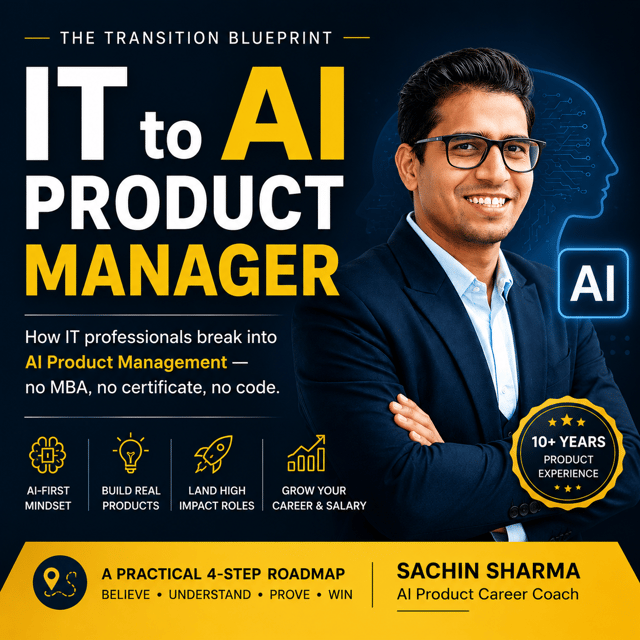
IT to AI Product Manager (Free eBook)
About me
- Product Management with Sachin Sharma - YouTubehttps://www.youtube.com/@catchupwithsachin
- Product Career Academy | Sachin Sharma | Substackhttps://productcareeracademy.substack.com/


Frequently asked questions
What is a product manager interview like?
A product manager interview typically has multiple rounds covering product sense (how you think about building or improving products), execution (metrics, prioritisation, trade-offs), strategy, and behavioural questions about your past work. Many companies also include a case study, a guesstimate, or a take-home assignment. Expect constant follow-up "why" questions, because interviewers are testing the structure and user-focus of your thinking, not just your final answer.
How to prepare for a product management interview?
Start by understanding the core question types — product design, product improvement, metrics and analytics, guesstimates, and behavioural — then practise the core question types — product design, product improvement, metrics and analytics, guesstimates, and behavioural — then practise answering out loud using a consistent structure (users → problems → solutions → trade-offs → metrics). Study the company's product, users, and recent launches before every round, give yourself 3–4 weeks of consistent practice, and replace passive reading with speaking your answers aloud and taking mock interviews for real feedback.
How to crack a product manager interview?
Cracking a product manager interview comes down to three things: structured thinking, relevant stories, and deliberate practice. Prepare 5–7 strong stories from your own experience using a STAR-style format, learn a repeatable structure for design and metrics questions, and rehearse under interview-like pressure. Candidates who do multiple mock interviews and iterate on feedback consistently outperform those who only read guides, so treat practice as the final and most important stage of your preparation.
How to answer product management interview questions?
Never jump straight to a solution. Take a moment to clarify the goal and constraints, structure your answer (for example: users → problems → solutions → trade-offs → success metrics), and think aloud so the interviewer can follow your reasoning. Back your points with examples from real products or your own work, and whenever you state an opinion, explain the "why" behind it. Practising this pattern repeatedly is what turns average answers into strong ones.
What are the most common product management interview questions and answers?
The most frequently asked product management interview questions fall into a few buckets: "Design or improve a product for X", "What metrics would you track for X?", "Estimate the number of X", "How would you handle conflicting priorities?", and behavioural questions like "Tell me about a time you failed". Strong answers follow a clear structure — clarify the problem, state assumptions, break the problem into parts, and close with trade-offs and success metrics — rather than a memorised reply. Preparing one polished example per category covers most interviews.
How to answer "Why are you interested in product management?" in an interview?
Interviewers ask this to check whether you understand what the role actually involves and whether your motivation will last. Avoid generic answers like "I love working with people and technology". Instead, connect your own experience to specific parts of the job — a time you identified a user problem, influenced a decision without authority, or owned an outcome end to end — and explain why product management is the logical next step for you.
Are mock interviews useful for product management interviews?
Yes, and they are one of the highest-impact parts of preparation. Reading sample answers feels productive, but only a mock interview exposes real gaps — unclear structure, rambling, weak metrics, or missing trade-offs. Aim for at least 2–3 mocks with someone who has worked as or hired product managers, share your resume and target role in advance, and actively work on the feedback after each session.
How to write a product manager resume?
Lead every bullet with impact, not responsibilities — for example, "Increased activation by 18% by simplifying onboarding" instead of "Responsible for onboarding". Keep it to one page, tailor it to the specific PM role you are targeting, and quantify results wherever possible. If you are moving from engineering or another function, reframe your experience around product decisions, user problems, and outcomes you owned rather than technical tasks you performed.
What should a product manager resume look like?
A strong product manager resume is one page, cleanly formatted, and scannable in under 30 seconds. The typical structure is: a short summary stating your PM focus, a concise skills line (product discovery, roadmapping, analytics tools), professional experience written as impact-driven bullets with numbers, and education. Avoid dense paragraphs, long technical skill lists, and generic duties — every bullet should answer "what changed because of you?"
Are product manager resume templates worth using?
A good template is useful for structure — it stops you from burying your impact, missing key sections, or ending up with a cluttered layout. But a template alone will not get you interviews; recruiters shortlist based on the substance inside it, especially quantified outcomes and PM-relevant framing. Use a PM-specific template as the skeleton, customise every bullet to the role you are applying for, and if possible get the final version reviewed by an experienced product manager.
How to transition to product management from engineering?
Start building product skills inside your current job: volunteer to own features, talk to customers, write specs or PRDs, and participate in prioritisation and roadmap discussions. In parallel, learn core PM concepts — product discovery, metrics, user research — and reposition your resume so it leads with product outcomes instead of code. Internal transfers, associate PM roles, and startup positions are the most common entry routes, and practising product interviews is essential, because engineers are usually evaluated on product thinking rather than technical depth.
How do I switch from IT to an AI product manager role?
Treat it as a two-track plan: strengthen your product management fundamentals (discovery, metrics, prioritisation, stakeholder management) and build AI-specific knowledge on top — how LLMs and ML models work, what AI products can and cannot do, and how AI features are evaluated. Look for opportunities to work on data-driven or AI-adjacent features in your current role, and add one AI project or case study you can discuss in depth. Hiring managers look for proof that you can make sound product decisions in an AI context, so be ready to talk through real use cases, limitations, and trade-offs.