Testimonials
Services
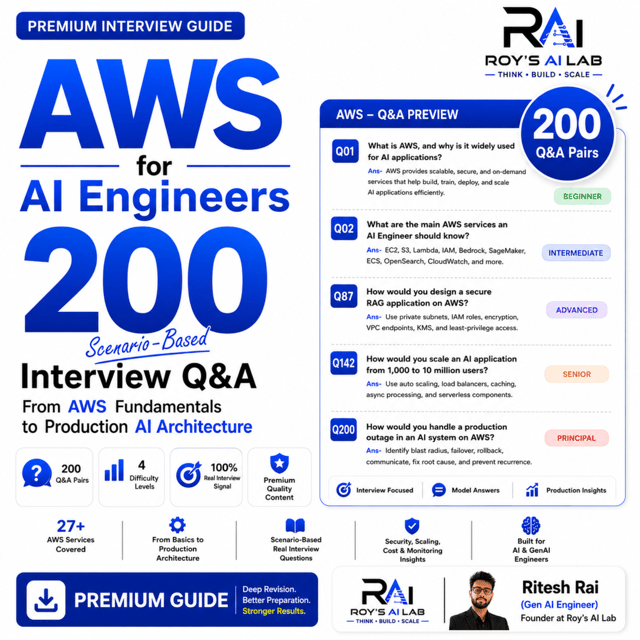
AWS for AI Engineers: 200 Interview Q&A
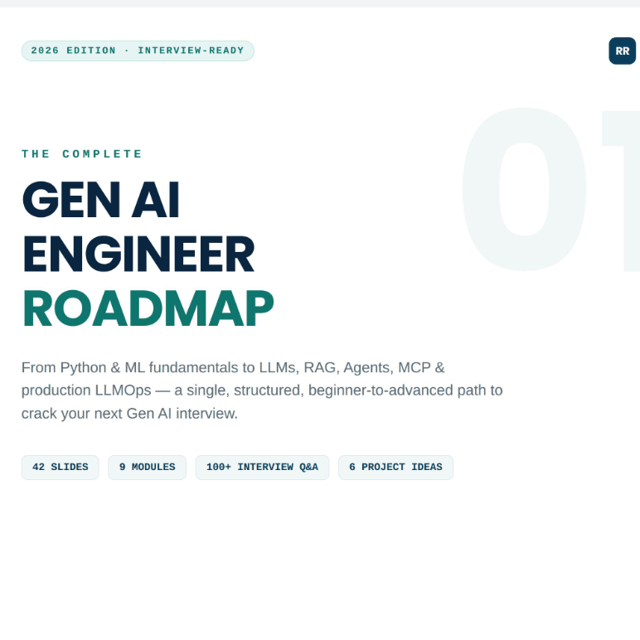
Gen AI / AI Engineer Blueprint 2026
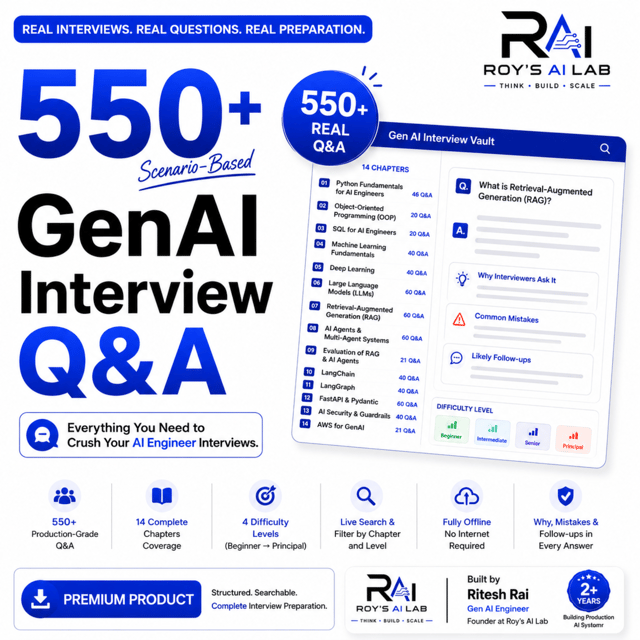
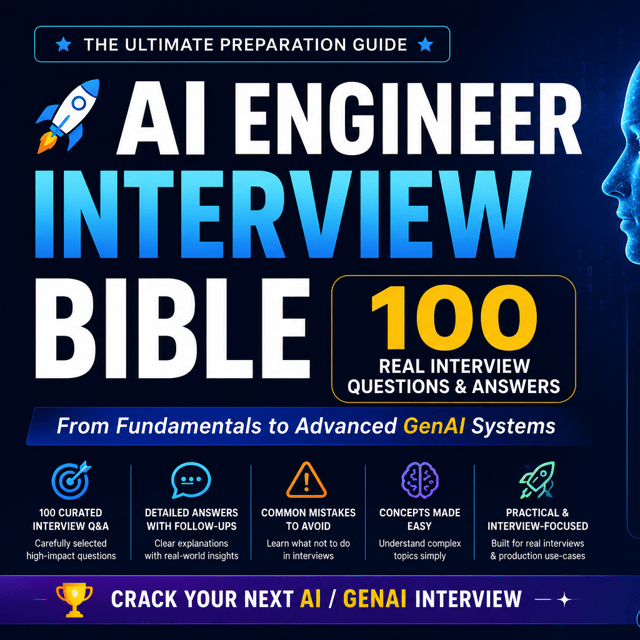
The Ultimate AI Engineer Interview Handbook
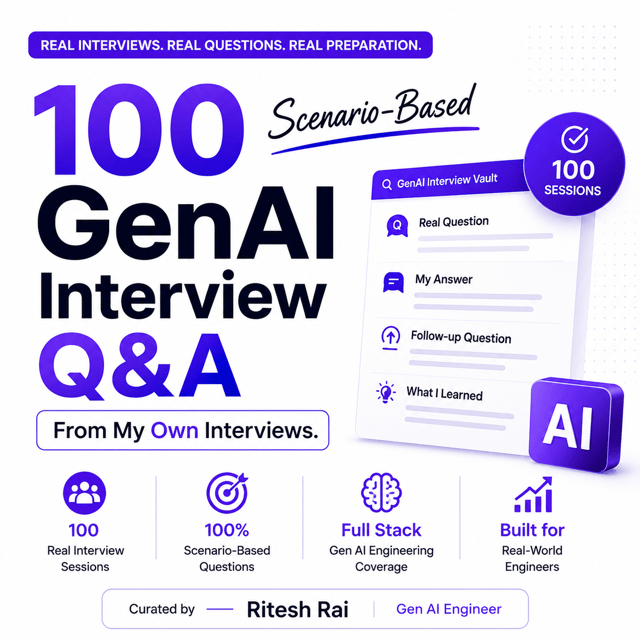
100 Scenario-Based Gen AI Q&A — My Own Interviews
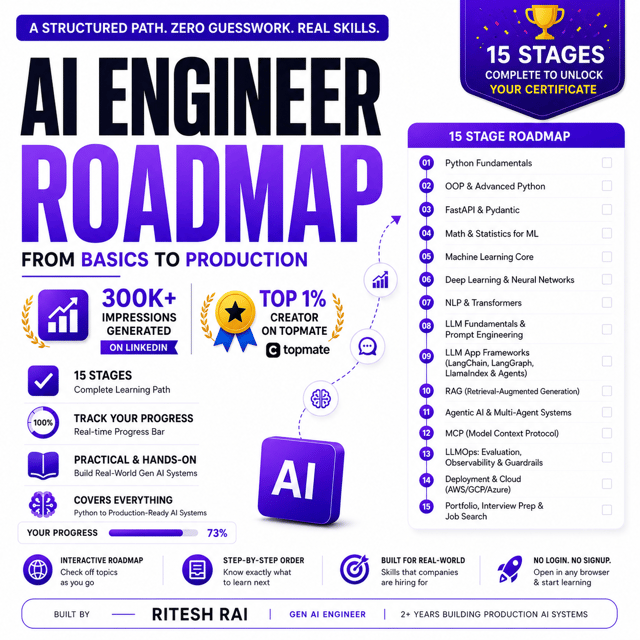
AI Engineer Roadmap - Interactive Progress Tracker
About me
Frequently asked questions
What are the most commonly asked GenAI interview questions and answers?
The most common GenAI interview questions and answers revolve around LLM fundamentals (tokens, context windows, temperature), prompt engineering (zero-shot, few-shot, chain-of-thought), RAG, fine-tuning vs RAG, vector databases, hallucination handling, and frameworks like LangChain and LangGraph. Interviewers increasingly prefer scenario-based questions — for example, "Your RAG chatbot gives wrong answers, how do you debug it?" — so practise explaining your reasoning, not just definitions.
What are common GenAI interview questions and answers for experienced candidates?
GenAI interview questions and answers for experienced professionals go deeper than theory — expect system design prompts like "design a RAG system for a million documents," trade-off discussions (RAG vs fine-tuning, latency vs cost), evaluation strategy, guardrails, and production deployment on cloud platforms. You should also be ready to walk through a GenAI system you built end to end and justify every architectural decision you made.
What are the common GenAI interview questions for freshers?
GenAI interview questions for freshers usually cover Python basics, how LLMs work, embeddings and vector databases, the concept of RAG, prompt engineering, and the difference between a chatbot and an AI agent. Interviewers also expect at least one hands-on project, so build a simple end-to-end RAG application and be able to explain it clearly — it immediately sets you apart from candidates who have only read theory.
Where can I find a GenAI interview questions and answers PDF for preparation?
You can find GenAI interview questions and answers PDF compilations on GitHub repositories, GeeksforGeeks, and in structured interview handbooks that organize questions topic-wise — LLM basics, RAG, agents, and cloud deployment. A PDF is useful for quick revision, but pair it with hands-on practice, because interviewers judge how you handle follow-up questions, not how much you have memorized.
What is the full form of the RAG pipeline?
The full form of the RAG pipeline is Retrieval-Augmented Generation. It describes a system where the model first retrieves relevant information from an external knowledge source and then generates an answer grounded in that retrieved context — which reduces hallucinations and lets the LLM work with private or up-to-date data without retraining.
What is a RAG pipeline in AI?
A RAG pipeline in AI is an architecture that connects a large language model to external knowledge. The user's query is converted into embeddings, similar documents are retrieved from a vector database, and the retrieved context is added to the prompt so the LLM produces an accurate, source-based answer. It is the standard pattern behind chatbots over company documents, support assistants, and enterprise knowledge search tools.
What does a typical RAG pipeline architecture look like?
A standard RAG pipeline architecture has two phases. The ingestion phase loads documents, splits them into chunks, converts the chunks into embeddings, and stores them in a vector database. The query phase embeds the user's question, retrieves the most similar chunks, optionally reranks them, injects them into the prompt, and sends everything to the LLM. Mature setups also add hybrid search, metadata filters, caching, and an evaluation layer.
How to build a RAG pipeline?
If you are learning how to build a RAG pipeline, start with a simple version: collect your documents, split them into chunks, generate embeddings, and store them in a vector database like FAISS, Chroma, or Pinecone. At query time, embed the question, retrieve the top matching chunks, place them into a prompt template, and generate the answer with an LLM. Once the basic version works, improve retrieval with better chunking, hybrid search, and reranking, and add evaluation to measure accuracy.
How do I build a RAG pipeline using LangChain?
Building a RAG pipeline using LangChain is one of the fastest ways to get started. Use LangChain document loaders to load files, text splitters to chunk them, an embeddings model (OpenAI or Hugging Face), and a vector store such as FAISS, Chroma, or Pinecone. Then connect a retriever to a prompt template and an LLM using LangChain's chains or LCEL. This gives you a working RAG application in a few dozen lines of Python, which you can extend with reranking, memory, and evaluation.
How to evaluate a RAG pipeline?
To understand how to evaluate a RAG pipeline properly, measure retrieval and generation separately. For retrieval, track metrics like context precision, context recall, and hit rate; for generation, check faithfulness (is the answer grounded in the retrieved context?) and answer relevance. Build a small golden test set of question–answer pairs, run evaluations using frameworks like RAGAS or LLM-as-a-judge, and monitor latency and cost so improvements don't hurt production performance.
What are some good RAG pipeline projects for a portfolio?
Strong RAG pipeline projects include a chat-with-PDF assistant, a customer support bot trained on product documentation, an HR policy Q&A tool with metadata filters, and a multi-document research assistant that returns cited answers. An advanced option is upgrading a basic bot with hybrid search, reranking, and an evaluation dashboard — these projects demonstrate production-level thinking, which is exactly what interviewers look for.
What are multi-agent systems in AI?
Multi-agent systems in AI are applications where several specialized LLM-powered agents collaborate to complete a task — for example, a planner breaks down the goal, a researcher gathers information, a coder writes the solution, and a critic reviews the output. Each agent has its own role, prompt, tools, and memory, with an orchestrator coordinating them. They are a core pattern in agentic AI, and frameworks like LangGraph, CrewAI, and AutoGen are commonly used to build them.
How to build multi-agent systems?
If you want to learn how to build multi-agent systems, start by breaking your task into clear subtasks and assigning each one an agent with a specific role, prompt, and set of tools. Choose an orchestration pattern — supervisor, sequential handoff, or group discussion — and manage shared state between agents; LangGraph is a popular choice because it lets you define agents as graph nodes with explicit control flow. Begin with two or three agents, add error handling and human-in-the-loop checkpoints, and test with real tasks before scaling up.
What is a realistic AI engineer roadmap for 2026?
A practical AI engineer roadmap for 2026 follows this sequence: strengthen Python and API fundamentals, learn how LLMs work and how to prompt them effectively, then move to LangChain and LangGraph, build RAG applications, design multi-agent systems, learn LLM evaluation and observability, and finally deploy applications using FastAPI, Docker, and a cloud platform like AWS. Back every stage with a hands-on project, because hiring teams increasingly shortlist candidates who can demonstrate working systems rather than certificates alone.
Do AI engineers need to learn AWS?
For most production-focused roles, yes. A practical AWS for AI engineers skill set includes Amazon Bedrock for accessing LLMs, SageMaker for model hosting, Lambda and S3 for application infrastructure, vector database options, IAM basics, and cost monitoring, since most companies run their GenAI workloads in the cloud. Even if your target company uses Azure or GCP, the deployment concepts transfer directly, and interviewers increasingly test whether you can take an AI prototype all the way to production.