Testimonials
Services

1:1 Mentorship
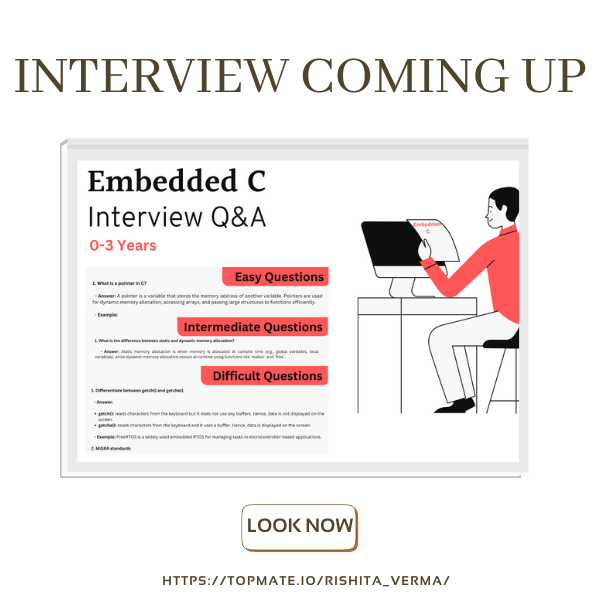
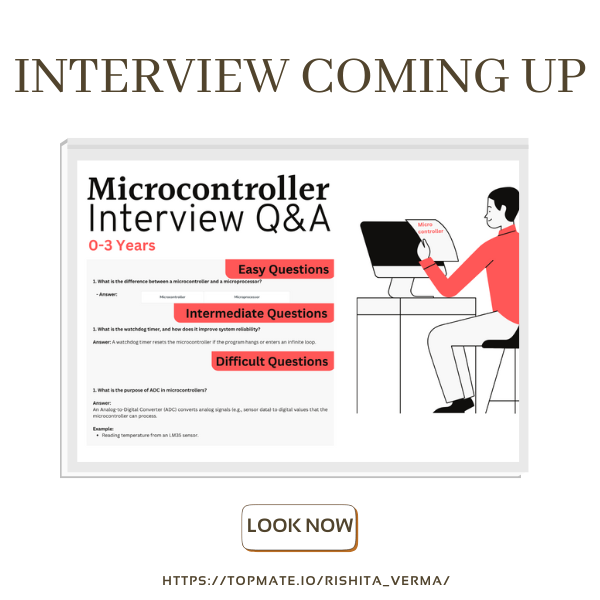
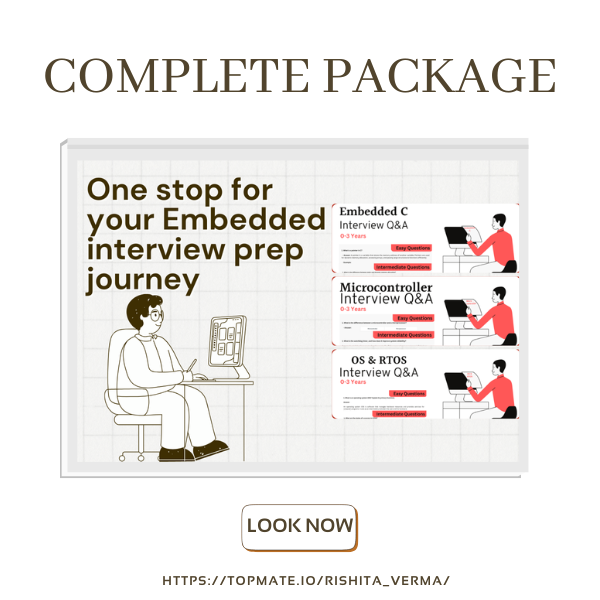
Interview Q&A - Combined Package

Embedded Interview Roadmap Workshop
Resume Review
Mock Interview

Mock Interview
About me
Frequently asked questions
How do I prepare for an embedded systems interview?
If you are planning how to prepare for an embedded systems interview, follow a fixed sequence: first strengthen C fundamentals (pointers, storage classes, volatile, memory layout), then revise microcontroller architecture and peripherals such as GPIO, UART, SPI, I2C, timers and interrupts, and then learn core RTOS concepts, ideally through FreeRTOS. After that, revise your own projects thoroughly, since most interview time is spent on them, and finish with frequently asked questions plus at least one mock interview. In India, service companies lean heavily on C output-based questions, while product companies go deeper into protocols, RTOS internals and debugging.
What are the most commonly asked embedded systems interview questions?
Most embedded systems interview questions come from a predictable set of topics: microprocessor vs microcontroller, the volatile keyword and where it is mandatory, interrupts vs polling, ISR constraints, I2C vs SPI vs UART, memory-mapped I/O, endianness, watchdog timers, function pointers, and cross-compilation. Prepare a clear, example-backed answer for each of these, because interviewers typically start here before moving to your projects.
What embedded systems interview questions are asked for freshers?
Most embedded systems interview questions for freshers stay at the fundamentals level: microcontroller basics, firmware vs application software, volatile and const, interrupt handling, simple communication protocols and short C programs. Interviewers also spend significant time on your academic or hobby projects, so be ready to explain the block diagram, your specific contribution and the problems you debugged. Knowing one controller well, such as 8051, Arduino or STM32, is enough if your basics are strong.
What topics do embedded C interview questions and answers usually cover?
If you go through popular embedded C interview questions and answers, the same core areas repeat: volatile and const usage, static keyword behaviour, pointer arithmetic, structure padding and bit fields, macros vs inline functions, stack vs heap, implementing memcpy or memset, bit manipulation and ISR-safe code. Reading answers alone is not enough — practise writing small programs for each topic, because interviewers usually convert every concept into a coding or output-prediction question.
What embedded C interview questions for freshers should I expect in campus placements?
Most embedded C interview questions for freshers are output-prediction and concept-check problems: predicting output of increment and pointer expressions, explaining storage classes, reversing a string without library functions, swapping numbers without a temp variable, explaining volatile with a hardware example, and finding bugs in short snippets. Companies use these to check whether your C basics are genuinely hands-on. Practise solving them on paper within a time limit, since campus and service-company rounds are strictly timed.
How are embedded C interview questions for experienced candidates different?
At 3+ years of experience, embedded C interview questions for experienced candidates shift from definitions to design and debugging: optimizing code for size and speed, linker scripts and startup code, DMA, cache coherency, reentrancy and concurrency bugs, hard fault analysis and driver architecture. Every claim on your resume will get a follow-up "why", so be ready to defend your design decisions with trade-offs from real projects.
Which topics do RTOS interview questions and answers usually cover?
Most RTOS interview questions and answers focus on a small set of core areas: task states and scheduling, priority inversion and priority inheritance, mutex vs semaphore, ISR-safe API usage, context switching, queues and mailboxes, deadlock conditions, and latency or jitter. Anchoring each answer with a FreeRTOS example — API names, a project scenario, a bug you debugged — makes it far more convincing than textbook definitions.
What RTOS interview questions do experienced candidates get?
RTOS interview questions for experienced candidates are usually scenario-driven: diagnose a priority inversion in a running system, assign priorities to a set of periodic tasks, handle a stack overflow, choose an appropriate tick rate, or explain how you measured worst-case response time in a past project. Interviewers also drill deep into the RTOS work mentioned on your resume, so revise that project's architecture and trade-offs beforehand.
How do I prepare for RTOS interview questions for Qualcomm?
To handle RTOS interview questions for Qualcomm, build strong fundamentals in scheduling, inter-task communication, interrupt handling and memory topics like cache and memory barriers, since embedded and firmware roles there test RTOS depth alongside advanced C. Practise explaining priority inversion, context switch steps and real-time constraints with concrete examples from your own projects, and keep computer-architecture basics like boot flow and performance sharp.
Is downloading an embedded systems interview questions and answers PDF enough for preparation?
Downloading an embedded systems interview questions and answers PDF is a good way to revise before the interview, because compiled lists show you the standard questions in one place. However, treat any PDF as a starting point — compiled lists often contain errors or outdated explanations, so verify concepts against datasheets and standard texts. Candidates who clear embedded roles usually build their own short notes after practising, rather than memorising someone else's PDF.
Are embedded systems interview questions on GeeksforGeeks enough to crack an interview?
Standard embedded systems interview questions on GeeksforGeeks cover the basics well and are a good starting point for revision, but they are rarely enough on their own. Embedded interviews also test datasheet reading, debugging approach, RTOS hands-on skills and project depth, which generic question banks do not cover. Use such platforms to build fundamentals quickly, then add hands-on practice and company-specific preparation.
Do companies ask embedded C interview questions in MCQ format?
Yes. Many service-based companies in India and most campus placement drives begin with an online assessment that includes embedded C interview questions in MCQ format — output prediction, operator precedence, pointers, loops and bit manipulation. Only candidates who clear this round move to technical interviews, so practise timed MCQs separately, because speed matters as much as accuracy in this round.
Is a mock interview useful before an embedded systems interview?
Yes, and it matters more for embedded roles than most other domains because interviewers keep asking follow-up "why" questions — why this protocol, why this task priority, why volatile here. A domain-specific mock interview with an experienced embedded or firmware engineer exposes weak project explanations, pressure-handling gaps and time-management issues that self-study misses. One or two mocks in the final week of preparation are usually enough to fix structure and confidence.
How do I make my resume ATS-friendly for embedded systems jobs?
Use a simple single-column layout with standard headings, and mirror the exact keywords from the job description — embedded C, RTOS, microcontrollers, communication protocols and debugging tools. Replace duty-style lines with quantified project bullets, such as reduced boot time or memory footprint by a measurable amount, and avoid tables, text boxes and graphics that ATS parsers misread. Run your resume through an ATS score checker before applying; most rejections at this stage happen due to formatting and missing keywords, not lack of skills.
Can I switch to an embedded systems career from an IT or service company background?
Yes, and this switch is common in India. Start by getting genuinely strong in C, pick one microcontroller such as STM32 or ESP32, build two or three projects that combine peripherals like UART, I2C and interrupts with a small RTOS, and publish the code with clear documentation. Then update your resume with embedded-specific keywords, prepare for the standard C and microcontroller questions, and target companies hiring at the junior firmware level — with focused preparation, most people complete this switch within a few months.