Testimonials
Services
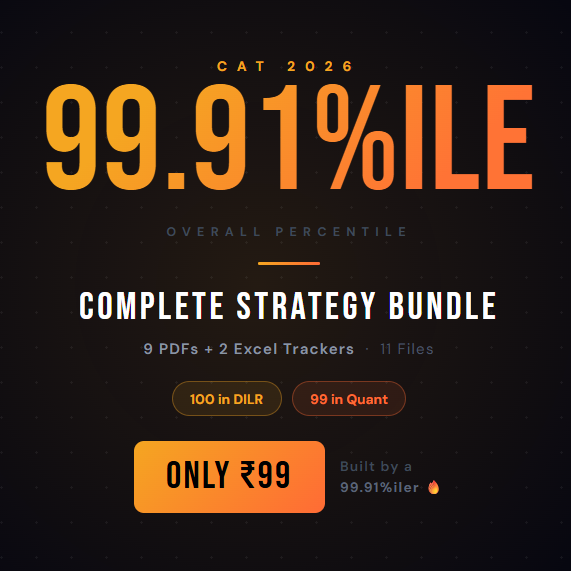
CAT 2026 Complete Strategy Bundle by a 99.91%iler
CAT 2026 Strategy Session | 99.91%iler
MBA Profile Review + B-School Guidance
Your CAT Partner till D-Day
About me
Frequently asked questions
What is the CAT exam used for?
The CAT (Common Admission Test) is the entrance exam for MBA and PGDM admissions in India. Your CAT score is accepted by the IIMs and hundreds of other leading B-schools across the country, which is why it is considered the most important management entrance exam for anyone targeting a top MBA programme in India.
What is the CAT exam syllabus?
The CAT exam syllabus covers three sections: Verbal Ability and Reading Comprehension (VARC), Data Interpretation and Logical Reasoning (DILR), and Quantitative Ability (QA). VARC tests reading and English usage, DILR tests how well you work with data sets and logic puzzles, and QA covers maths up to the class 10 level, including arithmetic, algebra, and geometry. Each section is timed separately for 40 minutes.
When is the CAT exam date 2026 expected to be announced?
CAT is usually held on the last Sunday of November, and the official notification with the exact date typically comes out around July or August. So the CAT exam date 2026 is expected to fall around late November, but confirm the final date on the official website once it is announced.
How to give the CAT exam?
First, check eligibility: you need a bachelor's degree with at least 50% marks (45% for reserved categories), and final-year students can also apply. Next, complete your CAT exam registration on the official website when the window opens, usually sometime between early August and late September. After that, download your admit card, and appear at your allotted test centre on exam day. The exam is computer-based with 40 minutes for each of the three sections, and an on-screen calculator is provided.
How much are the CAT exam fees?
The registration fee is a few thousand rupees for the general category, with a lower fee for SC, ST, and PwD candidates. It is paid online while filling the form, and the exact amount is revised slightly almost every year, so confirm the current CAT exam fees on the official website before applying.
How to crack the CAT exam?
Cracking the CAT exam comes down to four things: know the syllabus and pattern thoroughly, build strong basics in all three sections, practise with previous years' papers and mocks, and analyse every mock to fix weak areas. Consistency matters more than intensity — steady daily practice with proper mock analysis beats random long study hours, especially in the last three months before the exam.
How to start CAT preparation for beginners?
Start by reading the full syllabus and attempting one previous year paper as a diagnostic to know your current level. Then build basics section by section — revise quant fundamentals from school level, develop a daily reading habit for VARC, and begin DILR early since most beginners find it unfamiliar. Once your base is set, move into timed sectional practice and full-length mocks.
What is the ideal CAT preparation duration?
For most aspirants, a CAT preparation duration of 6–9 months with 2–3 hours of focused daily study works well. If your quant basics are weak or you are a working professional, plan for 9–12 months. What matters more than the number of months is consistency — regular daily effort with frequent mocks beats last-minute cramming.
Which CAT preparation books do I actually need?
You only need a small set of CAT preparation books: one standard book per section for concepts, school-level material to rebuild quant fundamentals, and previous years' CAT papers, which are the most valuable resource of all. Add full-length mocks on top of this. Collecting too many books only scatters your preparation — going deep with fewer resources works better.
Can I manage CAT preparation online without joining CAT preparation classes?
Yes, plenty of aspirants complete their CAT preparation online using free lectures, question banks, and mock tests, and many toppers every year prepare without any coaching. What coaching really provides is structure and accountability, so if you go the self-study route, build a written study plan, stick to a fixed mock schedule, and get periodic strategy check-ins with a mentor to stay on track.
What is DILR in CAT?
DILR stands for Data Interpretation and Logical Reasoning. It is one of the three sections of the CAT exam and tests how well you read charts, tables, and data sets, and how sharp your reasoning is with puzzles like arrangements, games and tournaments, and Venn diagrams. Unlike QA, it depends more on practice and thinking style than on formulas.
How to prepare DILR for CAT?
The best way to prepare DILR for CAT is daily set practice — solve one or two sets every day instead of binging once a week. Work through previous years' CAT sets, get comfortable with the common puzzle types, and focus on set selection and accuracy rather than speed alone. Over time you will instinctively recognise which sets to attempt and which to leave.
How to solve DILR in CAT?
In the exam, spend the first few minutes scanning all the sets and shortlist the two or three that look most familiar. Start with the easiest one, aim for accuracy over the number of attempts, and drop a set quickly if you are stuck — a fresh set is worth more than a stubborn one. Under time pressure, smart selection and calm reading matter more than raw solving speed.
What is RC in CAT preparation?
RC stands for Reading Comprehension — passages followed by questions that test your understanding, inference, and grasp of the author's tone. RC usually carries the biggest weight in the VARC section, which is why it sits at the centre of CAT preparation. Build a daily reading habit with editorials and long-form articles, and practise passages regularly while focusing on why the wrong options are wrong, not just why the right one is right.
Is it worth reading CAT preparation Reddit threads?
CAT preparation Reddit threads are genuinely useful for honest topper experiences, strategy breakdowns, and mock discussions that you rarely get from official sources. Just remember that most advice there is generic, and every aspirant's baseline, timeline, and target are different. Use Reddit for perspective and motivation, but filter everything through your own plan and the data from your own mocks.