Testimonials
Services
Get your recruitment process reviewed 💯
Personal Finance - Detailed Review 💵


Learn Tech for Tech hiring 😎
Get your first software engineering job!
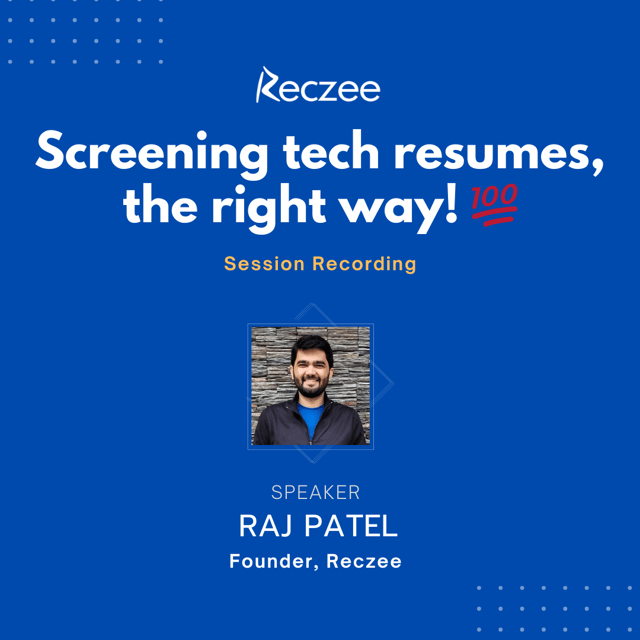
Not getting any interviews?
About me
- Unlock productivity in hiring | Reczeehttps://www.reczee.com
- Raj's sessions are insightful and practical, simplifying tech hiring and job-seeking for attendees, significantly impacting their skills and knowledge.
 AI-generated based on testimonials
Frequently asked questions
How to review a resume with ChatGPT?
Paste your resume along with the target job description and ask for specific feedback — missing keywords, weak action verbs, formatting gaps, and ATS-compatibility issues. You can also ask it to score your resume against the job description and list the exact requirements you haven't addressed. The limitation is that ChatGPT can only judge what you give it, so it can't tell you whether a project is genuinely impressive to a hiring manager. Use it for a strong first pass, then get the refined version checked by someone who has actually screened resumes for engineering roles.
Is a paid resume review service better than a free resume review?
A free resume review — from a senior, a college placement cell, or an AI tool — is usually enough to fix obvious issues like typos, generic objectives, and missing skills. A paid resume review service earns its cost when you're not getting shortlisted despite applying regularly, or when you're targeting competitive SDE roles at product-based companies where recruiters spend only a few seconds on each resume. More than the price, judge the reviewer's background — someone who has actually screened tech resumes can tell you what gets shortlisted in the Indian market, not just fix grammar.
Is LinkedIn resume review worth it?
It depends entirely on who is reviewing your resume. A LinkedIn resume review is worth it when the reviewer has real tech-hiring or recruitment experience and gives you specific, line-level feedback instead of generic advice. If it's just automated suggestions or template tips you could find anywhere, it adds little value. Before paying, check the reviewer's background, what exactly is covered (content, ATS keywords, structure), and whether they understand hiring for the roles you're targeting in India.
How long does a resume review take?
An AI-based review takes only a few minutes, while a review by an experienced human typically takes a day to a few days depending on their process. If it happens over a live call, expect a 30–60 minute session covering structure, content, and role-specific keywords, plus time afterwards to apply the changes. Be cautious of anyone promising a detailed rewrite in minutes — a proper review involves reading your resume against your target roles, not just skimming for typos.
What is a blind resume review?
A blind resume review is when a resume is evaluated after removing personal details such as name, gender, age, and sometimes college name, so the assessment is based purely on skills, experience, and projects. Many companies use blind screening in tech hiring to reduce unconscious bias and give every candidate a fair first pass. For candidates, it also proves an important point — the measurable content of your resume matters far more than personal branding elements.
What is a DSA interview round?
A DSA interview round is the stage of a tech hiring process where you solve data structures and algorithms problems on a shared coding editor or whiteboard while explaining your approach. You're judged on how you identify the pattern, choose the right data structure, handle edge cases, and reason about time and space complexity — not just on whether the code runs. In India, most product-based companies have one or two such rounds before moving to system design and hiring manager rounds.
What are the most common DSA interview questions for freshers?
For freshers, most DSA interview questions revolve around arrays and strings (two pointers, sliding window), linked lists, stacks and queues, binary search, recursion and backtracking, trees and BSTs, and basic dynamic programming. Hashing-based problems appear in almost every interview because they test how you optimize a brute-force approach. Just as important as solving them is practising your thought process out loud, since interviewers in fresher rounds weigh communication and approach as heavily as the final code.
How to prepare for a DSA interview?
Follow the core topics in order — arrays, strings, hashing, linked lists, stacks, queues, trees, graphs, and then dynamic programming — and solve a curated set of problems in each instead of randomly grinding hundreds of questions. One to two focused hours a day works well if you stay consistent, and revisiting problems you failed after a week helps patterns stick. For most freshers and early-career engineers, 8–12 weeks of consistent preparation is realistic, and the final weeks should shift to timed mock interviews that simulate real pressure.
How to crack a DSA interview?
Cracking a DSA interview is less about memorizing solutions and more about pattern recognition — most questions map to a small set of techniques like two pointers, binary search on answer, BFS/DFS, or top-down dynamic programming. Always start by clarifying the problem, walking through an example, and stating a brute-force approach before optimizing, because interviewers evaluate structured thinking as much as correct code. If you get stuck, think aloud and test your idea against edge cases instead of going silent. Timed mock interviews with someone who has taken real interviews are the fastest way to expose blind spots.
What is a system design interview?
A system design interview tests whether you can architect a large-scale system — typical prompts include designing a URL shortener, a chat app, or a food delivery platform. There is no single correct answer; you're evaluated on how you gather requirements, estimate scale, choose databases, caches, and queues, and justify trade-offs between options. These rounds usually appear for mid-level and senior software engineering roles, though many companies now include a lighter version for experienced candidates at lower levels too.
How to prepare for a system design interview?
Build the fundamentals first — scalability basics, load balancing, caching, database indexing, sharding, replication, message queues, and consistency trade-offs — and then apply them by designing well-known systems like a news feed, chat app, or ride-sharing backend. Follow one structured resource path end to end rather than jumping between random articles, and write your designs down instead of only reading solutions. If your background is mostly DSA, the biggest jump is learning to discuss trade-offs confidently, so practise presenting designs to someone who can stress-test your decisions.
How to approach a system design interview?
Use a clear framework: clarify functional and non-functional requirements, estimate traffic and storage, sketch a high-level design, deep-dive into the components the interviewer focuses on, and close by discussing bottlenecks and trade-offs. Keep talking throughout — silence while drawing is the most common mistake, since your reasoning matters as much as the final diagram. Making assumptions is fine as long as you state them out loud and adjust gracefully when the interviewer pushes back.
Is Grokking the System Design Interview worth it?
Yes, if you're starting from scratch — it organizes the most frequently asked design questions into repeatable patterns, which is exactly what beginners need before their first design round. Its limitation is that it is a read-only resource: many candidates finish it and still freeze in live interviews because they've never defended a design under questioning. A practical approach is to use it as your foundation and then reinforce it with mock system design interviews where you present and defend your design in real time.
Is the System Design Interview book by Alex Xu enough to prepare?
The System Design Interview book by Alex Xu is one of the best starting points because it walks through real interview questions step by step with clear diagrams, and Volume 2 adds more advanced, modern problems. On its own, though, it usually isn't enough for senior or product-company loops, where interviews demand that you handle follow-ups, defend decisions, and adapt your design on the fly. Pair the book with hands-on practice — designing systems end to end and doing at least a few mock interviews — to cover what interviewers actually test.
Why am I not getting interview calls even after applying to so many jobs?
The usual culprits are a resume that isn't optimized for the roles you're targeting — missing keywords that ATS filters and recruiters scan for — applying only through portals instead of getting referrals, and targeting roles that don't match your experience level. Start by auditing your resume against 3–5 real job descriptions, get it reviewed by someone who has actually hired in your domain, and build referrals on LinkedIn before mass-applying again. If calls still don't come, the gap is usually in how your projects and impact are presented, not in your eligibility.