Testimonials
Services
Career Guidance DM – Ask Me Anything
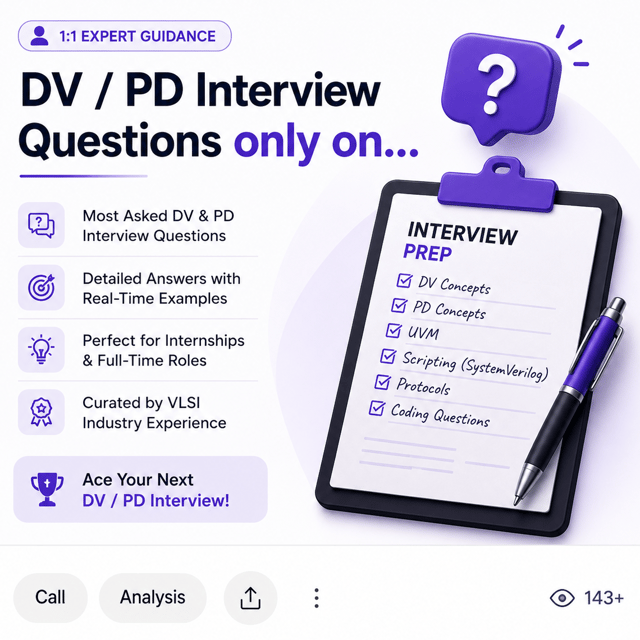
DV / PD Interview Questions only one role
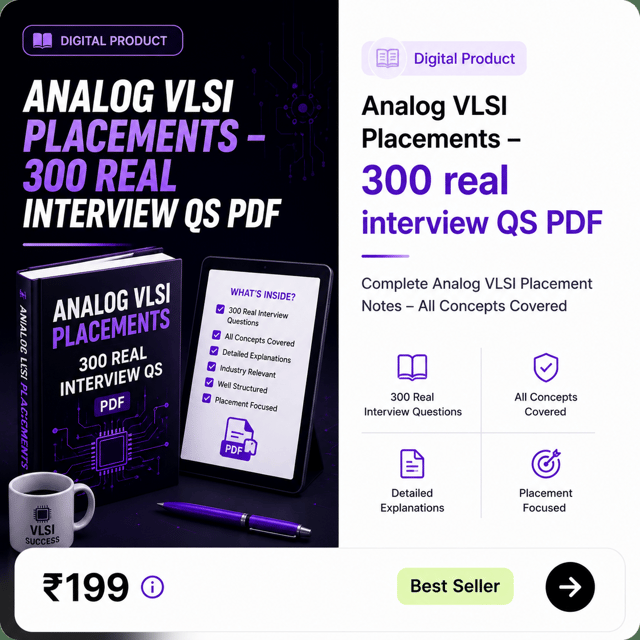
Analog VLSI Placements – 300 real interview QS PDF

About me
Frequently asked questions
What are the most commonly asked VLSI interview questions and answers for freshers?
Fresher VLSI interviews usually start with digital electronics fundamentals — number systems, combinational and sequential logic, flip-flops, setup and hold time, and metastability — then move to Verilog/SystemVerilog coding, CMOS and MOSFET basics, and detailed questions on your projects and internships. The most efficient way to prepare is to practise from a structured set of VLSI interview questions and answers, and specifically VLSI interview questions for freshers, since interviewers mostly pick from a predictable pool of concepts. Write your own answer for every question and get it checked by someone from the industry, because memorised answers are easy for interviewers to spot.
Where can I download a reliable VLSI interview questions PDF for preparation?
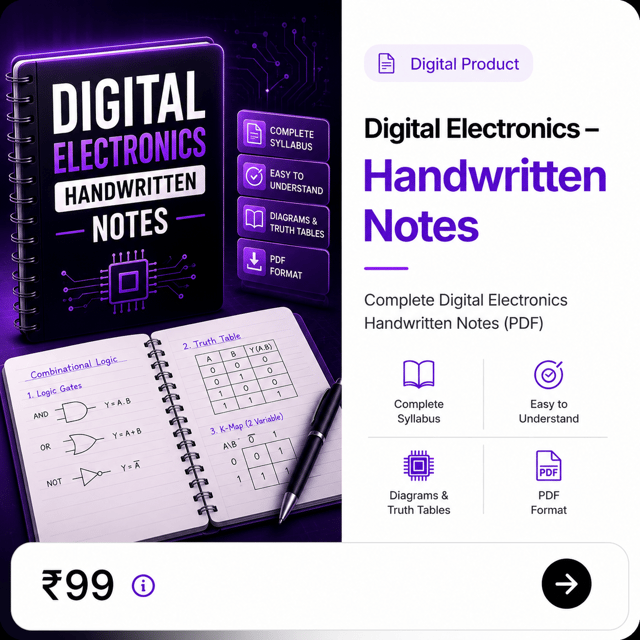
A VLSI interview questions PDF compiled by a VLSI mentor or community is usually safer than random dumps, because the questions come from real interviews and are organised by topic. While choosing a VLSI interview questions PDF, check three things: whether the questions are collected from actual company interviews, whether each answer is explained rather than just listed, and whether the topics match the role you are targeting, such as design verification, physical design, DFT, or analog. Handwritten notes on digital electronics and MOSFETs are also popular for last-minute revision.
Which is the best VLSI interview questions book for freshers?
No single book covers VLSI interviews completely, because what you are asked depends heavily on the role — digital design, design verification, physical design, DFT, or analog design. Most successful candidates use standard subject textbooks to build concepts and pair them with a VLSI interview questions book or compiled question bank for role-specific practice. If your interview is close, a question bank based on real interview questions gives better returns than starting a thick textbook from scratch.
Is preparing from VLSI interview questions on GitHub enough to crack an interview?
GitHub is a good free starting point, but VLSI interview questions GitHub repositories alone are rarely enough — answers are often incomplete, unverified, or outdated, and nobody points out the gaps in your understanding. Use them to get a broad view of what is asked, then validate your answers through mock interviews or feedback from someone working in the VLSI industry. Interviewers evaluate how you reason through a problem, which is exactly what self-study from repositories misses.
How do VLSI interview questions for experienced engineers differ from fresher interviews?
Fresher interviews stay close to fundamentals, coursework, and basic coding, whereas VLSI interview questions for experienced engineers go deep into the specific domain and, more importantly, into your real project decisions. Expect questions like why a particular testbench architecture was chosen, how a stubborn bug was root-caused, how timing closure was achieved, or what trade-offs you made under deadline pressure. Experienced candidates should prepare detailed project stories alongside technical revision — this is where most experienced interviews are won or lost.
What kind of design verification interview questions and answers should a fresher prepare?
For freshers, design verification interview questions and answers typically cover SystemVerilog data types and constructs, OOP concepts like classes and inheritance, randomization and constraints, functional coverage, SystemVerilog assertions, and basic UVM, along with digital fundamentals. Scenario-based questions are increasingly common — interviewers ask how you would verify a FIFO, arbiter, or memory and how you would build a testbench for it. Practising design verification interview questions for freshers that include such scenarios prepares you far better than theory-only lists.
Is there a good design verification interview questions and answers PDF that freshers can practise from?
Yes, and a design verification interview questions and answers PDF compiled from real interviews is one of the fastest ways to prepare, because DV interviews repeat a well-defined set of concepts. Make sure the PDF includes scenario-based and code-output questions, not just definitions, and covers SystemVerilog, assertions, coverage, and UVM. Many VLSI mentors who take mock interviews share such compiled question banks — use the PDF to test yourself and treat every question you get wrong as a topic to revisit.
Do design verification interviews change for experienced candidates?
Yes, the depth changes completely. Design verification interview questions for experienced engineers focus on UVM testbench architecture, coverage-driven verification, scoreboard and checker design, debugging real simulation failures, and methodology trade-offs, instead of basic syntax. You will also be asked to walk through how you handled coverage closure, regression runs on tight timelines, or tricky bugs, so prepare project-specific explanations with clear reasoning rather than memorised definitions.
What are the most frequently asked SystemVerilog interview questions and answers?
The most common SystemVerilog interview questions and answers cover 4-state vs 2-state data types, arrays (fixed-size, dynamic, queues, associative), tasks vs functions, fork-join blocks, clocking blocks and interfaces, classes and OOP, randomization and constraints, inter-process communication using mailboxes, semaphores, and events, and SystemVerilog assertions. Interviewers love showing small code snippets and asking for the output, so practise writing and simulating short SystemVerilog programs instead of only reading answers.
Which SystemVerilog interview questions on constraints are asked most often?
Expect questions on how the randomization solver works, inline constraints, soft constraints, constraint inheritance, solve...before, dist and inside operators, implication (->) and if...else constraints, uniqueness constraints, and why randomize() can fail or return 0. SystemVerilog interview questions on constraints often show a snippet and ask you to predict the generated values, so understanding the constraint solver's behaviour matters far more than memorising syntax.
Where can I find a SystemVerilog interview questions PDF for quick revision?
A good SystemVerilog interview questions PDF works best as a revision tool after you have actually practised the concepts in a simulator. Look for one that covers the areas interviewers really probe — constraints and randomization, OOP, queues and associative arrays, clocking blocks, and assertions — with short explanations of the reasoning behind each answer. VLSI mentors and communities often share such compiled PDFs, and using one in the final week before an interview helps you revise quickly without missing commonly asked topics.
How are SystemVerilog interview questions for experienced engineers different from fresher-level questions?
Fresher-level questions check whether you know the language, while SystemVerilog interview questions for experienced engineers check whether you can use it well on a real project. Expect questions on UVM environment structure, factory overrides and configuration objects, scoreboard design, race conditions between clocking domains, simulation performance, and debugging randomization failures. You should also be ready to write code on the spot, since experienced candidates are frequently asked to extend or fix an existing testbench snippet.
How can a student or fresher get a VLSI internship in India?
Start by building two or three strong, verifiable projects — RTL design or verification projects you can explain line by line work best — then strengthen your digital fundamentals and at least one HDL, and apply through off-campus drives, LinkedIn, and referrals from engineers already working in semiconductor companies. Because VLSI internships in India are extremely competitive, most successful candidates get their resume and preparation roadmap reviewed by a VLSI mentor before applying, which noticeably improves shortlisting chances.
How should I prepare for analog VLSI placements as a fresher?
Analog placement interviews stay close to a core set of concepts: MOSFET operating regions and small-signal models, second-order effects, current mirrors, single-stage and differential amplifier topologies, op-amp behaviour, stability, and frequency response, along with RC circuit analysis. Solving real analog VLSI placement questions — some VLSI mentors compile sets of 300 actual interview questions — works better than only reading textbooks, because analog interviewers rarely move beyond this core pool; they simply ask the same concepts at increasing depth. Practise deriving circuit behaviour on paper, since analog interviews are derivation-heavy.
How should a fresher structure a resume for VLSI core companies?
Keep it to one page, put a clear skills section up front (Verilog, SystemVerilog, UVM, and tools like Cadence, Synopsys, or Vivado only if you have actually used them), and describe each project in terms of what you designed or verified, the problems you solved, and the results — not the course names you completed. Core VLSI companies shortlist heavily on projects, so generic lines like "hardworking ECE student" hurt you. Getting a VLSI-focused resume review before applying, ideally from someone working in the industry, helps fix missing keywords, weak project descriptions, and formatting issues that silently cost interviews.