Testimonials
Services
Complete Playwright SDET Kit
2026 Job Ready Interview Preparation Guide Kit
500+ Real Time Scenarios Based Interview Questions
Jenkins For Testers
Api Testing (Postman) Interview Questions Answers
SQL Interview Questions Answers
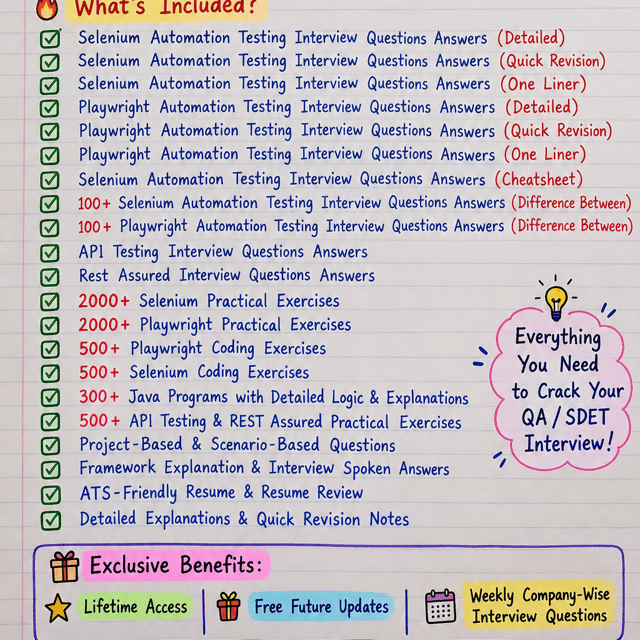
2026 SDET/QA AUTOMATION JOB-READY MASTER KIT
Javascript Important Questions
500+ API TESTING PRACTICAL EXERCISE
500+ REST ASSURED PRACTICAL EXERCISE
500+ Java Programs for Testers
300++ Jira Questions and Answers
Interview prep & tips
About me
- Testing Corner - YouTubehttps://www.youtube.com/@TestingCorner
- Testing Corner by Pooja offers invaluable resources for interview prep, praised for clarity, depth, and impactful mentorship within the testing community.
 AI-generated based on testimonials

Frequently asked questions
What questions are asked in a QA interview?
Most QA interviews in India begin with manual testing fundamentals — SDLC vs STLC, test case writing, bug life cycle, severity vs priority, and types of testing — before moving to automation. Expect tool-specific questions on Selenium, Playwright or Cypress, coding exercises in Java or JavaScript, SQL queries, API testing with Postman or Rest Assured, and scenario-based questions on Agile and CI/CD. Interviewers also usually ask you to walk through a project you have tested end to end.
Which topics should I cover while practising QA interview questions and answers?
Cover six areas: manual testing concepts, at least one automation tool, a programming language (Java, JavaScript or Python), SQL, API testing, and Agile basics. Practise writing answers in your own words instead of memorising, because interviewers quickly spot rehearsed replies. Scenario questions like "what would you do if a bug is found in production" or "how would you decide test cases for a new feature" are now asked more often than pure definitions.
How do I prepare for QA interview questions for freshers when I have no real project experience?
Build hands-on proof: practise writing test cases for everyday apps, create a small Selenium or Postman mini project, and upload it to GitHub. Learn the standard fresher questions — verification vs validation, smoke vs sanity, defect life cycle, priority vs severity — and answer them with small examples. Strong fundamentals plus one demo project usually convinces interviewers even without corporate experience.
What are the most frequently asked Selenium interview questions and answers?
The classics are: Selenium and its components, WebDriver architecture, types of locators, implicit vs explicit waits, handling dropdowns, frames and popups, XPath vs CSS selectors, the Page Object Model, and TestNG annotations. For MNC roles, expect framework-design questions — how you built or maintained a framework, reporting, and Jenkins or GitHub integration. Revising these in a question-and-answer format is the fastest way to cover most of what gets asked.
What topics do Selenium interview questions for 5 years of experience usually cover?
At that level, interviewers test depth, not definitions: designing a framework from scratch, choosing between data-driven, keyword-driven and hybrid approaches, handling flaky tests, parallel execution, scaling suites through Jenkins, BDD with Cucumber, and code-quality practices. You should also be ready to justify your architecture decisions and discuss mentoring juniors or reviewing automation code, since senior roles expect you to own the quality of the framework itself.
What are the top manual testing interview questions asked in MNC interviews?
Frequently repeated ones include: explain the software testing life cycle, what is a test plan, test scenario vs test case, severity vs priority with examples, regression vs retesting, smoke vs sanity testing, defect life cycle, and techniques like boundary value analysis and equivalence partitioning. MNCs also ask how you logged bugs in Jira and coordinated with developers, so prepare one real example for each answer.
Which manual testing interview questions for freshers should I revise first?
Start with the definitions that open almost every interview: what is testing, why testing is needed, verification vs validation, QA vs QC, and levels of testing (unit, integration, system, acceptance). Then move to practical ones — writing a test case for a login screen, explaining the bug life cycle, and describing severity vs priority with an example. These few topics alone typically cover the first screening round.
Where can I find manual testing interview questions with answers for quick revision before an interview?
Look for compiled question banks created by working QA professionals rather than random blogs, since curated sets are grouped by topic and difficulty and are designed for last-minute revision. LinkedIn posts, QA communities, and structured notes from interview coaches are common sources. Pick one reliable set and revise it two or three times instead of jumping between ten different PDFs.
How to prepare for a manual testing interview as a complete beginner?
Follow a sequence: first master theory (STLC, test design techniques, bug life cycle), then practise writing test cases and bug reports, learn basic SQL and Jira, and finally attempt mock interviews. Give equal time to explaining answers verbally, because most fresher-level rejections happen due to poor communication rather than lack of knowledge. Keep one page of must-revise questions for the final day before the interview.
How to crack a manual testing interview on the first attempt?
Three things decide it: clarity on your resume projects, crisp answers with real examples, and confidence in basics. Never let the interviewer catch a mismatch between what is written on your resume and what you can actually explain. Prepare "tell me about yourself", "explain your project" and "why testing" thoroughly, because these set the tone for the entire round. Doing one mock interview with a working QA helps you fix gaps before the real one.
How to explain a manual testing project in an interview?
Use a fixed structure in under three minutes: project name and purpose, your exact role, the modules you tested, how you wrote and executed test cases, how you reported bugs, and one challenge you handled. Always connect it to numbers — number of test cases executed, defects logged, modules covered. Interviewers judge the realism of your project explanation more than the project itself, so rehearse it aloud.
What is Selenium WebDriver, and why does every automation interview start with it?
Selenium WebDriver is an open-source browser automation tool that drives Chrome, Firefox, Edge and other browsers directly, without the external server that the older Selenium RC required. Interviewers open with it because your answer reveals whether you actually understand automation or have only recorded and played back scripts. Be ready to explain how WebDriver communicates with browsers through the W3C protocol, and how it differs from the Selenium IDE and Selenium Grid.
How should I answer "What is Maven in Selenium" in an interview?
Explain that Maven is a build-management tool used with Selenium to handle dependencies, plugins and test execution through the pom.xml file. A strong answer adds why it matters: it downloads the correct Selenium and TestNG versions automatically, keeps the framework portable across machines, and integrates smoothly with Jenkins for continuous integration. Mentioning commands like mvn clean and mvn test shows hands-on usage.
What is POM in Selenium, and how does it improve automation frameworks?
POM (Page Object Model) is a design pattern in which every web page of an application gets its own class that stores that page's locators and actions, keeping them separate from the actual test scripts. This improves maintainability — when a locator changes, you fix it in one page class instead of dozens of tests — and makes the code reusable and readable. The usual follow-up is POM vs PageFactory, so prepare that difference as well.
How to handle dynamic elements in Selenium?
The standard answer interviewers expect is to build flexible XPaths using contains(), starts-with() or text- and attribute-based functions instead of absolute paths, so that partial attribute values which stay constant are used for identification. Combine this with explicit waits so the element is fully loaded before interaction. If the interviewer probes further, mention CSS selectors, relative locators or JavaScript executors as backup approaches for stubborn dynamic elements.