Testimonials
Services




🎯Land & Dominate Deloitt | ~ A Deloitte Edition
The No-Mercy Job Plan – Get Hired or Stay Jobless
Confused about Career & jobs ? DM Me.
🚀 High-Growth IT Pack

📈Dominate TCS Data Analyst Interview
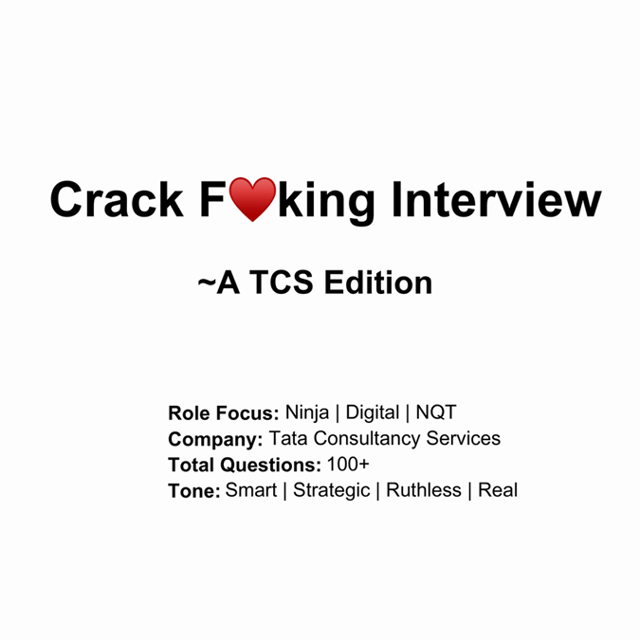
🔥TCS Freshers Interview-Don’t Get Rejected Again
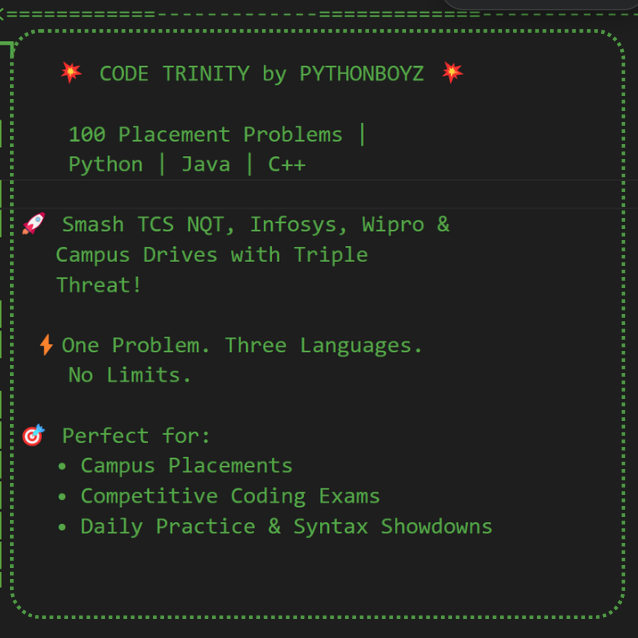
100 Solved Placement Problems | Python ,Java, C++
🏢 Product-Based Companies Pack
About me
Frequently asked questions
What is the TCS NQT exam?
TCS NQT (National Qualifier Test) is the recruitment exam used by TCS to shortlist freshers for entry-level IT roles, conducted online through the TCS iON platform. It tests quantitative aptitude, logical reasoning and verbal ability, along with programming and coding sections depending on the variant you register for. Clearing it makes you eligible for TCS interview rounds, and NQT scores are also accepted by several other companies that hire through the same test, which is why most final-year students start their service-based company preparation with it.
How do I complete TCS NQT 2026 registration?
Registration is done online on the official TCS iON NQT portal. You create an account with your email and phone number, fill in your personal and academic details exactly as they appear on your documents, upload the required photograph and certificates, choose the appropriate test variant, and submit before the registration last date. Slots and cities fill up quickly, so register early rather than waiting for the deadline, and keep checking your registered email for admit card and exam updates.
When will the TCS NQT exam date 2026 be announced?
TCS announces the TCS NQT exam date 2026 on its official NQT page, and the test is usually conducted in multiple cycles across the year instead of a single date. Once you register, the exact date and slot details are shared on the TCS iON portal and through email. Since application windows often close well before the exam, don't wait for the date announcement to register, and rely on the official portal and TCS careers page for confirmed dates rather than unverified sources.
How to check TCS NQT results?
Results are checked by logging in through the TCS NQT login page on the official TCS iON portal with your registered email and password — your score or qualifier status appears in your dashboard once declared. TCS also informs shortlisted candidates about the next interview rounds over email, so watch your inbox and spam folder. Results usually take a few weeks after the exam, and the score published in your account is treated as final.
How to start placement preparation?
If you're confused about how to start placement preparation, begin with one programming language — Python, Java or C++ — and then move to core DSA topics like arrays, strings, linked lists, stacks, trees and basic dynamic programming. In parallel, practise quantitative aptitude, logical reasoning and verbal questions daily, since most placement tests start with these rounds. Add SQL and CS fundamentals like DBMS, OS and networks, build one or two solid projects for your resume, and finish with company-specific previous papers and mock interviews. Give yourself at least 3–6 months of consistent daily practice rather than a last-minute sprint.
Do I really need a placement preparation course, or can I self-study?
You can absolutely crack placements through self-study if you're disciplined — free DSA sheets, aptitude practice apps and YouTube tutorials cover most of the syllabus. A structured placement preparation course mainly helps when you're starting late, need company-specific material for exams like TCS NQT, Infosys or Accenture, or want mentor guidance and mock interviews instead of piecing together random resources. Honestly judge how much time you have left before placements and whether you can stay consistent without accountability — if campus season is close, a guided plan usually saves more time than hunting for free material.
How is placement preparation for CSE students different from other branches?
For IT and software roles, the test pattern is the same for every branch, but placement preparation for CSE students usually feels easier because DSA, DBMS, operating systems and networks are already part of their curriculum. Students from other branches generally have to self-learn coding and aptitude alongside their core subjects, so they need to start earlier. CSE students should use that head start to aim beyond service-based companies at product-based roles, where deeper DSA skills matter more. Whatever your branch, recruiters assess the same core skills, so your preparation matters more than your degree.
What is the best way to do aptitude preparation for placements?
Effective aptitude preparation for placements comes down to daily timed practice rather than last-minute cramming. Cover quantitative aptitude, logical reasoning and verbal ability topic by topic, learn speed tricks for percentages, ratios, time-speed-distance and probability, and then solve section-wise mocks under a strict timer. Every company has a slightly different pattern and cut-off, so practising previous papers of your target companies — TCS, Infosys, Accenture, Deloitte and similar — gives you the biggest edge. Maintain an error log of every question you get wrong and revise it weekly.
What are the most asked DSA interview questions for freshers?
For freshers, most DSA interview questions come from arrays and strings (two pointers, sliding window), hashing, linked lists, stacks and queues, recursion and backtracking, binary search, trees and basic graphs, plus a simple dynamic programming problem if the role is coding-heavy. Interviewers also routinely ask you to explain the time and space complexity of your solution. Instead of memorising question lists, practise topic-wise patterns and be able to code each one from scratch, because companies rarely ask a question exactly the way it appears in a solved set.
How to prepare for a DSA interview?
The practical answer to how to prepare for a DSA interview is pattern-based practice: pick one language, learn the core data structures (arrays, strings, linked lists, stacks, queues, trees, graphs, heaps), then drill standard patterns like two pointers, sliding window, binary search, recursion, BFS/DFS and basic DP by solving problems daily for at least 8–10 weeks. Downloading a DSA interview questions PDF and reading solutions won't help unless you actually implement and debug each solution yourself. In the final weeks, do mock interviews where you solve a new problem while explaining your thought process out loud, since that's exactly how real interviews run.
How to answer DSA interview questions?
When a DSA problem is thrown at you, don't jump straight to code. First restate the problem and clarify the input size and constraints, walk through an example, then start with a brute-force approach and state its complexity before optimising with the right data structure. Explain your thinking out loud the whole time — interviewers evaluate your approach and problem-solving far more than a memorised answer. Once you've coded it, dry-run on the example and edge cases like empty input, duplicates and extreme values, and finish by stating the final time and space complexity.
What are placement papers and do they actually help?
Placement papers are previous years' question papers from company placement exams — TCS, Infosys, Cognizant, Accenture, Deloitte and similar companies have repeatable patterns across their aptitude, coding and technical sections. They genuinely help because the question types, difficulty level and time pressure stay consistent across drives, so solving them trains you for the real exam and its section-wise cut-offs. Use them as timed mock tests in the last few weeks before your drive, after your fundamentals are done — practising only placement papers without the basics won't be enough.