Testimonials
Services
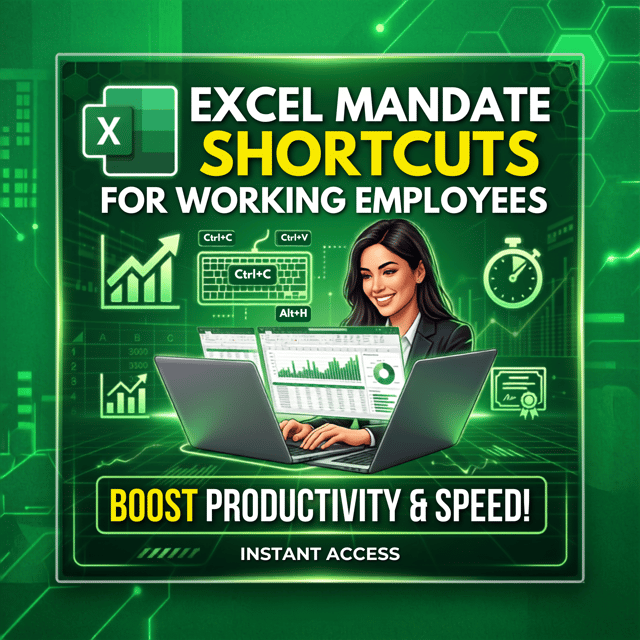
Excel Shortcut Guide for Working Employees

1:1 Mentorship in Tamil
Frequently asked questions
What are the most common Excel interview questions for freshers?
Most Excel interview questions for freshers come from a small set of topics: relative vs absolute cell references, basic formulas like SUM, AVERAGE, COUNT and IF, VLOOKUP, sorting and filtering, removing duplicates, and the difference between a worksheet and a workbook. Interviewers often ask you to explain a formula in plain words or complete a small live task, so practise on a sample dataset instead of only reading answers. If you know these fundamentals and can talk through your steps clearly, you can handle most fresher-level Excel rounds.
What Excel interview questions for data analyst roles should I expect?
Excel interview questions for data analyst roles go well beyond basics. Expect pivot tables, VLOOKUP/XLOOKUP and INDEX-MATCH, SUMIFS and COUNTIFS, text and date functions for cleaning data, conditional formatting, charts, and sometimes Power Query. Many companies also give a short practical test with a messy dataset, so practise cleaning data and building a summary from scratch, and be ready to explain why you chose a particular function.
How to crack Excel interview questions in the first attempt?
First, revise the top 30–40 questions topic-wise: formulas, lookups, pivot tables, and shortcuts. Second, practise hands-on, because many companies include a live Excel test. Third, learn a simple framework for how to answer Excel interview questions — define the function, explain when you would use it, give a short example, and mention a shortcut that saves time. A mock round with a friend, or a quick 1:1 session with a mentor to clear specific doubts, usually helps more than reading one more question list.
Where can I download an Excel interview questions and answers PDF?
You will find both free and paid options. Free Excel interview questions and answers PDF files circulate on job portals and training blogs, while many educators and mentors sell premium PDF guides that compile frequently asked questions with properly explained answers and shortcuts. Before downloading, check that the guide is organised topic-wise, explains the reasoning behind each answer, and covers both fresher and experienced-level questions — that is what separates a useful guide from a random copy-pasted list.
Which Excel shortcut keys should every working professional know?
Start with the ones you will use daily: Ctrl+C/V/Z for copy, paste and undo, Ctrl+arrow keys to jump to the edges of your data, Ctrl+Shift+arrow to select large ranges, Ctrl+; for today's date, Alt+= for AutoSum, and Ctrl+Shift+L to toggle filters. These Excel shortcut keys alone can noticeably cut your daily reporting time. Pick five new shortcuts a week and force yourself to use them until they become muscle memory.
What is the Excel shortcut to delete a row?
The Excel shortcut to delete a row is Ctrl + – (minus). Press Shift+Space to select the entire row first, then press Ctrl + – and choose "Entire row" when the Delete box appears. To insert a row instead, use Ctrl+Shift+= (plus). On a Mac, the equivalent is Cmd + – . And if you delete the wrong row, Ctrl+Z will undo it.
What is the Excel shortcut for strikethrough?
The Excel shortcut for strikethrough is Ctrl + 5 on Windows — select the cell or range and press it once to apply, and once more to remove. On a Mac, use Cmd+Shift+X. It is handy for striking off completed tasks in trackers and checklists without deleting the text.
What is the Excel shortcut for filter?
The Excel shortcut for filter is Ctrl + Shift + L, which turns filter dropdowns on or off for your selected data. Once filters are applied, press Alt + Down Arrow to open the dropdown so you can search and tick values without touching the mouse. Mac users can use Cmd+Shift+L for the same action.
Is there a good Excel shortcuts cheat sheet or PDF for daily office work?
Yes. You will find free Excel shortcuts PDF files on official support pages and training blogs, and several educators sell structured shortcut guides designed for working employees, grouped by tasks like navigation, formatting, and data selection. A good Excel shortcuts cheat sheet is organised by what you are trying to do, not arranged alphabetically — that is what makes it usable at your desk. Keep it beside your monitor for a few weeks until the shortcuts become automatic.
Are Excel shortcuts for Mac different from Windows?
Yes, most Excel shortcuts for Mac swap the Windows Ctrl key for Cmd, and some use Option or Control instead — for example, filter is Cmd+Shift+L on Mac versus Ctrl+Shift+L on Windows, and strikethrough is Cmd+Shift+X versus Ctrl+5 on Windows. The underlying actions are the same, so you only need to learn the modifier-key differences once. If you are buying a shortcut guide or PDF, check that it includes a Mac section, because most free lists cover only Windows.
What is personal branding and why does it matter for your career?
Personal branding is the practice of deliberately presenting your skills, experience, and point of view so that recruiters, clients, and peers associate your name with a specific expertise. It matters because hiring managers and clients almost always check you online before an interview or a call, and a clear brand means opportunities start coming to you instead of you chasing them. For working professionals, it is the difference between being "another resume" and being the person someone remembers when a relevant role or project opens up.
How to use LinkedIn for personal branding as a beginner?
Start with three things: a keyword-rich headline and About section that clearly say who you help and how, a consistent posting rhythm (even one practical post a week), and genuine engagement with posts in your field. A simple LinkedIn personal branding strategy for beginners is to share what you are learning — a shortcut you found useful, a project takeaway, a lesson from a mistake — rather than only announcing achievements. Done consistently for 90 days, this makes your profile work for you even when you are not job hunting.
Is a LinkedIn personal branding course better than hiring a LinkedIn personal branding consultant?
They solve different problems. A LinkedIn personal branding course gives you structured fundamentals — profile optimisation, content frameworks, posting strategy — at a low cost, and works well if you are self-motivated. A LinkedIn personal branding consultant reviews your actual profile and content, points out what is not working, and gives specific corrections, which is faster if you have been posting without traction. Many consultants also offer 1:1 video sessions that cost far less than agency retainers, so a practical route is: learn the basics through a course, then take one 1:1 session for personalised feedback.
What are some good LinkedIn personal branding examples to learn from?
The best LinkedIn personal branding examples usually share three patterns: a headline that states a clear niche instead of just a job title, an About section written like a story with proof such as numbers and outcomes, and posts that teach something practical rather than only listing achievements. Instead of copying anyone, pick five people in your field, study how they open, structure, and close their posts, and adapt those formats to your own voice and experience.
What do LinkedIn personal branding services usually include?
Most LinkedIn personal branding services cover profile optimisation (headline, About section, banner, featured section), a content plan or ghostwritten posts, an engagement strategy, and periodic profile reviews. The format varies: agencies handle everything end to end on a monthly retainer, freelancers work per project, and independent experts and professors offer 1:1 sessions where they audit your profile and teach you the system. If you want to build the skill yourself rather than outsource it, choose someone who teaches you the strategy, not just rewrites your profile.