Testimonials
Services

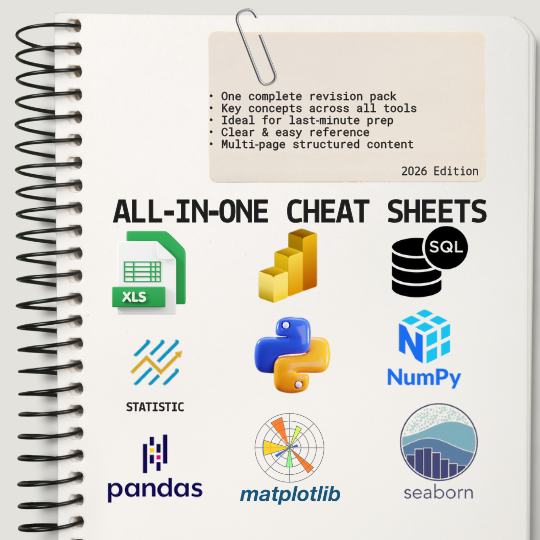
ALL‑IN‑ONE CHEAT SHEETS COMBO ~ 2026 EDITION
Data Analyst Starter Toolkit 2026 EDITION
About me
Frequently asked questions
What is the right data analyst roadmap for freshers?
A practical data analyst roadmap for freshers takes about 4–6 months: start with Excel and basic statistics, then SQL (the most tested skill in Indian interviews), then one BI tool such as Power BI or Tableau, and finally Python with pandas if your target roles ask for it. Build 2–3 portfolio projects on real datasets along the way instead of only collecting certificates. Follow the data analyst roadmap step by step rather than learning five tools at once — depth in the basics plus visible projects is what gets freshers shortlisted.
Where can I get a reliable data analyst roadmap pdf?
You'll find a free data analyst roadmap pdf on learning platforms, YouTube channels and data communities, while paid toolkits usually bundle the roadmap with templates, cheat sheets and project ideas. Judge any pdf on three things: whether tools are sequenced logically, whether it suggests projects with real datasets, and whether it covers interview preparation and not just tool names. A pdf only works if you actually finish the projects in it — most people collect several and complete none.
Is the data analyst roadmap 2026 different from what people followed earlier?
The core of the data analyst roadmap 2026 is unchanged — SQL, Excel, statistics and a visualisation tool still decide employability. What has changed is that employers now expect comfort with AI-assisted analytics, such as using GenAI tools to speed up data cleaning, queries and reporting, along with stronger proof of work since screening has become stricter. Keep the classic learning sequence and add AI tools, real datasets and a public portfolio on top of it.
Can I follow a data analyst roadmap after 10th?
You can start a data analyst roadmap after 10th — Excel, basic statistics and even SQL are learnable at that stage — but keep expectations realistic, because data analyst jobs in India almost always require a bachelor's degree. Use your school and college years to finish the tools, build small projects and choose any degree stream, preferably one with math or statistics. That way you graduate with a portfolio while most of your peers start from zero.
How to become a data analyst in India?
How to become a data analyst in India comes down to a simple stack: a bachelor's degree in any stream, plus job-ready skills — SQL, Excel, statistics, one visualisation tool like Power BI or Tableau, and basic Python for many roles. Give yourself 4–6 months of focused learning, build 2–3 end-to-end projects, then apply through Naukri, LinkedIn and referrals, targeting entry-level titles like data analyst, business analyst and reporting analyst. Internships or freelance data work dramatically improve your first-job chances.
How to become a data scientist in India?
If you're asking how to become a data scientist, the honest path is mathematics and statistics first, then Python, then machine learning fundamentals — regression, classification, clustering and model evaluation — practised on real datasets rather than only courses. Many people enter through a data analyst role first, because SQL, Excel and business-context skills transfer directly, then add ML and move internally or apply outside. A bachelor's degree is the baseline; a strong project portfolio matters more than a fancy certificate.
What are the most common data analyst interview questions?
Most data analyst interview questions fall into four buckets: SQL (joins, GROUP BY, subqueries, window functions), Excel (VLOOKUP/XLOOKUP, pivot tables, data cleaning), statistics (averages vs distributions, sampling, basic hypothesis testing), and scenario or guesstimate rounds, which are very common in India. Almost every panel also asks you to walk through your projects and explain the business impact. Freshers face more fundamentals and aptitude questions, while experienced candidates get deeper SQL and stakeholder-driven case questions.
How should I start my data analyst interview preparation?
Effective data analyst interview preparation works backwards from the job description. Spend the first 2–3 weeks revising SQL and Excel daily, then practise statistics basics and 8–10 guesstimates or case questions, and prepare a crisp two-minute story for each project using situation–action–result. In the final week, do at least two or three mock interviews — with a mentor, a friend or on camera — because clear communication, not just correct answers, is what most panels actually score.
How to crack a data analyst interview as a fresher?
There's no shortcut for how to crack a data analyst interview without experience — your projects have to do the talking. Build 2–3 solid projects on public datasets, publish them on GitHub or as a dashboard link, and be ready to defend every choice you made in them. Then practise data analyst interview questions and answers for freshers out loud — SQL joins, Excel functions, a couple of guesstimates and a confident "tell me about yourself" — since fresher panels test clarity and fundamentals far more than advanced tools.
Which data analyst interview questions for 3 years of experience are most common?
Data analyst interview questions for 3 years of experience go well beyond tool syntax: expect complex SQL (window functions, query optimisation, handling large tables), questions on dashboard or report design decisions, and prompts like "tell me about an analysis that changed a business decision." Interviewers also probe how you handle messy data, conflicting stakeholders and ownership of metrics. Prepare three or four quantified stories from your current role — impact narratives carry more weight than textbook definitions at this level.
How to make a data analyst resume that gets shortlisted?
When deciding how to make a data analyst resume, keep it to one page (two if experienced), open with a skills section — SQL, Excel, Python, Power BI or Tableau — and write every bullet as "did X using Y, which improved Z by N%." Add 2–3 projects with tools and measurable outcomes, keep the layout ATS-friendly with standard headings, and mirror keywords from each job posting, since ATS filters and recruiters on Naukri and LinkedIn shortlist largely on matching skills and numbers.
How to make a data analyst resume with no experience?
How to make a data analyst resume with no experience comes down to one thing: letting projects replace work history. Since a data analyst resume for freshers has no full-time roles to show, put 2–3 academic, internship or self-initiated projects at the top with the dataset, tools and measurable result for each, followed by certifications in SQL, Excel or Power BI and any internship or freelance exposure. Cut filler lines like "hardworking team player" — every saved line should go toward proof of skill.
What should a data analyst resume look like?
The simple answer to what should a data analyst resume look like is: clean, single-column and skimmable. Order it as a short summary, a skills block (SQL, Excel, Python, BI tools), experience or projects with quantified bullets, then education and certifications. Keep it to one page for freshers and a maximum of two for experienced candidates, and avoid photos, tables, graphics and multi-column layouts that confuse ATS parsing. If a recruiter can spot your SQL level and one measurable achievement within ten seconds, the layout is working.
Is it okay to use a data analyst resume template?
Yes — a data analyst resume template solves formatting, not content. Pick a simple, ATS-friendly one with a single column, standard section headings and no text boxes or graphics, then customise the skills, keywords and project bullets for every application. The most common mistake is sending the same filled template everywhere; recruiters spot generic resumes instantly, so treat the template as the skeleton and your metrics and projects as the differentiators.