Testimonials
Services
PRISM Turbulence Modeling Handbook – Module 7A
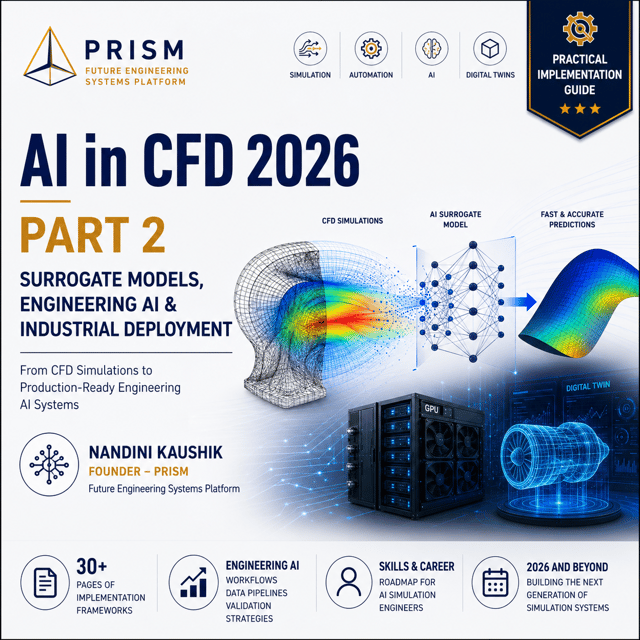
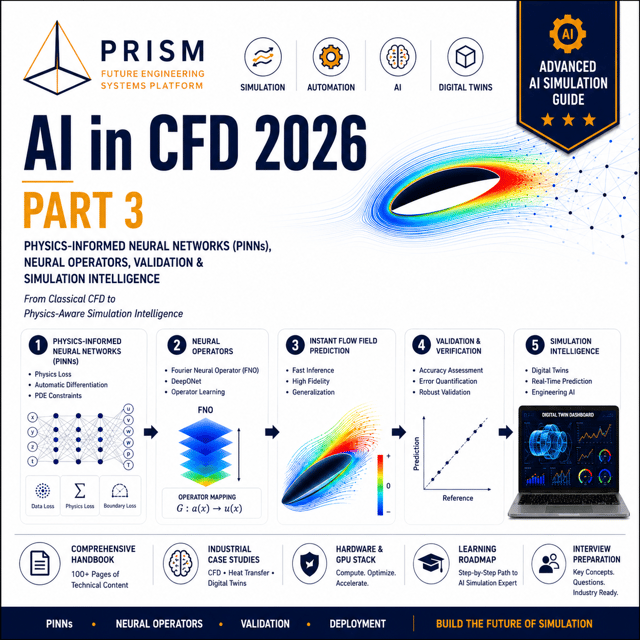
AI in CFD 2026 – Part 3 | PINNs & Neural Operators
Frequently asked questions
What is computational fluid dynamics?
Computational fluid dynamics (CFD) is the branch of engineering that uses numerical methods and computers to analyse how liquids and gases behave. Instead of solving the governing flow equations by hand, CFD divides a flow domain into millions of small cells and solves the equations of fluid motion for each one, predicting velocity, pressure, temperature, and turbulence. This lets engineers study everything from airflow over an aircraft wing to cooling inside an electronic device before any hardware is built.
What is computational fluid dynamics used for?
It is used across automotive, aerospace, energy, HVAC, marine, and biomedical industries. Typical applications include vehicle aerodynamics, engine and battery cooling, gas turbine and wind turbine flow analysis, electronics and data centre thermal management, ventilation design, and even blood flow modelling. In India, CFD is widely used by automotive OEMs, EV startups, aerospace and defence organisations, and energy companies to reduce physical testing costs and shorten design cycles.
How to learn computational fluid dynamics from scratch?
Start with the fundamentals — fluid mechanics, heat transfer, and basic numerical methods — because CFD is only as good as the physics understanding behind it. Next, pick one mainstream tool and learn the complete workflow of geometry, meshing, solver setup, and post-processing through small, well-defined problems like pipe flow or flow over a cylinder. Follow a structured course or learning pathway instead of scattered random tutorials, and validate every result against analytical solutions or experimental data. Consistent practice on progressively harder cases, documented as a portfolio, is what actually builds job-ready CFD skill.
How to learn CFD simulation step by step?
Follow the same sequence professionals use: clean up the geometry, generate a mesh with proper refinement near walls, define the physics and boundary conditions, solve while monitoring convergence, and post-process the results. Practise this loop on benchmark problems such as fully developed pipe flow, flow over a cylinder, and flow over an airfoil, checking your answers against known data. Once comfortable, add complexity like turbulence models, heat transfer, and transient simulations. Learning one tool deeply teaches you concepts that transfer easily to any other CFD software.
How to run a CFD simulation?
A typical run has five stages: define the objective, prepare the geometry, create the mesh, set up the physics and boundary conditions, and solve and post-process the results. Choose physics models appropriate to your case, monitor residuals and key quantities to confirm the solution has genuinely converged, and always perform a mesh independence check before trusting the output. The most common beginner mistake is accepting colourful contour plots without validation, so build validation into your workflow from day one.
Which CFD simulation software should I learn first?
For industry jobs in India, Ansys Fluent is the most commonly demanded tool, while OpenFOAM is a powerful free, open-source option that teaches you what happens under the hood. STAR-CCM+ is widely used in automotive and marine work, and browser-based tools are handy for quick practice. If cost is a concern, student and free versions of these tools are genuinely enough to learn on. Employers hire for fundamentals — meshing, physics setup, and validation — not just software menus, so depth in one tool beats shallow exposure to many.
How do I start learning turbulence modeling for CFD?
Begin with the physics: what turbulence is, why it makes the equations impossible to solve directly, and how boundary layers behave. Then learn the workhorse RANS models such as k-epsilon and k-omega SST, understand wall functions and the y-plus concept, and only after that explore scale-resolving approaches like LES. Practise on canonical cases — flat plate, backward-facing step, flow around a cylinder — and compare results against experimental data to develop model-selection judgement. Turbulence modeling is widely considered one of the hardest CFD topics, so a structured handbook or guided module speeds up progress considerably.
How do I become a CFD simulation engineer?
Build on a mechanical, aerospace, or chemical engineering foundation and get genuinely strong in fluid mechanics, heat transfer, and numerical methods. Learn at least one major solver end to end, create a portfolio of well-documented simulations with validation evidence, and pursue internships or entry-level roles in automotive, aerospace, energy, or engineering services companies. Interviewers typically probe your understanding of meshing decisions, turbulence model selection, y-plus, and convergence rather than just tool names. Adding AI and machine learning skills on top of classical CFD is increasingly valued as the industry moves toward AI-augmented simulation.
What kind of CFD simulation jobs are available in India?
Common roles include CFD engineer, thermal analysis engineer, aerodynamics engineer, combustion analyst, and digital simulation engineer. Hiring industries span automotive OEMs and EV startups, aerospace and defence organisations, gas turbine and wind energy companies, HVAC and electronics cooling firms, and engineering services providers serving global clients. There is also growing freelance and remote contract work for engineers with strong portfolios. Roles that combine classical CFD with AI-driven simulation and digital twins are an emerging, fast-growing segment.
Is a computational fluid dynamics course worth it for working engineers?
It can be, if the course is practical and project-driven rather than slide-only theory. Working engineers usually benefit most from structured pathways that include hands-on simulation exercises, validation practice, and guidance on industry-relevant applications, because self-study from scattered free material often takes far longer. Before enrolling, check whether you will build a portfolio of completed, validated cases and whether someone with real industry experience answers doubts. A course is worth it when it leaves you with demonstrable skills, not just a completion certificate.
Which computational fluid dynamics book should I start with?
John D. Anderson's "Computational Fluid Dynamics: The Basics with Applications" is the most recommended starting point because it builds intuition alongside the mathematics. After that, "An Introduction to Computational Fluid Dynamics" by Versteeg and Malalasekera is the standard next step for understanding the finite volume method. Treat books as theory anchors and pair them with software practice, because CFD is a skill learned by running simulations, not only by reading.
How is AI used in CFD simulation?
AI is being used to accelerate and augment traditional simulation, not replace it. Key approaches include physics-informed neural networks (PINNs), neural operators that learn flow behaviour for near-instant predictions, machine learning models that improve turbulence closures, and AI-driven digital twins that mirror physical systems in real time. This shift toward AI-augmented simulation engineering means engineers who understand both classical CFD and these AI methods are becoming the most sought-after profiles in the field.